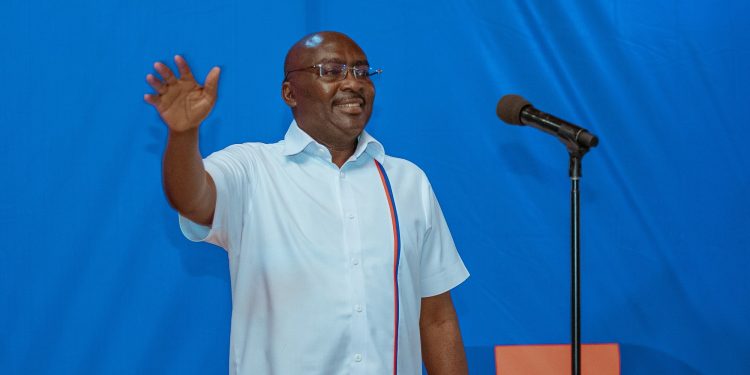
Mahamudu Bawumia has won the New Patriotic Party’s presidential primary and will lead the party into Ghana’s 2028 general election, after delegates voted in an internal contest held nationwide.
Electoral Commission officials announced the final results at the party’s national headquarters in Accra after collation from constituencies across the country, according to a report carried by MyJoyOnline.
NPP primaries produce clear majority for Bawumia
Bawumia polled 110,643 votes, representing 56.48% of valid votes cast. He cleared the 50% threshold and secured the nomination on the first round.
Meanwhile, Kennedy Ohene Agyapong placed second with 46,554 votes (23.76%). Bryan Acheampong followed with 36,303 votes (18.53%). Yaw Osei Adutwum received 1,999 votes (1.02%), while Kwabena Agyei Agyapong polled 402 votes (0.21%). The same report said 196,462 votes were cast and 561 ballots were rejected.
What party rules require in a presidential contest
Ghana’s Constitution sets the national standard for a first-round presidential win. It requires more than 50% of valid votes cast for a candidate to be elected president. It also provides for a second election within 21 days if no candidate crosses that threshold in a multi-candidate race.
Although the NPP contest is an internal election, party officials referenced the same majority principle in their public declaration of the winner, as reported during the results announcement.
How the vote was organised
Delegates voted across Ghana’s regions during a single-day process. The party opened polling centres nationwide and then moved results to collation points.
After that, officials tallied constituency figures and announced the outcome at the national level. The results declaration took place at the party headquarters, with Electoral Commission officials present during the final confirmation.
The candidates and the stakes for 2028
Bawumia faced four challengers in the race: Agyapong, Acheampong, Adutwum and Agyei Agyapong.
The primary set an early marker for the party’s rebuilding effort ahead of 2028. It also settled a major internal question for the opposition, as Ghana’s political parties begin positioning for the next national contest.
Bawumia served as Ghana’s vice president from 2017 to 2025 and ran as the NPP’s presidential candidate in 2024.
Immediate focus turns to unity and campaign organisation
Following the declaration, party organisers began shifting attention from voting logistics to consolidation. They now face the task of integrating campaign teams and coordinating parliamentary and constituency structures around the chosen flagbearer.
At the same time, the NPP must manage internal expectations after a competitive contest. The vote produced clear margins among the top three candidates. However, it also revealed substantial support for alternative contenders within the delegate base.
The party leadership has not released a full public timetable for post-primary steps in the materials reviewed. Still, the selection gives the NPP a confirmed candidate and allows it to plan public engagements, fundraising and policy messaging around a single nominee.
Bawumia’s nomination also resets his political role inside the party. It positions him as the central figure for NPP strategy ahead of 2028, while rivals decide their next moves within party structures and national politics.
The declaration ends the formal voting phase of the NPP primaries and begins the longer campaign phase toward Ghana’s next general election.