
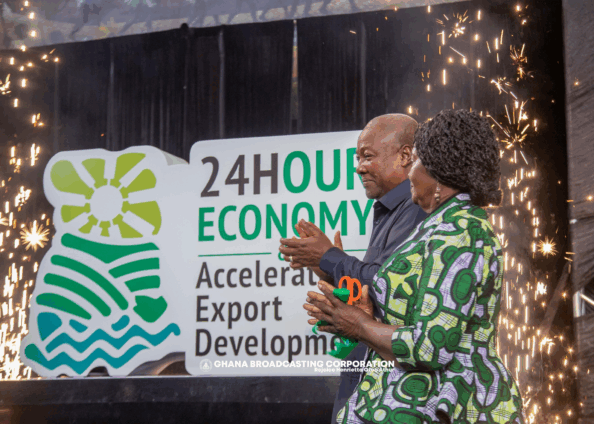
Ghana is placing “Feed Industries” at the heart of its 24-Hour Economy push. The Ministry of Trade, Industries & Agribusiness says the framework will expand industrial raw-material supply, sustain day-and-night factory operations, create youth jobs, and raise exports. The plan includes more than 15,000 acres secured in the Central Region for a Youth in Exotic Crops & Agro-Industrial Value-Chain Programme built to feed factories, not only farms.
What the framework changes on the ground
Feed Industries reframes farming as an input strategy for industry. The goal is steady, year-round flows of export-grade crops to processors, less downtime, and better capacity use. Priority crops include pineapple, citrus, avocado, mango, coconut, papaya, and ginger. The shift also targets more value-added processing in place of raw exports.
Land, crops and youth pipeline
Under the land bank now in place, the programme will contract and support young growers across enclaves near processing zones. Authorities project 18,000+ direct and indirect jobs spanning farming, mechanisation, aggregation, processing, logistics, quality control, packaging, and exports. On-site or near-site accommodation is planned to support shift work and retention.
Anchors in the Central Region
Within the Central Region agro-industrial corridor, anchor processors include Ekumfi Fruit & Juices Ltd and Central Citrus Processing Ltd. Both are positioned as long-term off-takers with predictable volumes and input pricing to enable 24-hour operations. Public records indicate Ekumfi’s plant can process about 10 tonnes of fruit per hour, while CCPL has outlined plans around 15 tonnes of oranges per hour. These capacities show how reliable crop flows can translate into continuous shifts.
How it fits the 24-Hour Economy agenda
A 24-Hour Economy is a policy approach that enables firms to operate across three shifts through inputs, infrastructure, and incentives. Government documents and partner briefs describe agriculture and agro-processing as central to this plan, with sub-programmes designed to stabilise supply chains and unlock export growth. Feed Industries is the raw-material engine in that architecture.
Why it matters for trade and jobs
If raw-material gaps shrink, factories can plan output, meet contracts, and price more competitively. That supports import substitution for juices, concentrates, and food inputs, while raising non-traditional exports from processed goods. The Ministry also links the model to decent, non-casual youth work with housing close to plants to cut travel time and improve safety. The policy is designed as a scalable “Feed Industries → 24-Hour Processing → Export Growth” pathway.
The next checkpoints to watch
Three tests will show progress. First, how fast land parcels convert to planted acreage and signed off-take deals. Second, whether anchor processors maintain round-the-clock shifts without supply breaks. Third, how many youth roles move from short-term contracts to stable employment. Official updates so far point to secured acreage, named anchors, and job targets; execution data over the coming seasons will be key.
Ghana’s move aligns farms with factory floors. If the promised crop flows materialise at scale, the 24-Hour Economy gains a steady heartbeat—and processors gain the confidence to run through the night.