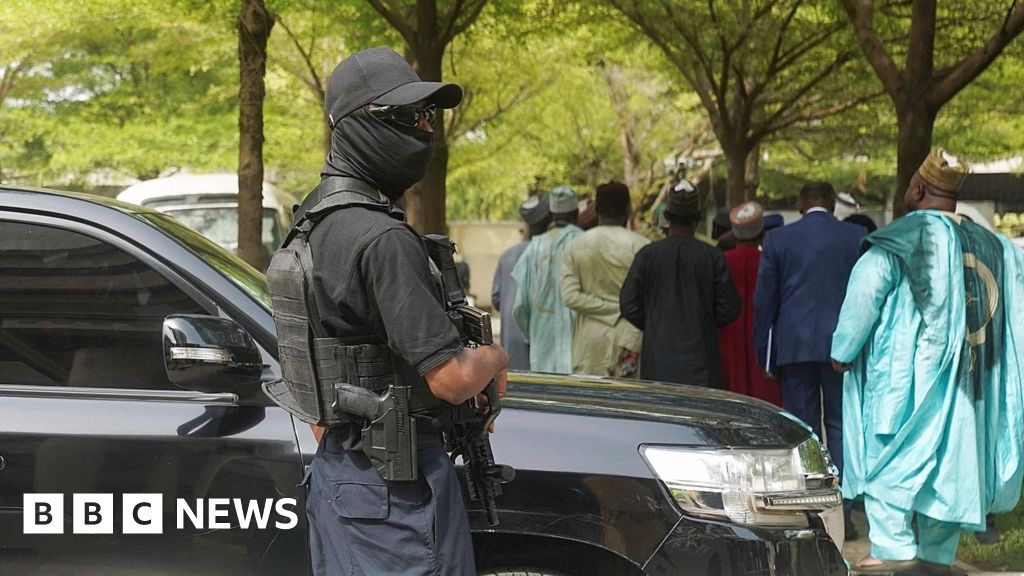
Nigeria’s military tribunal proceedings against over 30 officers for an alleged October 2025 Independence Day coup plot reveal systemic vulnerabilities in West Africa’s most populous democracy, raising urgent questions about civil-military relations across the ECOWAS region where constitutional governance remains fragile.
The indictment of six civilians this week provides the first concrete details of what investigators describe as an elaborate conspiracy to overthrow President Bola Tinubu during Nigeria’s 65th independence celebrations. Court documents identify Colonel Mohammed Ma’aji, a 50-year-old officer from Niger State, as the alleged chief strategist of a plot that required substantial financing and reached into Nigeria’s entertainment industry.
For ECOWAS, already grappling with military takeovers in Mali, Burkina Faso, and Niger, Nigeria’s coup allegations underscore the regional bloc’s institutional weakness in protecting democratic norms. Nigeria’s role as ECOWAS’s economic and military anchor makes any threat to its democratic stability a continental concern.
Financial Networks and Military Penetration
Investigators believe former Bayelsa State Governor Timipre Sylva, 67, served as a key financier, though he remains “still at large” according to court documents. His name appears across seven of 13 counts, suggesting extensive financial networks supporting the alleged conspiracy.
The financial scope reveals sophisticated planning: civilians allegedly received payments ranging from 2 million naira ($1,500) to 50 million naira ($37,000) for services the prosecution characterizes as “terrorism financing.” These figures indicate substantial resource mobilization beyond typical military plotting.
Premium Times investigations identified 40 suspects, predominantly military personnel, suggesting deep institutional penetration. The diversity of accused participants – from senior officers to Nollywood filmmaker Stanley Amandi – points to broad social recruitment extending beyond traditional military networks.
Democratic Institutions Under Stress
The last-minute cancellation of Nigeria’s October 1 independence parade, traditionally attended by the president, demonstrated how coup threats can paralyze state functions. The government’s initial silence followed by delayed military acknowledgment in January reflects institutional communication failures during crisis management.
Nigeria’s military tribunal system, conducting proceedings behind closed doors, raises transparency concerns. Unlike civilian courts, military justice lacks public oversight mechanisms essential for accountability in democratic societies. This opacity contrasts unfavorably with Ghana’s public handling of security challenges and Senegal’s transparent electoral processes.
The involvement of religious networks – including prayers offered in Zaria’s Kusfa religious center – illustrates how traditional legitimacy sources intersect with modern coup planning. This pattern mirrors dynamics seen in Sahel military takeovers where religious endorsement provided social cover.
Regional Security Architecture Implications
Nigeria contributes approximately 70% of ECOWAS’s budget and provides military leadership for regional interventions. Any successful coup would fundamentally alter West Africa’s security architecture, potentially emboldening military actors across member states.
The plot’s timing during independence celebrations mirrors tactics used in recent Sahel coups, where symbolic national moments provided propaganda opportunities. This suggests coordination or learning across regional military networks that transcend national boundaries.
ECOWAS’s response capabilities remain questionable given its failure to prevent or reverse recent coups in member states. Nigeria’s own vulnerability exposes the bloc’s dependence on its largest member for institutional stability.
Governance Lessons for West African Democracies
The alleged conspiracy reveals critical gaps in Nigeria’s civil-military oversight mechanisms. Unlike established democracies where parliamentary defense committees provide continuous military oversight, Nigeria’s National Assembly exercises limited defense sector governance.
Intelligence failures allowed extensive planning to proceed undetected until the final moment. This contrasts with Ghana’s proactive approach to military intelligence integration and Côte d’Ivoire’s post-crisis intelligence reforms.
The involvement of civilian financiers and propagandists suggests coup plotting has evolved beyond military circles to include economic and media networks. This requires enhanced financial intelligence capabilities and media monitoring systems across ECOWAS states.
Nigeria’s handling of this crisis will establish precedents for how West African democracies manage military challenges. Transparent judicial proceedings, comprehensive civil-military reforms, and strengthened democratic oversight mechanisms remain essential for restoring confidence in Nigeria’s institutions and, by extension, ECOWAS’s democratic governance model.
The stakes extend beyond Nigeria’s borders: successful democratic consolidation in West Africa’s giant could provide the institutional leadership ECOWAS desperately needs to counter authoritarian trends across the region.