South Africa’s AI Policy Collapse Exposes Governance Gaps as West Africa Watches
South Africa’s Department of Communications and Digital Technologies was forced to withdraw its Draft National AI Policy in early 2026 after government officials discovered that academic citations in the document’s reference list had been fabricated by a generative AI tool — the very technology the policy was designed to regulate. The incident has triggered a parliamentary roundtable process and an independent policy rebuild, raising pointed questions about institutional capacity for technology governance across the continent’s most advanced economies.
A Policy Framework Undermined by Its Own Subject Matter
The Draft National AI Policy had advanced through Cabinet approval channels with apparent momentum. On 24 February 2026, the Department of Communications and Digital Technologies (DCDT) briefed Parliament’s Portfolio Committee on Communications and Digital Technologies on the policy’s progress, with gazetting for a 60-day public consultation scheduled for March 2026 and finalisation targeted for the 2026/2027 financial year.
The policy rested on five structural pillars: skills capacity development, responsible governance frameworks, ethical and inclusive AI deployment, cultural preservation, and human-centred design principles. It proposed a sector-specific, multi-regulator model rather than a dedicated AI oversight body, embedding AI governance within existing supervisory architectures across finance, health, and telecommunications regulators.
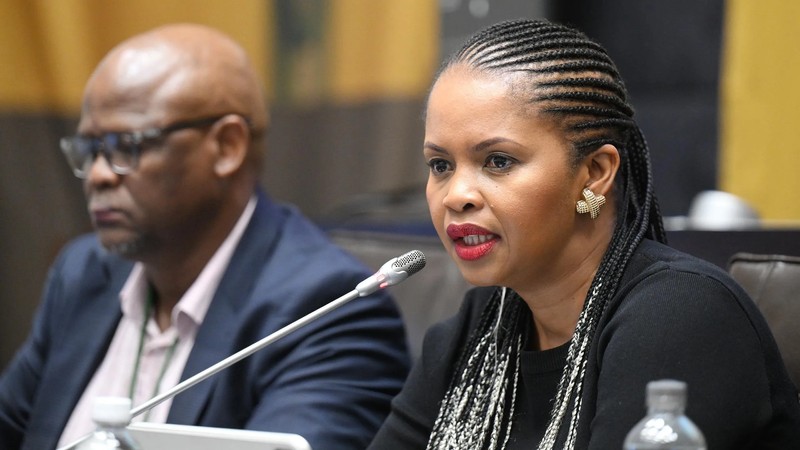
That architecture never reached public consultation. Communications Minister Solly Malatsi withdrew the draft after the fabricated citations were identified, appointing an independent panel of AI researchers, lawyers, and governance specialists to reconstruct the policy from credible foundations. The Portfolio Committee, chaired by Ms Khusela Sangoni-Diko, subsequently convened a roundtable bringing together policymakers, regulators, industry representatives, civil society organisations, and academic institutions to reset the governance process.
Institutional Design: The Multi-Regulator Question
The government’s preference for a distributed regulatory model reflects a deliberate institutional choice with significant implications for enforcement coherence. Rather than establishing a single AI authority comparable to the European Union’s AI Act enforcement structure, South Africa opted to assign oversight responsibilities to sector regulators already managing financial services, broadcasting, and data protection mandates.
This model carries real advantages: it avoids creating a new bureaucratic layer and leverages existing regulatory expertise within specific industries. But it also fragments accountability. When an AI system operating across financial services and healthcare causes harm, jurisdictional clarity becomes a governance liability rather than an asset.
The fabricated citations episode illustrates a related institutional vulnerability. Government ministries deploying generative AI tools in drafting processes without verification protocols expose the entire policy pipeline to credibility risk. The DCDT’s experience is not unique — it reflects a broader pattern in which public institutions adopt AI-assisted workflows faster than they develop the internal audit mechanisms to validate outputs.
West African Governance Implications: Learning from Pretoria’s Stumble
South Africa’s regulatory trajectory carries direct relevance for West African governments advancing their own digital governance frameworks. Ghana’s Data Protection Commission and Nigeria’s National Information Technology Development Agency (NITDA) are both navigating the question of whether AI oversight should sit within existing data protection and telecommunications mandates or require dedicated institutional architecture.
Nigeria published an AI policy framework in 2024 that similarly favours a multi-stakeholder, sector-embedded approach. Ghana has yet to produce a formal AI governance document, though the Ministry of Communications and Digitalisation has signalled intent to align with continental frameworks. Both countries face the same structural constraint that undermined South Africa’s draft: the gap between policy ambition and the technical capacity needed to produce, evaluate, and implement credible AI governance instruments.
The African Union’s Continental AI Policy Framework, adopted in 2024, provides normative guidance emphasising human rights, data sovereignty, and inclusive access. But AU frameworks carry no binding enforcement mechanism, and member state implementation remains inconsistent. ECOWAS has not yet produced a dedicated AI governance instrument, leaving West African states to develop national frameworks in the absence of regional coordination — a gap that risks regulatory fragmentation across a market that AfCFTA is simultaneously attempting to integrate.
The AfCFTA Dimension: Digital Trade Requires Regulatory Interoperability
The African Continental Free Trade Area’s digital trade protocols depend, in part, on compatible regulatory environments across member states. Cross-border data flows, AI-driven financial services, and platform-based commerce all require that national AI governance frameworks operate on mutually recognisable principles — or risk creating non-tariff barriers dressed in regulatory language.
South Africa’s policy withdrawal delays that country’s contribution to any regional harmonisation process. More broadly, it signals that even the continent’s most institutionally developed economy struggled to produce a technically credible AI governance document on the first attempt. For West African governments with shallower technical bureaucracies, the lesson is not that AI governance is impossible but that the process demands different inputs: independent technical review, structured public consultation, and explicit verification protocols for AI-assisted drafting.
The WAEMU zone presents a partial model for regulatory coordination. The Banque Centrale des États de l’Afrique de l’Ouest (BCEAO) has begun examining AI applications in financial supervision, and its cross-border mandate gives it unusual leverage to establish shared standards across eight member states simultaneously. A similar coordination function for AI governance more broadly — perhaps anchored within ECOWAS’s existing digital economy agenda — would reduce the duplication costs that individual national policy processes currently generate.
Rebuilding Credibility: What the Independent Panel Must Deliver
Minister Malatsi’s decision to appoint an independent panel of researchers, lawyers, and governance specialists represents a meaningful institutional correction. The panel’s composition — spanning technical AI expertise, legal analysis, and governance design — addresses precisely the disciplinary gaps that allowed a fabricated reference list to advance through a Cabinet briefing cycle undetected.
For the rebuilt policy to restore institutional credibility, it must resolve several outstanding design questions. The multi-regulator model requires explicit jurisdictional mapping: which regulator holds primary authority when AI systems operate across sector boundaries? What liability framework applies when AI-generated outputs in public sector documents cause policy harm, as the DCDT’s own experience now illustrates? How does the policy align with the AU Continental Framework’s data sovereignty provisions while accommodating South Africa’s existing Protection of Personal Information Act (POPIA) architecture?
The Portfolio Committee roundtable process, if structured around these specific governance mechanisms rather than broad stakeholder consultation, offers a legitimate pathway to a technically defensible policy. The 60-day public consultation originally planned for March 2026 should proceed once the independent panel’s draft is complete — with explicit disclosure of any AI tools used in the drafting process and the verification methodology applied to all cited sources.
South Africa’s AI governance stumble is a recoverable institutional failure. Its value to the broader West African policy community lies precisely in its visibility: a documented case study of what happens when technical capacity gaps meet political timelines in high-stakes regulatory processes. The continent’s governments now have both a cautionary precedent and a correction model to work from.