A Ruling Coalition Fractures Under Constitutional Pressure
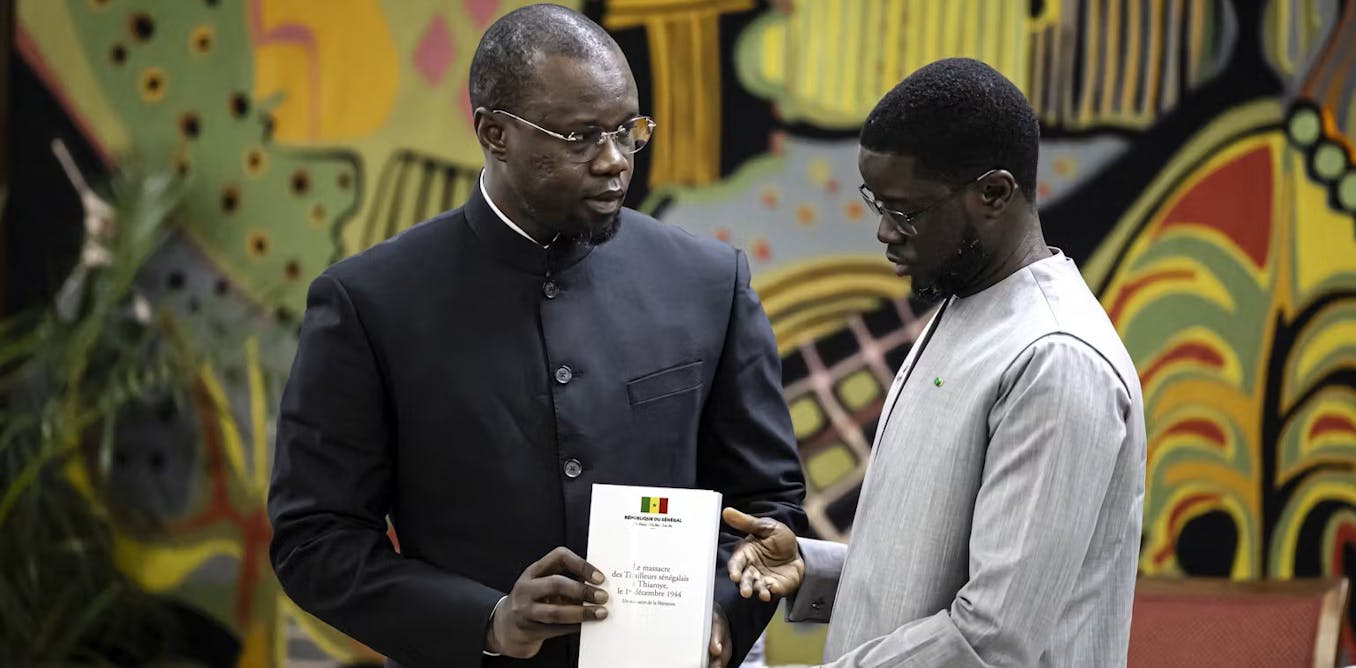
On 22 May 2026, Senegalese President Bassirou Diomaye Faye dismissed Prime Minister Ousmane Sonko and dissolved the government, ending a political partnership that had dismantled the decade-long dominance of former President Macky Sall. The split inside Pastef, Senegal’s ruling party, is not merely a personality clash: it reflects a structural incompatibility between constitutional authority and party-based political capital that Senegal’s institutions were never designed to accommodate simultaneously.
For West African governance observers, the breakdown raises a precise institutional question: when an anti-establishment movement captures state power, can it sustain dual leadership without constitutional mechanisms to manage competing mandates?
The Constitutional Architecture of Rivalry
Senegal’s constitution defines presidential and prime ministerial powers across Articles 42 through 52, establishing a clear hierarchy in which executive authority is indivisible. The president holds discretionary appointment powers; the prime minister operates within the executive framework the president defines. That constitutional asymmetry was always a latent source of tension within the Faye-Sonko arrangement.
The partnership was forged under political duress. When Sonko’s candidacy for the 2024 presidential election was invalidated in January of that year, he backed Faye, Pastef’s secretary-general, as a surrogate candidate. Faye won. Sonko became prime minister. The governing formula rested on an unwritten division of labor: Faye managed state institutions, Sonko maintained popular legitimacy and party control.
That formula contained its own contradictions. Faye subsequently resigned all leadership positions within Pastef, as the presidency demands separation from partisan roles. Sonko, constitutionally permitted to retain his party leadership, did not. The result was a structural asymmetry: Faye held state authority; Sonko held the party machinery. Neither could fully govern without the other, yet each controlled resources the other needed.
Symbolic Capital and Its Institutional Limits
The Wolof slogan “Sonko mooy Diomaye” (Sonko is Diomaye) functioned as a political survival instrument under the Sall administration, projecting unified opposition identity at a moment of state repression. Applied to governance, however, that symbolic fusion became an institutional liability.
As Senegalese journalist Sidy Diop documented, the proclaimed unity gave way to a visible duality in which “roles are being redefined and ambitions are becoming clearer.” Signs of fracture emerged publicly at a Pastef rally in November 2025, where Sonko signaled the beginning of what he called a “post-November 8 era.” Six months later, Faye confirmed in a public interview that substantive disagreements existed, specifically denouncing what he described as “excessive personalisation” of power around the prime minister.
The sociological framework developed by French theorist Pierre Bourdieu is analytically useful here. Institutional structures impose behavioral norms and communicative postures on their occupants. The presidency demands a “sovereign habitus” oriented toward institutional continuity and protocol. The role of party leader and popular mobilizer demands disruption and charisma. Sonko excelled at the latter; Faye was shaped by the former. Their divergence was not accidental: it was structurally produced.
Governance Costs of the Dual-Power Model
The practical governance costs of the Faye-Sonko deadlock materialized across three dimensions: coalition management, executive coherence, and economic credibility.
On coalition management, disputes over who should lead the ruling alliance created internal factionalism within Pastef, dividing party structures between Faye loyalists and Sonko supporters. That fragmentation weakens the party’s legislative discipline at a moment when Senegal faces significant fiscal pressures.
On executive coherence, conflicting visions of power and political alliance strategy generated policy ambiguity. Investors and institutional partners require predictable decision-making chains. A government in which the president and prime minister publicly disagree on political alliances sends damaging signals to credit markets and bilateral partners.
On economic credibility, Senegal is navigating a debt restructuring process while attempting to leverage its offshore oil and gas revenues, particularly from the Sangomar and GTA fields, into structural development. Political instability at the executive level complicates negotiations with the International Monetary Fund, bond markets, and potential infrastructure investors. Senegal’s public debt exceeded 99% of GDP in 2023 according to IMF data, a figure that demands sustained institutional credibility, not executive dysfunction.
Regional Implications: ECOWAS Governance Benchmarks and West African Precedent
Senegal has historically served as one of ECOWAS‘s most stable democratic anchors, particularly as military coups have destabilized Mali, Burkina Faso, Guinea, and Niger since 2020. The credibility of Senegalese democratic institutions carries weight beyond its borders: it reinforces the normative case for constitutional governance within the ECOWAS framework at a moment when that framework faces an existential challenge from the Alliance of Sahel States.
A descent into prolonged political turmoil in Dakar would hand adversaries of the ECOWAS model a significant rhetorical and political victory. Conversely, a managed transition in which Faye consolidates institutional authority and Pastef recalibrates its internal governance structures could demonstrate that anti-establishment movements can operate within constitutional boundaries without abandoning their reform mandates.
The Senegalese case also offers a cautionary precedent for similar political configurations elsewhere in West Africa, where opposition coalitions built on personal loyalty rather than institutional rules face analogous pressures upon reaching power. Nigeria’s complex executive arrangements and Ivory Coast’s recurring succession tensions reflect comparable dynamics, even if their constitutional architectures differ.
Institutional Pathways and the Post-Dismissal Political Landscape
Following his dismissal, Sonko moved rapidly to secure the position of Speaker of Parliament, repositioning himself within the formal institutional structure while simultaneously signaling a return to opposition-style political mobilization. That maneuver is constitutionally legitimate. It is also politically destabilizing, placing a former prime minister with a mass popular base in direct institutional opposition to the president he helped elect.
Faye now faces the challenge of governing without the popular legitimacy Sonko provided, while managing a party whose internal cohesion depended on the myth of unified leadership. His capacity to appoint a credible prime minister, maintain legislative majorities, and advance Senegal’s economic reform agenda will determine whether the rupture becomes a governance crisis or a manageable political reconfiguration.
Three institutional priorities are now in focus. First, Faye must establish a functional prime ministerial appointment that commands both technocratic credibility and sufficient party support to sustain legislative business. Second, Pastef’s internal governance structures require formalization: a party whose authority rests on a single leader’s charisma rather than institutional rules is inherently fragile. Third, Senegal’s constitutional framework may benefit from clearer statutory guidance on the relationship between party leadership and executive office, a gap the current crisis has exposed with unusual clarity.
The Faye-Sonko rupture is, in structural terms, the predictable outcome of a governing arrangement that substituted personal loyalty for institutional design. Senegal’s democratic institutions have survived significant stress before. Whether they absorb this rupture without deeper political fragmentation depends on decisions made in Dakar in the weeks and months ahead.