
South Africa’s Mass Repatriation Drive Tests ECOWAS Diplomatic Frameworks and Regional Labour Mobility Commitments
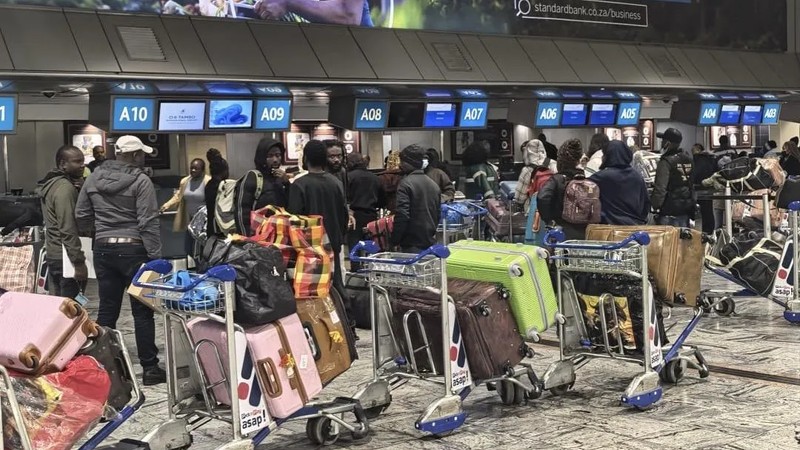
South Africa’s Department of Home Affairs has confirmed the repatriation of 268 Nigerian nationals on 11 June 2026, the first of two scheduled flights removing a cohort of 586 Nigerians processed for deportation under the country’s Immigration Act. With over 2,400 foreign nationals removed in concurrent operations targeting Ghanaian, Mozambican, and Zimbabwean communities, the operation raises pointed questions about how Southern and West African governments are managing labour mobility governance, bilateral diplomatic obligations, and the institutional architecture meant to protect migrant workers across the continent.
The Mechanics of Removal: Enforcement Procedures and Legal Framework
Stephen van Neel, head of immigration enforcement at the Department of Home Affairs, confirmed at OR Tambo International Airport that all 268 Nigerians transported on the first flight were found to be residing in South Africa without valid documentation. “Of the 270, two of them are officials, so we have about 268 Nigerians that are repatriated,” van Neel stated.
Under South Africa’s Immigration Act, each individual has been declared undesirable, triggering a mandatory five-year re-entry ban. Van Neel confirmed that one-on-one interviews were conducted to verify immigration status and identify exceptional circumstances, including custody arrangements that could result in the wrongful separation of children.
The Nigerian High Commission issued Emergency Travel Documents to all 586 individuals cleared for removal, enabling lawful exit processing. A second flight carrying the remaining cohort was scheduled for 15 June 2026. Home Affairs Minister Dr Leon Schreiber framed the operations within a broader institutional mandate: “Home Affairs is irrevocably committed to enforcing South Africa’s immigration laws and restoring the rule of law. Our ongoing orderly and lawful deportations and repatriations, which have increased by 46% over the past two years, are clear evidence of this.”
The scale of concurrent operations is significant. On 6 and 7 June 2026, the Border Management Authority (BMA) processed 663 Ghanaian nationals for return through OR Tambo International Airport. On 3 June 2026, the BMA processed 933 Mozambican nationals through the Lebombo Port of Entry, with 926 ultimately departing. Approximately 1,000 Nigerian nationals registered voluntarily for repatriation, with 500 cleared ahead of the first flight.
Political Context: Anti-Migrant Mobilisation and the June 30 Ultimatum
The repatriation operations are unfolding against a backdrop of organised anti-migrant pressure. The group March and March has issued a public ultimatum demanding all undocumented foreign nationals leave South Africa by 30 June 2026, with protests reported across the Western Cape, KwaZulu-Natal, and Gauteng provinces. The movement has called for tighter immigration enforcement and employer accountability for hiring undocumented workers.
President Cyril Ramaphosa addressed the nation on 7 June 2026, announcing a package of measures including intensified arrests and deportations, stricter border controls, and reforms to immigration and labour legislation. Ramaphosa also referenced increased cooperation with African countries to address structural drivers of migration, though no specific bilateral agreements were detailed.
The political pressure creates a governance tension that analysts of Southern African migration policy have long flagged: enforcement-led responses to undocumented migration can undermine longer-term frameworks for regulated labour mobility, particularly when removal operations are accelerated by domestic political timelines rather than administrative capacity.
ECOWAS Protocols and the West African Governance Gap
For West African governments, the repatriation of Nigerian and Ghanaian nationals from South Africa exposes a structural gap in continental mobility governance. The ECOWAS Protocol on Free Movement of Persons, adopted in 1979 and supplemented by subsequent residency and establishment protocols, guarantees citizens of member states the right to move, reside, and establish businesses within the 15-member bloc. That framework, however, does not extend to Southern Africa.
South Africa is a member of the Southern African Development Community (SADC), which has its own Draft Protocol on the Facilitation of Movement of Persons, though this instrument has never entered into force due to insufficient ratification. The absence of an operational SADC mobility framework means West African nationals in South Africa are subject to standard bilateral immigration arrangements, with no regional protocol offering supplementary protection or regularisation pathways.
Nigeria and Ghana, as middle-income economies with significant diaspora populations across Africa, have an institutional interest in negotiating stronger bilateral labour agreements with South Africa. Nigeria’s GDP, the largest in Africa at approximately US$477 billion (2023, World Bank), and Ghana’s status as one of West Africa’s most stable democracies give both countries diplomatic leverage. Yet neither government has publicly articulated a formal bilateral labour mobility framework with Pretoria that would reduce the vulnerability of their nationals to mass removal operations.
AfCFTA’s Labour Mobility Blind Spot
The African Continental Free Trade Area (AfCFTA), operational since January 2021, is progressively liberalising goods and services trade across 54 signatory states. Its Protocol on the Free Movement of Persons, under negotiation as part of the broader continental framework, remains unsigned and unratified. Until that instrument enters force, the movement of African workers across intra-continental borders remains governed by a patchwork of bilateral agreements and national immigration statutes, with enforcement discretion resting entirely with receiving-country governments.
South Africa’s removal of over 2,400 nationals from Nigeria, Ghana, Mozambique, and Zimbabwe in a single operational cycle illustrates the practical consequences of that governance gap. Workers who migrate within Africa seeking economic opportunity have no continental legal architecture protecting their residency rights, labour entitlements, or due process guarantees beyond what individual bilateral arrangements provide.
The AU’s Agenda 2063 explicitly targets the free movement of persons as a flagship objective, and the AfCFTA Secretariat in Accra has positioned labour mobility as integral to the single market vision. However, the distance between that ambition and the operational reality documented at OR Tambo International Airport on 11 June 2026 remains considerable.
Implications for Investor Confidence and Regional Labour Markets
For investors and employers operating across West and Southern Africa, the repatriation operations signal regulatory risk in cross-border labour deployment. Companies relying on skilled or semi-skilled West African workers in South African operations face compliance exposure if workforce documentation is not rigorously maintained. The five-year re-entry ban applied to all 268 Nigerians removed on the first flight effectively terminates their employability in South Africa for the medium term, regardless of the economic contributions they may have made.
From a regional competitiveness standpoint, Côte d’Ivoire and Senegal, both of which have invested in positioning themselves as West African hubs for professional services and manufacturing, have an interest in how the Nigerian and Ghanaian governments respond diplomatically. A credible bilateral labour agreement between ECOWAS member states and South Africa could establish a model for regulated mobility that reduces irregular migration while protecting workers’ rights, generating a governance precedent applicable across the continent.
The Nigerian High Commission’s cooperation in issuing Emergency Travel Documents facilitated the removal process, but Abuja and Accra now face a domestic accountability question: what institutional mechanisms exist to support nationals who return involuntarily, reintegrate them into labour markets, and address the structural economic conditions that drove emigration in the first place? That question connects directly to governance quality, public investment, and the credibility of national development frameworks, not merely to migration policy.