Nigeria’s Electricity Tariff Reform Exposes a Regulatory Accountability Gap, Not Just an Energy Crisis
When Nigeria’s electricity regulator, the Nigerian Electricity Regulatory Commission (NERC), raised tariffs for Band A consumers by over 240% in April 2024, it framed the decision as cost-reflective reform. Twelve months later, aggregate system losses have worsened, metering rates remain below 50%, and the federal government faces a monthly subsidy liability of approximately ₦161 billion (US$117 million). The tariff increase has not improved supply. It has transferred the cost of institutional failure from distribution companies to consumers.
That outcome is not incidental. It is structural, and it raises a governance question that labour unions, consumers, and regional policymakers have largely failed to ask: under what conditions should a regulator be permitted to raise consumer prices when the operators it oversees are not meeting their own performance targets?
The Regulatory Formula That Rewards Inefficiency
Nigeria’s electricity tariff is set under the Multi-Year Tariff Order (MYTO) Framework, which calculates the revenue requirement for each distribution company and divides it by the volume of electricity actually billed and collected. The formula has a critical design flaw: the higher the losses, the higher the tariff required to recover costs.
This mechanism structurally insulates distribution companies from the financial consequences of their own operational failures. It does not penalise underperformance. It monetises it.
The scale of those losses is not marginal. In the first quarter of 2024, Nigeria’s aggregate technical, commercial, and collection losses stood at 36.36%. By the third quarter, they had risen to 39.10%. The most recent available data, from the first quarter of 2025, shows aggregate technical and commercial losses at 39.6%, against a regulatory target of 20.5%. That gap represents an estimated ₦200.5 billion (approximately US$146 million) in forgone revenue in a single quarter.
Not one of Nigeria’s twelve distribution companies met its loss-reduction target. The Kaduna Electricity Distribution Company recorded actual losses of 70.84% against a target of 25%, a deviation so large it suggests either the regulatory target was never credible, or enforcement was never intended.
West Africa’s Metering Deficit in Regional Context
At the operational core of Nigeria’s commercial losses sits a metering crisis that has persisted across successive reform programmes. As of December 2024, only 6.29 million of 13.5 million registered electricity customers were metered, a rate of 46.57%. The majority of Nigerian consumers are billed through estimated consumption, a system that erodes payment culture, inflates billing disputes, and makes collection enforcement legally and practically difficult.
Nigeria’s National Mass Metering Programme, the Meter Asset Provider scheme, and related initiatives have each failed to close the gap. Meter installations in 2024 reached a four-year low, declining 34% since 2021. The World Bank’s Nigeria Distribution Sector Recovery Programme has identified metering as central to the sector’s financial distress, estimating that smart meter deployment under its current financing window could close nearly half of the seven-million-unit deficit, provided distribution companies fulfil procurement commitments.
Regionally, Nigeria’s performance is an outlier even among peers managing distribution crises. Ghana, itself under significant fiscal pressure from its electricity sector, recorded aggregate losses of 32% in 2024. Kenya has reduced its losses to 21.7% through sustained regulatory pressure on its distribution utility. India, after a decade of federal reform investment, brought losses to 16.16%. The global benchmark for efficient systems sits between 6% and 9%.
For ECOWAS member states advancing energy market integration under the West African Power Pool (WAPP), Nigeria’s distribution inefficiency is not a domestic concern alone. Cross-border electricity trade, a core instrument of WAPP’s mandate, requires financially solvent and operationally credible national utilities. A Nigerian distribution sector that loses nearly 40% of electricity before collection cannot be a reliable anchor for regional energy exchange.
Fiscal Exposure and the Hidden Cost of Generator Dependency
The financial consequences of sustained inefficiency extend well beyond the electricity bill. Nigeria’s 2024 NERC Annual Report disclosed that the federal government must absorb ₦1.94 trillion, equivalent to 62.59% of the sector’s outstanding obligations, averaging over ₦161 billion per month. This is not a deliberate social subsidy targeted at low-income households. It is a fiscal transfer that compensates for operational failure at the distribution level.
The World Bank estimates annual economic losses from Nigeria’s unreliable electricity supply at between 5% and 7% of GDP, approximately US$25 billion. That figure exceeds Nigeria’s annual public health expenditure, which stood at 4.08% of GDP in 2021 and 4.19% in 2023.
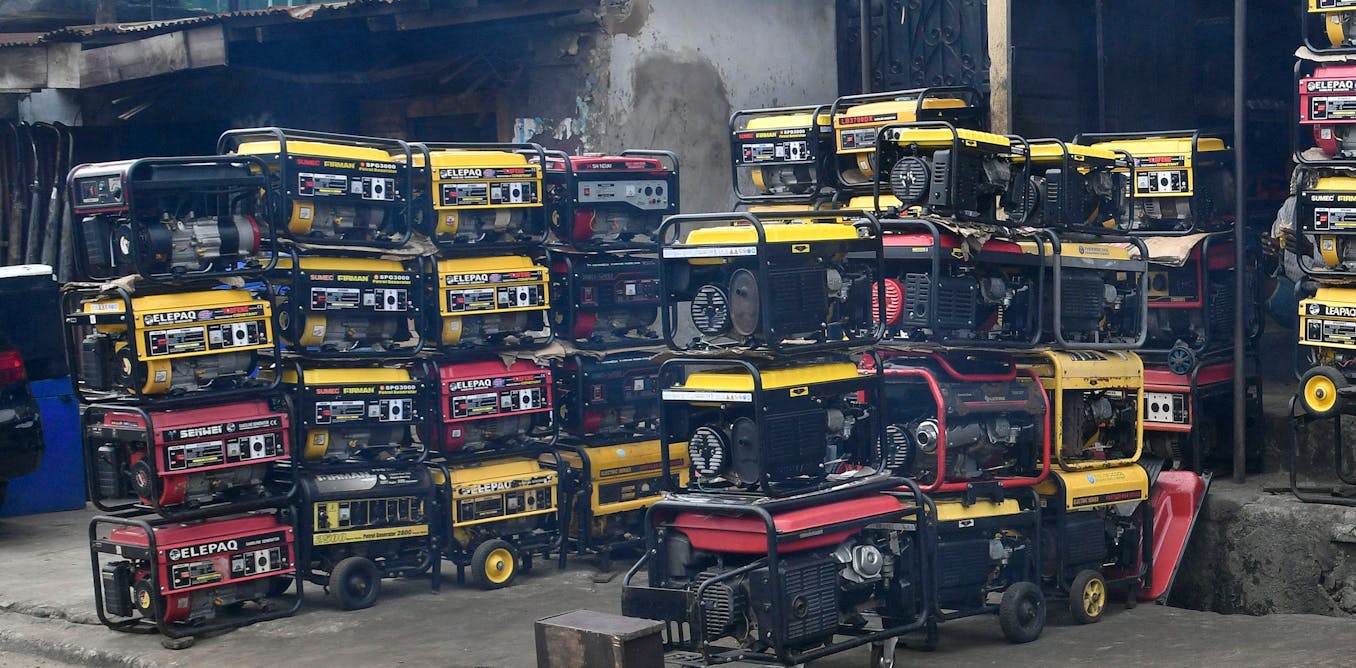
The burden does not appear in any tariff calculation. Over 22 million diesel and petrol generators supply roughly 26% of Nigerian households and 30% of micro, small, and medium enterprises. This parallel energy system is expensive, environmentally damaging, and regressive: it imposes higher per-unit energy costs on the businesses and households least equipped to absorb them, while remaining entirely outside the regulatory framework that is supposed to govern electricity pricing.
For foreign investors assessing Nigeria’s manufacturing competitiveness under the African Continental Free Trade Area (AfCFTA), generator dependency is a direct cost-of-doing-business variable. It raises production costs, reduces price competitiveness relative to peers like Côte d’Ivoire and Senegal, and signals institutional risk that no tariff reform alone can resolve.
Reframing the Regulatory Compact: Efficiency Before Cost Recovery
Cost-reflective tariff reform is a legitimate policy instrument. A distribution sector that cannot recover its costs cannot finance capital investment, and without capital investment, service quality cannot improve. The sequencing argument advanced by NERC and its international partners is not without merit.
But sequencing requires conditionality. Tariff increases that are not bound to measurable, time-limited, and enforceable efficiency commitments from distribution companies do not constitute reform. They constitute a reallocation of liability, from operators who have failed to perform, to consumers who have no alternative supplier.
A credible regulatory framework would tie any future tariff adjustment to verified reductions in aggregate losses, demonstrated progress on metering deployment, and published service-level outcomes. The NERC has the statutory authority to impose performance bonds, license conditions, and ultimately revoke distribution franchises. That authority has not been exercised at a scale commensurate with the documented failure.
Ghana’s Electricity Company of Ghana and Kenya’s Kenya Power have both operated under loss-reduction performance frameworks tied to tariff reviews, with mixed but measurable results. Nigeria’s regulatory architecture already contains the instruments for equivalent conditionality. The question is whether NERC will apply them, and whether the Ministry of Power will support enforcement over accommodation.
For Nigeria’s electricity consumers, the current trajectory offers a precise diagnosis: they are not paying for electricity. They are paying for a system’s documented failure to deliver it, and being asked to pay more each time that failure deepens. That is a governance problem before it is an energy problem, and it will not be resolved by the next tariff order alone.