South Africa’s Mass Repatriations Expose ECOWAS Migration Governance Gaps as June 30 Deadline Looms
More than 2,400 nationals from Nigeria, Ghana, Mozambique, Zimbabwe and Malawi have been processed for repatriation from South Africa in less than two weeks, as Pretoria’s Border Management Authority accelerates immigration enforcement under pressure from anti-immigrant protest movements demanding all undocumented migrants leave the country by 30 June 2025. The operations raise pointed questions about West African states’ consular capacity, bilateral migration frameworks, and the structural conditions that push citizens into irregular status abroad.
The Scale and Mechanics of the Operations
The repatriation wave began in earnest on 3 June, when South Africa’s Border Management Authority (BMA) processed 933 Mozambican nationals at the Lebombo Port of Entry, with 926 ultimately departing after biometric screening and immigration verification. BMA Commissioner Dr Michael Masiapato confirmed that the process included coordination with Mozambican authorities and compliance checks under South Africa’s Immigration Act.
Between 6 and 7 June, 663 Ghanaian nationals were processed at OR Tambo International Airport in two separate operations coordinated with the Ghanaian High Commission in Pretoria. Of the first cohort of 332, authorities declared 321 “undesirable” under the Immigration Act for overstaying their legal period of stay. A second group of 331 included 170 individuals who had overstayed by 30 days or more. A chartered flight carrying 340 passengers, including detainees from the Lindela Holding Facility, departed for Accra. A further 300 Ghanaians were processed in a parallel operation, with most found undocumented or in breach of visa conditions.
On 7 June, a further 141 Mozambican nationals were deported through Lebombo, including minors processed alongside social services officials. Nigeria repatriated a first group of 262 nationals, predominantly women and children, who landed at Murtala Mohammed International Airport in Lagos. A second Nigerian flight is scheduled for 15 June, with approximately 1,000 Nigerians confirmed for voluntary return in the coming weeks.
One official breakdown of total returns across nationalities recorded 958 Ghanaians, 640 Malawians, 583 Mozambicans, 296 Zimbabweans and 268 Nigerians, a distribution that maps directly onto the Southern and West African labour migration corridors feeding South Africa’s economy.
Voluntary Return or Coerced Departure? The Governance Question
South African authorities have described the operations as a combination of deportations and voluntary returns coordinated through foreign missions. The distinction matters legally and diplomatically. Under the African Union’s Migration Policy Framework for Africa and ECOWAS’s Protocol on Free Movement of Persons, member states retain the right to regulate entry and residency, but are bound by obligations on due process, non-refoulement and the protection of migrants’ rights.
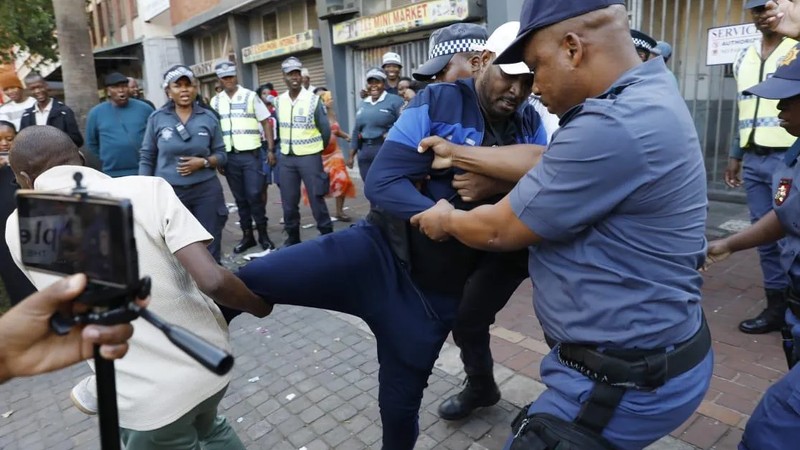
Officials acknowledged that some individuals were leaving because they were undocumented, while others departed because they no longer felt physically safe, a direct consequence of mob activity in the Western Cape, KwaZulu-Natal and Gauteng, where groups armed with sticks, whips and shields marched through communities warning foreigners without residency papers to leave. The self-imposed 30 June deadline set by anti-immigrant groups has functioned as a parallel enforcement mechanism operating outside any legal framework, one that South African authorities have neither clearly condemned nor effectively neutralised.
The use of Emergency Travel Certificates issued by the Ghanaian High Commission to facilitate departures, rather than standard travel documents, points to a deeper consular governance failure: a significant portion of Ghanaian nationals living in South Africa had been doing so without valid documentation, suggesting either lapsed visa conditions or entry without authorisation. This is not a problem unique to Ghana. It reflects a broader pattern in which West African labour migrants enter Southern Africa through formal channels and subsequently fall into irregular status, often due to the absence of bilateral labour mobility agreements that would regularise long-term stays.
West African Institutional Response: Consular Capacity Under Scrutiny
The speed with which Ghana and Nigeria mobilised consular operations, including chartered flights and coordination with South African immigration authorities, reflects improved bilateral crisis response compared to previous waves of xenophobic violence in 2008 and 2019. However, the reactive nature of these operations underscores the absence of proactive migration governance frameworks between West African states and South Africa.
Ghana and Nigeria are both members of ECOWAS, whose free movement protocol grants citizens the right to enter member states without a visa for up to 90 days. That protocol does not extend to South Africa, a non-ECOWAS member. But the concentration of West Africans in irregular status in South Africa suggests that ECOWAS member states have not developed adequate bilateral instruments, whether labour mobility agreements, regularisation pathways or social protection frameworks, to manage their citizens’ migration to non-member economies.
Nigeria’s Ministry of Foreign Affairs and Ghana’s Ministry of Foreign Affairs and Regional Integration have both engaged directly in the repatriation logistics, but neither government has publicly articulated a policy response that addresses the structural drivers of irregular migration. With approximately 1,000 additional Nigerians confirmed for voluntary return, and further Ghanaian processing operations likely, the consular burden is not diminishing.
South Africa’s Structural Contradiction: Labour Demand and Political Hostility
South Africa’s recurring migration crises are inseparable from its domestic political economy. With an official unemployment rate exceeding 30%, the country’s labour market generates persistent political pressure to scapegoat foreign nationals for job scarcity, service delivery failures and crime. Yet South Africa simultaneously depends on migrant labour across sectors including agriculture, construction, domestic work and informal retail, sectors where citizen labour supply is structurally insufficient or unwilling to fill prevailing wage levels.
This contradiction has produced four major waves of xenophobic violence since 2008, when dozens of migrants were killed and thousands displaced. The current episode differs in one significant respect: the June 30 deadline set by protest groups has created a defined enforcement horizon that is driving mass voluntary departures ahead of any formal government action, effectively outsourcing immigration enforcement to vigilante pressure.
For West African governments, the reputational and economic costs are measurable. Remittance flows from South Africa to Ghana and Nigeria, while smaller than those from Europe or North America, represent income for households in origin communities. Forced or pressured returns disrupt those flows and return migrants, often without assets or reintegration support, into labour markets already strained by youth unemployment.
Regional Integration Implications and Policy Pathways
The ECOWAS Commission and the AU’s Department of Political Affairs, Peace and Security have not issued formal statements on the South Africa repatriations at the time of publication. That silence reflects the limits of West African institutional reach beyond the ECOWAS zone, but it also represents a missed opportunity to assert continental norms on migrant protection.
Three concrete policy mechanisms merit attention from West African governments and regional institutions. First, Ghana and Nigeria should accelerate negotiations for bilateral labour mobility agreements with South Africa that create regularisation pathways for long-term residents currently in irregular status. Second, ECOWAS should engage the Southern African Development Community (SADC) through the AU framework to develop inter-regional migration governance protocols, a gap that AfCFTA’s labour mobility provisions have not yet filled. Third, both governments should establish reintegration support programmes for returning nationals, linking returnees to vocational training, business development finance and employment placement services, instruments that already exist within ECOWAS’s own development frameworks but remain underfunded and poorly coordinated.
The immediate crisis will pass when the June 30 deadline expires or is defused. The governance deficit that produced it, on both sides of the Limpopo, will not resolve itself without deliberate institutional action from Accra, Abuja, Pretoria and the regional bodies that claim authority over African migration.