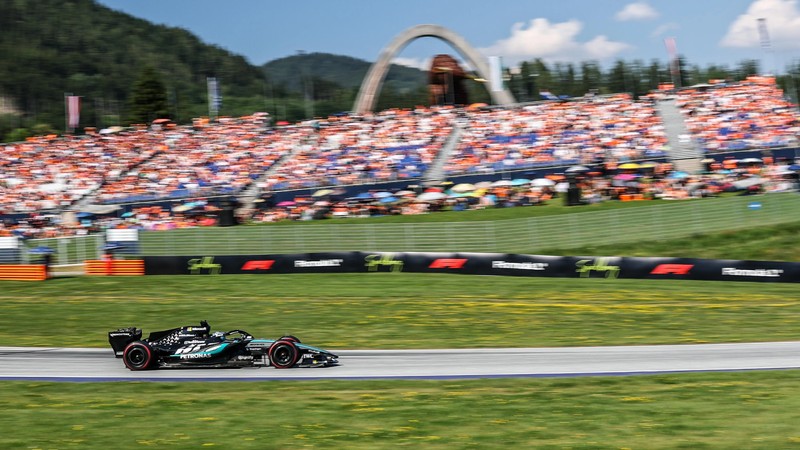
George Russell converted pole position into victory at the Austrian Grand Prix in Spielberg on Sunday, claiming his seventh career win and reducing his deficit to championship leader Kimi Antonelli to 40 points. The result reshapes the 2025 Formula One title contest at the season’s midpoint, with three drivers now separated by 51 points across eight of the scheduled 22 rounds.
Russell crossed the line 1.6 seconds ahead of Max Verstappen, who had spent the second half of the race closing on the Mercedes before being forced to defend second position against a charging Antonelli in the final lap. Verstappen held off the Italian by just 0.375 seconds, a margin that encapsulates how fine the competitive margins have become across the top three constructors.
The win was Russell’s first since the season opener in Australia, after which he had briefly appeared to be the dominant title contender. A difficult stretch through Monaco and Montreal had eroded that early advantage, and Sunday’s result in Austria restores some of that momentum, repositioning him ahead of Ferrari’s Lewis Hamilton, who dropped to fifth and now sits 51 points off the lead.
How did the race strategy determine the outcome?
The strategic decisions made in the pit lane proved as consequential as anything on track. Verstappen pitted on Lap 18, with Russell stopping one lap later. Red Bull chose not to pursue an undercut at that moment, instead keeping Verstappen out six additional laps to build a tyre-life advantage for the final stint, a gamble that ultimately did not pay off.
By staying out longer, Verstappen’s tyres degraded before his eventual stop, leaving him more than 10 seconds to recover over the remaining 22 laps. He gained nearly 10 seconds on Russell across that span, but it was not enough to mount a genuine challenge for the lead. The final laps became less about catching Russell and more about holding off Antonelli, whose late surge brought him to within four tenths at the chequered flag.
The medium compound tyre was the near-universal choice at the start, with 20 of the 22 cars opting for it under scorching Austrian temperatures. That uniformity placed even greater weight on the timing and sequencing of stops, and Mercedes managed that window with precision.
Russell’s pace through the opening laps was composed rather than aggressive, maintaining a solid lead while Verstappen worked his way through the field after a difficult qualifying session that had ended in a crash at Turn 9. The Red Bull driver’s recovery drive included a tense sequence with Hamilton on Lap 11, where the two traded positions at Turns 3 and 4 before Verstappen dropped two wheels onto the gravel at Turn 6 and appealed for a penalty. The stewards noted the incident but took no further action.
What does this result mean for the championship structure?
Antonelli, leading the drivers’ standings in only his debut season, remains the benchmark. His fourth-place grid position had been partly self-inflicted: the Italian aborted his final qualifying lap after mistakenly believing double yellow flags were in force, when only single yellows were displayed following Verstappen’s crash. That misread cost him grid positions and ultimately complicated his race, though his pace in the closing laps demonstrated the underlying strength of his campaign.
Russell, by contrast, demonstrated on Sunday the kind of racecraft and technical self-awareness that championship bids require over a full season. He acknowledged after the race that recent rounds had involved an intensive process of analysing and correcting ingrained driving habits, working with Mercedes’ data engineers to identify where he had been losing time in circuits like Monaco and Montreal. The willingness to revise technique mid-season, rather than rely on instinct, speaks to the maturity of a driver who has already won a world championship and understands the incremental nature of a title fight.
Oscar Piastri finished fourth for McLaren, with Lando Norris seventh, leaving the Woking constructor in a competitive but not dominant position in the constructors’ standings. Ferrari’s double points-scoring opportunity was partially squandered: Hamilton’s fifth place and Charles Leclerc’s eighth on the same afternoon represents an underwhelming return from a circuit where the Scuderia had hoped for more. Isack Hadjar took sixth for Red Bull, while Racing Bulls’ Liam Lawson and Arvid Lindblad completed the points in ninth and tenth.
With 14 rounds remaining across the 22-race calendar, the arithmetic remains open for at least three drivers. Russell’s Austrian victory does not transform the championship picture so much as it prevents Antonelli from pulling clear. The real test will come in the next cluster of races, where tyre strategy, qualifying consistency, and the ability to manage pressure across a full grand prix distance will again determine whether Sunday’s result was a turning point or merely a postponement.