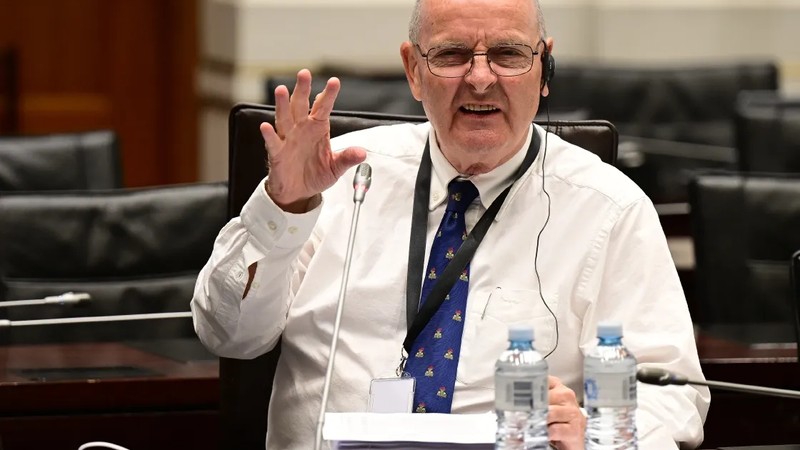
The Madlanga Commission of Inquiry is hearing testimony that cuts to the heart of a question South African governance has struggled to answer for more than a decade: how deeply did organised crime penetrate the South African Police Service, and which senior officers enabled it? Forensic investigator Paul O’Sullivan, whose work tracking transnational criminal networks has placed him repeatedly at the intersection of law enforcement and organised crime, is expected to deliver sworn evidence that implicates serving and former police officers in a pattern of corruption stretching from street-level gangsterism to the upper echelons of the SAPS command structure.
The story begins not with a police colonel or a luxury handbag, but with a human trafficking investigation that O’Sullivan was running into strip clubs. He discovered that young women were being transported from Eastern Europe, their passports confiscated on arrival, and forced into the sex trade to repay fabricated “loans” covering their flights and accommodation. That investigation, methodical and painstaking, eventually led him to Radovan Krejcir, a Czech fugitive who had fled his home country in 2005 and resettled in South Africa two years later.
Krejcir was not a minor figure. By the time O’Sullivan’s investigation intersected with his activities, the Czech national had established himself as one of the most feared operators in the South African underworld, running networks that spanned organised crime, violence-for-hire, and apparent infiltration of state institutions. A Johannesburg court convicted him in 2015 of attempted murder, kidnapping, and drug dealing; he is currently serving an effective 35-year sentence. Yet the commission is now being asked to examine whether his reach extended far beyond what his conviction formally captured.
As O’Sullivan pursued the trafficking trail, it led him to a discovery that reframed the entire investigation. He found that the wife of Major General Joey Mabasa, then head of crime intelligence, and Krejcir’s own wife were co-directors of the same registered company. The company’s registered address was not an office or a commercial premises, but a private house, and O’Sullivan alleges that the same house was the location where a German businessman was kidnapped and murdered in 2010. The convergence of those facts, in his account, was not coincidental.
Mabasa was eventually suspended, but O’Sullivan told the commission that no dismissal followed. More striking still, he said the general was later granted special pension arrangements that inflated his retirement benefit by R3.5 million. That figure, if accurate, represents not merely a personal windfall but a governance failure of institutional consequence: the use of administrative mechanisms to reward, or at minimum to cushion, an officer whose conduct had attracted serious criminal scrutiny.
Weeks into his investigation, O’Sullivan became aware that his own operational security had been compromised. He alleges that Colonel Francois Steyn, a serving police officer, accepted a R408,000 loan from Krejcir, paid directly into his home loan account, and subsequently leaked O’Sullivan’s private cellphone records to the gangster. The timing was not incidental. Krejcir, O’Sullivan told the commission, was actively attempting to have him killed. Knowing who O’Sullivan was calling, and when, could have given the criminal network advance warning of surveillance operations and placed informants and associates at direct physical risk.
O’Sullivan described a meeting at the Harbour Restaurant at Bedford Centre that illustrated the texture of that threat with unsettling clarity. A friend of his, who had been assisting him in monitoring a property where Krejcir was believed to be hiding, was summoned to the restaurant by the gangster. O’Sullivan quoted his friend’s account of what followed: “He leaned over the table and put his forefinger to my forehead and said, ‘If I find out you are lying, I can put a bullet through your head right there.'” A police colonel, O’Sullivan alleged, was seated at the same table, in full uniform. The station commander of the Bedfordview police station, O’Sullivan said, was present as Krejcir made his threat. Steyn appeared before the commission on 11 May.
That image, a uniformed officer at a table with a convicted gangster issuing death threats, is the institutional argument O’Sullivan is making. Krejcir, he told the commission, did not operate alone. He was backed, enabled, and protected by officers who lent the apparatus of the state to a criminal enterprise. Krejcir still faces trial over what O’Sullivan described as multiple attempts on his own life.
Procurement Corruption and the Question of Accountability at the Top
The Krejcir thread is only one strand of O’Sullivan’s evidence. He also levelled direct allegations against KwaZulu-Natal provincial police commissioner Lieutenant General Nhlanhla Mkhwanazi and national commissioner General Fannie Masemola, accusing both of receiving expensive Louis Vuitton bags from a SAPS supplier named Inbanathan Kistiah. O’Sullivan alleges the gifts were not social courtesies but commercial rewards: Kistiah, he claims, received a contract to supply bulletproof vests to the police at approximately five times their actual market value, and the bags were the consideration for that award.
Kistiah is currently on trial on fraud and corruption charges linked to a police procurement contract, giving the allegation a live judicial dimension rather than merely a historical one. O’Sullivan told the commission that he had served a subpoena on the Anti-Corruption Unit IDAC, and that the unit’s reply confirmed the matter remained under active investigation. He quoted the response directly: “These are criminal matters that remain active, and IDAC cannot share any of the information and/or documentation requested.”
The detail about Mkhwanazi is particularly striking from an accountability standpoint. O’Sullivan told the commission that the KwaZulu-Natal commissioner raised the subject of the bags himself while giving evidence to the inquiry, before denying that he had received one. The sequence, raising an allegation unprompted and then denying it, is the kind of evidentiary moment that commissions of inquiry exist to examine.
What O’Sullivan’s evidence collectively describes is a governance architecture that failed at multiple levels and across multiple institutions simultaneously: procurement systems that enabled inflated contracts, intelligence structures whose senior officers had undisclosed relationships with criminal networks, internal disciplinary mechanisms that suspended but did not remove compromised officers, and pension arrangements that rewarded them on exit. The Madlanga Commission’s task is to establish whether these failures were systemic or episodic, and whether the institutional reforms that followed Krejcir’s 2015 conviction were sufficient to close the vulnerabilities his network had exploited. O’Sullivan’s sworn statement suggests they were not.