A Tournament Exit That Raises Institutional Questions
Ghana exited the 2026 FIFA World Cup at the round of 32. The Black Stars competed, they fought, and they fell short. But behind Ernest Nuamah’s measured Instagram reflection lies a more pressing governance question: what does Ghana’s recurring failure to advance past the group stage reveal about the institutional architecture of its football development system?
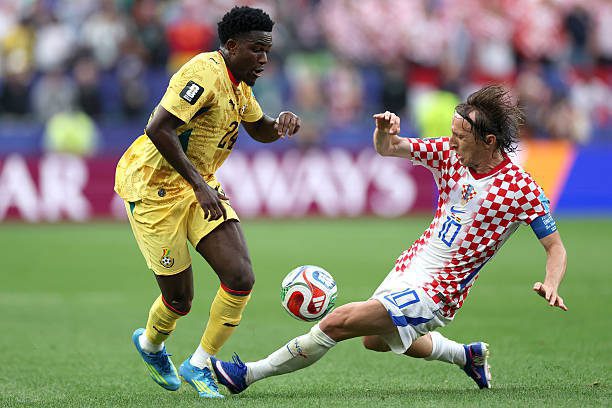
Nuamah, the Olympique Lyonnais winger, was one of the tournament’s more intriguing selections. He spent the bulk of the 2024-25 club season sidelined with injury, yet head coach Carlos Queiroz included him in the squad, a decision that drew scrutiny and ultimately produced mixed results. Nuamah started against Panama, made substitute appearances against Croatia and Colombia, and delivered the assist for Derrick Luckassen’s consolation goal in the defeat to Croatia in Philadelphia. His personal contribution was modest but visible. The team’s collective performance was not enough.
“Walking away from the biggest stage in the world with my head held high,” Nuamah wrote on Instagram. “We fought with everything we had, left our hearts on the field and gave our all to make our nation proud. Although we fell short as warriors, this journey has taught us invaluable lessons that will stay with us forever.”
The sentiment is genuine. The structural problem it obscures is not.
Selection Governance and Coaching Accountability
The decision to include an injury-recovering Nuamah over fully fit domestic or diaspora alternatives points to a deeper tension within the Ghana Football Association’s (GFA) relationship with its technical staff. Queiroz, the Portuguese coach with extensive international experience including stints with Iran and Portugal, operates within a system where selection rationale is rarely made transparent to the public or subject to formal institutional review.
This opacity matters. In peer nations like Senegal, the technical direction of the national team operates under a more structured accountability framework, with the Fédération Sénégalaise de Football maintaining clearer lines between administrative oversight and coaching autonomy. Senegal’s back-to-back Africa Cup of Nations (AFCON) titles in 2021 and 2023 were not accidental; they reflected sustained investment in player development pathways and a coaching continuity model that Ghana has struggled to replicate.
Ghana has cycled through eight head coaches in the past decade. Queiroz himself was appointed in 2024 after the GFA’s turbulent exit from the 2023 AFCON. Each transition carries institutional costs: disrupted squad chemistry, inconsistent tactical identity, and eroded player confidence. For a nation that reached the 2010 World Cup quarter-finals and has historically punched above its weight in African football, this instability represents a governance failure, not merely a sporting one.
Player Development and the Diaspora Integration Question
The European Club Pipeline
Nuamah’s trajectory is instructive. Recruited by Olympique Lyonnais from FC Nordsjaelland in Denmark, he represents a generation of Ghanaian talent developed almost entirely outside the country’s domestic league infrastructure. The Ghana Premier League, chronically underfunded and commercially underdeveloped, produces few players who transition directly to competitive international football at the highest level. The pipeline runs through Europe, not Accra.
This creates a structural dependency. Ghana’s national team quality is effectively outsourced to European club academies and development systems, leaving the GFA with limited leverage over player conditioning, tactical preparation, and even availability during international windows. When Nuamah arrived at the World Cup carrying an injury history accumulated at Lyon, the GFA had virtually no institutional mechanism to have managed that risk earlier in the cycle.
ECOWAS and Regional Talent Mobility
The broader West African context amplifies this challenge. ECOWAS protocols on free movement theoretically enable greater intra-regional talent mobility, yet the practical infrastructure for football development cooperation across member states remains underdeveloped. Ivory Coast, Ghana’s most direct regional competitor in football terms, has invested more systematically in domestic academy infrastructure, with clubs like ASEC Mimosas maintaining continental reputations for youth development that feed directly into the national team pipeline.
Nigeria, the region’s dominant football economy, faces analogous structural problems but benefits from a larger talent pool and greater commercial revenues from the Nigerian Premier League. Ghana, with a population of approximately 34 million and a GDP per capita of around US$2,200, operates with significantly tighter fiscal constraints on football investment. The GFA’s annual budget, heavily reliant on FIFA and CAF transfers rather than domestic commercial revenues, limits the institutional capacity to build the kind of integrated development system that sustained international competitiveness requires.
The AFCON 2027 Qualification Cycle as a Governance Test
Ghana returns to competitive action in October 2025 for the start of the 2027 Africa Cup of Nations qualification campaign. This cycle arrives at a critical juncture. The 2027 AFCON, co-hosted by Kenya, Uganda, and Tanzania, represents not only a sporting opportunity but a continental governance moment for CAF as it attempts to expand the tournament’s footprint into East Africa for the first time.
For the GFA, the qualification campaign is an immediate accountability test. A third consecutive AFCON group stage exit, following the 2021 and 2023 tournaments, would generate legitimate calls for structural reform that go beyond coaching changes. It would force a reckoning with player development investment, domestic league commercialization, and the GFA’s own institutional capacity.
Queiroz has spoken about building a cohesive tactical identity, but identity requires time, and time requires institutional patience that Ghanaian football governance has historically struggled to provide. The GFA’s executive committee, elected bodies with political pressures and commercial interests, must decide whether the post-World Cup moment is one for genuine structural investment or another cycle of reactive personnel changes.
Regional Integration and the Continental Football Economy
Ghana’s football governance challenges do not exist in isolation. They reflect broader structural questions about how West African nations position themselves within the continental football economy, a system where CAF distributes revenues, FIFA allocates World Cup slots, and European clubs extract talent with minimal reciprocal investment in origin countries.
The AfCFTA framework, while primarily focused on goods and services trade, creates a policy environment in which sports industry development could be more explicitly integrated into regional economic planning. Football generates significant economic activity, tourism revenue, broadcasting rights, and soft power projection. Ghana’s 2006 and 2010 World Cup campaigns demonstrably boosted investor sentiment and national brand visibility. A more institutionalized approach to football as an economic sector, rather than a purely sporting one, would align with the kind of governance-centered development thinking that ECOWAS has increasingly articulated in its regional integration agenda.
Nuamah will return to Lyon for pre-season. He is 21 years old, talented, and carries the weight of a nation’s expectations on a frame that spent much of last season in a medical room. His pride in representing Ghana is authentic and deserved. The institutional work required to ensure that future Black Stars squads arrive at World Cups not merely proud but genuinely competitive belongs to the GFA, the Ministry of Youth and Sports, and Ghana’s political leadership. Personal resilience is not a substitute for structural reform.