A Transfer That Signals Structural Patterns in African Football Labour
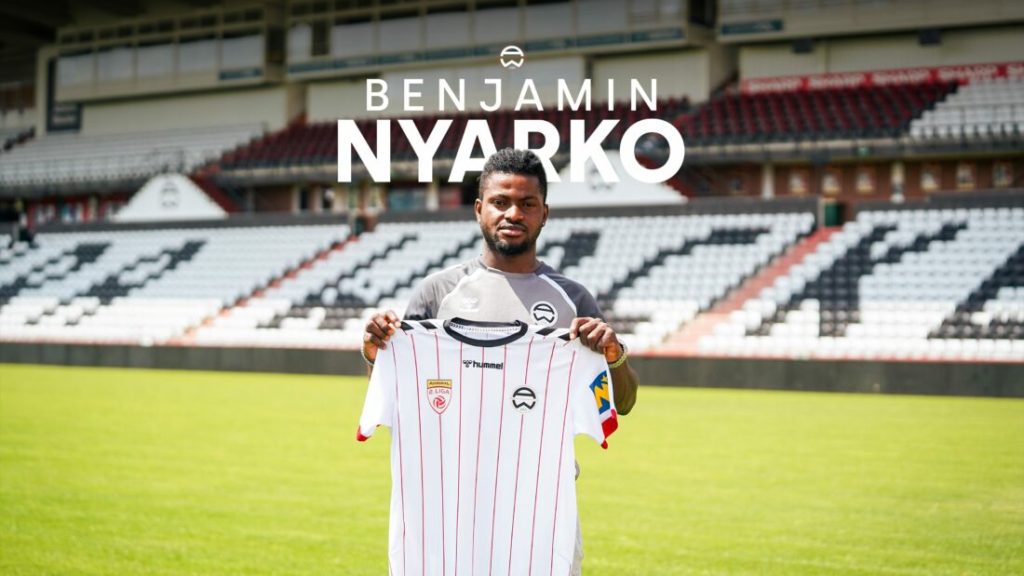
Ghanaian forward Benjamin Nyarko has completed a transfer from Czech top-flight club Slovan Liberec to Austrian second-division side Admira Wacker, a move that, on its surface, reads as routine football business. Beneath that surface, however, lies a governance and economic question that West African sports administrators, policymakers, and continental institutions have yet to resolve systematically: who captures the value when African athletic talent moves through European football markets, and what institutional frameworks govern that flow?
Nyarko, 22, arrives at Admira’s Südstadt ground ahead of the new campaign in Austria’s 2. Liga, where the club is targeting a stronger league position. Sporting director Ralf Muhr described the player as “a robust, quick and already internationally experienced striker,” signalling that the club’s technical staff view the signing as a deliberate upgrade to their attacking output rather than a speculative acquisition.
The European Pathway and What It Reveals About Talent Development Infrastructure
Nyarko’s trajectory follows a pattern well-documented in West African football: a young player develops in Ghana, moves into a mid-tier European league, and then navigates further transfers across the continent’s second and third divisions before either breaking into top-flight football or plateauing. The Czech Fortuna Liga, where Nyarko spent time at Slovan Liberec, functions as exactly this kind of intermediary market, a proving ground where African players accumulate European experience before clubs in Austria, Belgium, the Netherlands, or Scandinavia assess their readiness for a next step.
What this pathway rarely involves is structured benefit-sharing with the institutions that produced the player’s foundational development. Ghana’s football academies and grassroots clubs generate the raw talent; European clubs harvest and monetise it. The Ghana Football Association (GFA), operating under the broader governance architecture of the Confederation of African Football (CAF), has periodically attempted to strengthen solidarity mechanisms and training compensation frameworks. Enforcement, however, remains inconsistent, and the financial flows back to Ghanaian clubs are rarely proportionate to the developmental investment made.
FIFA Solidarity Mechanisms: Designed for Redistribution, Weak on Delivery
FIFA’s solidarity contribution mechanism theoretically allocates 5% of any transfer fee to clubs that trained a player between the ages of 12 and 23, distributed proportionally across those developmental years. For a player like Nyarko, moving between clubs in the Czech Republic and Austria, those contributions should flow back to Ghanaian clubs. In practice, the opacity of transfer valuations, the use of loan structures, and the administrative burden on smaller clubs in lower-income football associations mean that Ghanaian academies frequently fail to receive what the framework promises. The GFA lacks the legal and financial capacity to pursue these claims aggressively, a governance gap that CAF and the AU’s sports policy frameworks have not yet closed.
Ghana’s Position in the Regional and Continental Sports Economy
Ghana remains one of West Africa’s most consistent exporters of professional footballers, alongside Nigeria, Senegal, and Ivory Coast. The four countries together account for a disproportionate share of African players active in European professional leagues. Senegal’s model, built around the Académie Génération Foot and its structured partnership with FC Metz in France, offers a partial template for how benefit-sharing and development alignment can be institutionalised. Ivory Coast has similarly leveraged its ASEC Mimosas academy infrastructure to maintain traceable development pipelines with measurable return flows.
Ghana’s equivalent infrastructure, while producing players of consistent quality, operates with less institutional coherence. The country’s football governance has been periodically destabilised by corruption scandals, most visibly the 2018 exposé that led to the resignation of the GFA president and a temporary suspension of the domestic league. Recovery has been gradual. The GFA’s current administration has worked to restore credibility, but the structural reforms needed to convert Ghana’s talent production into durable economic returns remain incomplete.
ECOWAS and the Absence of a Regional Sports Governance Framework
ECOWAS, the 15-member regional bloc whose mandate covers economic integration, free movement of persons, and regulatory harmonisation across West Africa, has not developed a coherent sports economy policy. Free movement protocols that ECOWAS has advanced do facilitate player mobility within the region, but they do not address the asymmetry between West African talent supply and European demand-side capture of value. A regional framework that coordinated academy standards, transfer fee transparency, and solidarity fund enforcement across GFA, the Nigeria Football Federation, and the Fédération Sénégalaise de Football would give member associations collective bargaining weight they currently lack individually.
AfCFTA, the African Continental Free Trade Area, has opened discussions about trade in services that could, in principle, encompass sports and entertainment. Whether football’s labour export economy falls meaningfully within AfCFTA’s services protocol remains an open question for negotiators, but the commercial logic is clear: African football talent is a high-value export, and the continent’s trade architecture should treat it as such.
Admira Wacker’s Calculus and What It Means for Investor Confidence in African Talent
From Admira Wacker’s perspective, the Nyarko signing is a market-rational decision. Austrian 2. Liga clubs operate on constrained budgets, and sourcing players from Czech or Eastern European leagues, where African players have already acclimated to European conditions, reduces both transfer costs and adaptation risk. Nyarko’s profile, pace, physicality, and directness in the final third, fits a tactical template that Austrian second-division clubs consistently seek.
The club has scheduled an early friendly against Donaufeld on 18 July 2025, giving Nyarko an immediate opportunity to demonstrate his qualities to supporters and technical staff alike. Admira’s sporting director has been explicit that the expectation is not merely squad depth but a genuine attacking upgrade. That clarity of expectation, stated publicly, places accountability on both club and player in ways that benefit the transfer’s transparency.
For investors and scouts monitoring West African talent markets, the Nyarko transfer reinforces a well-established signal: Ghanaian players at the 22-to-25 age bracket, with prior European league exposure, represent reliable mid-market acquisitions for clubs in Austria, Belgium, and Scandinavia. The commercial case is sound. The governance question is whether Ghana and its regional peers can build the institutional architecture to ensure that this reliability translates into sustained investment in domestic football infrastructure, rather than a perpetual one-directional talent drain.
Policy Pathways: From Talent Export to Structured Development Return
Three institutional levers exist for Ghana and its West African neighbours to shift this dynamic. The GFA can invest in legal and administrative capacity specifically dedicated to tracking and recovering FIFA solidarity contributions, a function that the Nigerian Football Federation has begun to operationalise with greater consistency. CAF can use its revised statutes and the 2023 Club Licensing Regulations to impose stronger transparency requirements on member associations regarding transfer documentation. ECOWAS, through its Trade, Customs and Free Movement directorates, can develop a regional sports economy protocol that coordinates solidarity fund enforcement and sets minimum standards for academy certification across member states.
None of these pathways requires external validation or international institutional support. They require political will within existing African governance structures, administrative investment in institutions that already hold legal authority, and coordination among regional bodies whose mandates already overlap with the problem. Benjamin Nyarko’s transfer to Admira Wacker is, in isolation, a modest piece of football news. As a data point in a structural pattern, it is an invitation for West African institutions to govern their most consistent export with the seriousness it deserves.