The assassination of a provincial leader of South Africa’s March and March movement, and the South African state’s response to it, together expose a governance crisis that carries direct consequences for West African nations whose citizens are caught in the crossfire. The central thesis is straightforward: South Africa’s failure to enforce a clear boundary between legitimate political expression and vigilante enforcement of immigration law has created a dangerous vacuum, one that now demands a coordinated West African diplomatic and institutional response.
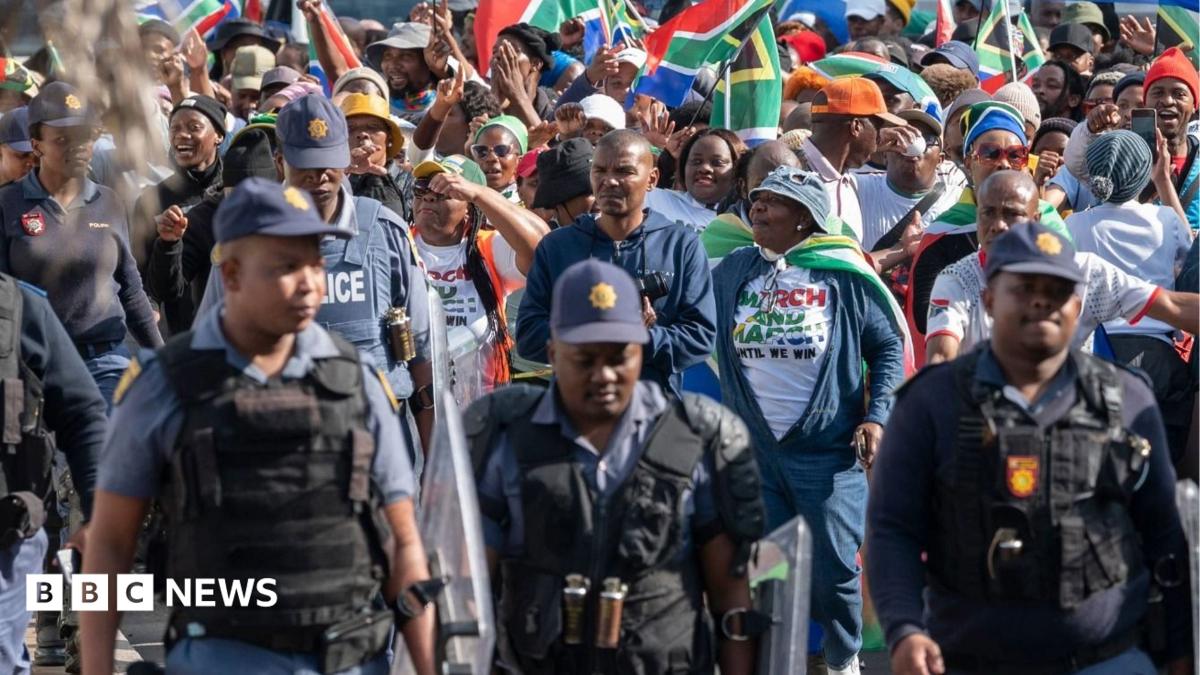
Andile Mvuyelwa Somgxada, the Gauteng province leader of March and March, was shot outside his home east of Johannesburg earlier this month and died several days later in hospital. The movement’s spokesperson, Sandile Dube, described the killing to the BBC as “an orchestrated hitman type of killing” and attributed it to retaliation for the group’s campaign to expel undocumented migrants. Acting police chief Lt Gen Puleng Dimpane has since announced a multidisciplinary investigative team, stating that the service is “committed to conducting a thorough investigation to establish the circumstances surrounding this murder and to ensure accountability.” That institutional response, however measured, arrives against a backdrop of weeks of violence, intimidation, and looting directed at foreign nationals across South Africa.
What makes this moment analytically significant is not the killing itself, but the governance architecture it reveals. March and March had set an unofficial deadline of 30 June for all undocumented migrants to leave South Africa, and has promised weekly marches until that demand is met. The South African government, rather than unambiguously rejecting this parallel enforcement structure, has simultaneously announced that more than 53,000 foreign nationals have been deported or repatriated since it launched a “migration management” campaign five weeks ago. The optics of that sequencing matter: a state accelerating deportations while vigilante groups claim credit for the pressure creates precisely the ambiguity that emboldens extrajudicial action.
Vigilante Enforcement and the Erosion of Legal Norms
The most concrete illustration of that erosion came on Tuesday, when five individuals were arrested in Limpopo province for impersonating immigration officers and unlawfully compelling a Nigerian national, legally resident in South Africa, to close his business. Lt Gen Dimpane issued a direct warning: “No individual or group has the authority to conduct immigration inspections, verify legal status, or remove people from communities.” The statement is legally correct, but its necessity is itself a measure of institutional failure. That a senior police official must publicly clarify the state’s monopoly on immigration enforcement indicates how far the normative boundary has already shifted in practice.
South Africa hosts more than three million documented foreign nationals, according to official figures, a number that excludes undocumented residents. The country’s structural position as the continent’s wealthiest economy has historically drawn labour migration from across the region, including from Ghana, Nigeria, Malawi, Kenya, and Uganda. That economic gravity does not disappear under political pressure; it simply redirects migration flows or drives them underground, reducing state visibility and increasing vulnerability for migrants.
For West African governments, the immediate policy question is consular protection and repatriation logistics. Ghana, Nigeria, Kenya, Malawi, and Uganda have all organised flights or buses for returning citizens in recent weeks. Nigeria’s voluntary repatriation scheme has now returned more than 1,200 nationals, with the final government-organised flight landing in Lagos on Wednesday carrying 306 passengers. These are competent, dignified responses. They are also, however, reactive measures that do not address the structural governance failure enabling the conditions that made them necessary.
The deeper institutional question is whether ECOWAS, as the primary regional body representing West African states, has the diplomatic instruments to engage South Africa bilaterally or through the African Union on the protection of its citizens abroad. ECOWAS’s free movement protocol, which governs movement among its fifteen member states, has no direct legal reach into South African territory. But the AU’s Constitutive Act and its migration governance frameworks do create normative obligations for member states to protect African nationals from xenophobic violence. Nigeria, as ECOWAS’s largest economy and the AU’s most influential West African voice, carries particular institutional weight in any such engagement. Lagos’s decision to organise repatriation flights signals a pragmatic short-term calculation; whether Abuja translates that into sustained diplomatic pressure on Pretoria is a different and more consequential question.
There is also an economic dimension that regional policymakers should not underestimate. West African entrepreneurs and traders in South Africa represent a node in informal but economically significant cross-continental commercial networks. The forced closure of a Nigerian-owned business in Limpopo is not an isolated incident; it is one data point in a pattern that, if sustained, will reduce West African commercial presence in southern Africa and weaken the intra-African trade density that AfCFTA is designed to expand. Investor confidence in the African Continental Free Trade Area depends, in part, on the credibility of the AU’s capacity to protect African economic actors operating across borders. Xenophobic violence that goes unaddressed by continental institutions directly undermines that credibility.
South Africa’s government faces a genuine governance dilemma. Undocumented migration does place measurable pressure on public services in a country where unemployment exceeds 32 percent and public health and education systems are already strained. Those pressures are real and politically potent. But the institutional response to migration pressure must be anchored in law, processed through administrative and judicial mechanisms, and clearly distinguished from mob enforcement. The multidisciplinary team now investigating Somgxada’s killing is a necessary step; it is not sufficient. South African authorities must prosecute those impersonating immigration officers with the same urgency they apply to the murder investigation, and the government must publicly and unambiguously refuse to allow political movements to set immigration enforcement timelines.
For West African governments, the policy pathway runs through three parallel tracks: sustained bilateral diplomatic engagement with Pretoria, coordinated AU-level advocacy for stronger continental norms on the protection of African migrants within Africa, and domestic investment in the economic conditions that reduce distress migration in the first place. The repatriation flights are a short-term necessity. The governance architecture that prevents the next crisis is a long-term institutional obligation, and it begins with West African states treating the protection of their citizens abroad as a core foreign policy function, not an afterthought activated by emergency.