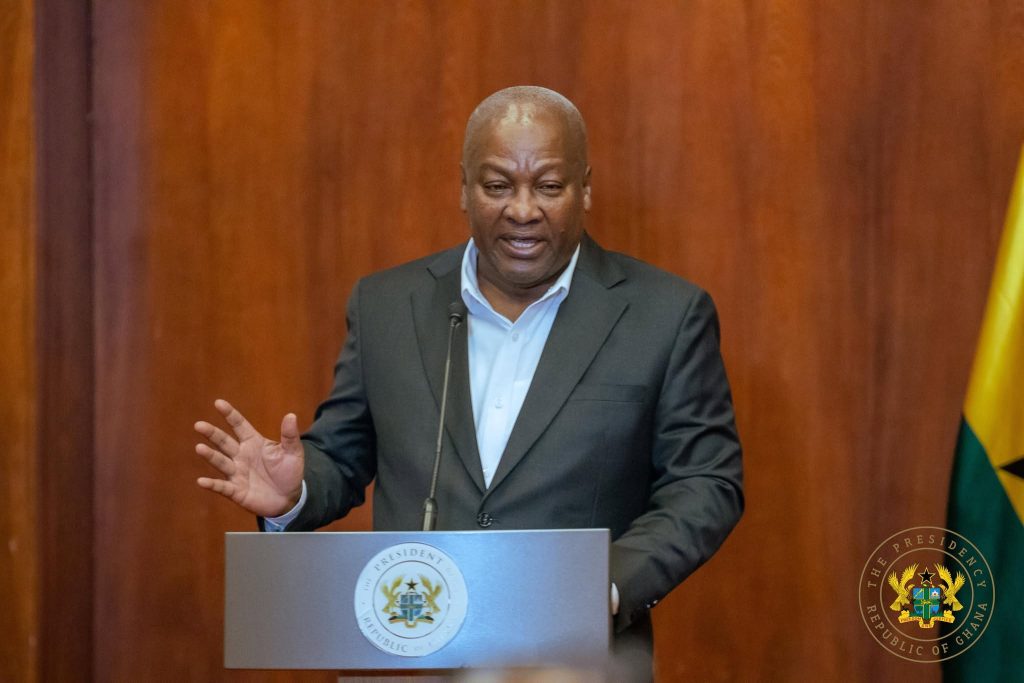
The nomination papers had barely been submitted before the question took shape in legal circles in Accra: what does it mean, institutionally, when a sitting president moves to expand the apex court by nearly seventeen percent in a single appointment round? President John Dramani Mahama’s nomination of three individuals to Ghana’s Supreme Court is, on its face, a routine constitutional exercise. Beneath that surface, however, it opens a pointed conversation about judicial composition, executive influence over the bench, and the governance standards that Ghana’s partners across West Africa are watching closely.
The three nominees are Court of Appeal Justice Sophia Bernasko-Essah, Court of Appeal Justice Amoako Asante, and Tony Forson, a senior legal practitioner and former President of the Ghana Bar Association. Each brings a distinct profile to the table. Justice Bernasko-Essah carries years of appellate court experience. Forson brings the perspective of the private bar and bar leadership, a relatively less common pathway to the Supreme Court. And Justice Amoako Asante carries perhaps the most regionally significant biography of the three.
Before returning to the Ghanaian bench, Amoako Asante served as President of the ECOWAS Court of Justice, the regional tribunal mandated to adjudicate disputes involving ECOWAS institutions and, critically, human rights violations by member states. That tenure places him at the intersection of national constitutional law and the supranational legal architecture that underpins West African integration. His potential elevation to Ghana’s apex court carries more than domestic significance: it introduces into Ghana’s highest judicial chamber a jurist who has operated within the region’s most consequential legal institution.
The nominations were made in consultation with the Judicial Council, as required under Ghana’s 1992 Constitution, which grants the President the power of appointment subject to parliamentary approval. That procedural compliance matters, because it is precisely the kind of institutional formalism that distinguishes Ghana’s governance record from several of its ECOWAS neighbors. Yet compliance with procedure and insulation from political pressure are not the same thing, and it is the latter that legal analysts tend to scrutinize when a new administration moves quickly to reshape the composition of the Supreme Court.
If Parliament approves all three nominations, the Supreme Court will grow from 18 to 21 justices. That expansion is not without precedent globally, but it is consequential in a constitutional democracy where the court holds final authority over electoral disputes, fundamental rights, and the constitutionality of legislation. Ghana’s Supreme Court has ruled on some of the most contested electoral petitions in West African democratic history, and its composition directly shapes how those rulings are perceived, domestically and regionally.
The parliamentary vetting process now becomes the critical governance mechanism. Ghana’s Parliament, currently navigating its own majority dynamics under the new Mahama administration, will subject each nominee to public hearings before the Appointments Committee. The quality of that vetting, the depth of questioning on judicial philosophy, on the nominees’ records on executive accountability, on their positions regarding constitutional interpretation, will determine whether the process functions as a genuine check or as procedural theater.
For investors and institutional partners operating across the ECOWAS zone, judicial credibility in Ghana functions as a regional reference point. Ghana has long served as a benchmark for anglophone West African governance, and its courts have been cited in comparative assessments alongside those of Senegal and Côte d’Ivoire as institutions that offer meaningful recourse. A Supreme Court perceived as politically constituted would erode that standing, with direct consequences for arbitration confidence, contract enforcement, and the rule-of-law metrics that multilateral institutions use to price risk in the sub-region.
Tony Forson’s nomination from the private bar also invites scrutiny of a different kind. Bar association leadership in Ghana has historically positioned itself as a watchdog of judicial and executive conduct. Forson’s transition from that advocacy role to the bench will require him to demonstrate, through the vetting process and beyond, that his jurisprudential commitments are grounded in constitutional principle rather than in the political alignments that tend to define bar association presidencies. That is not a disqualification; it is a test that the parliamentary committee is well placed to administer publicly.
What the nominations ultimately reveal is that Ghana’s judicial governance architecture is functioning, imperfectly but recognizably, as designed. The President nominates, the Judicial Council advises, Parliament vets, and the public watches. The mechanism exists. The variable is whether each institution within that chain exercises its authority with the rigor that the moment demands. For a country that has staked much of its regional reputation on the credibility of its democratic institutions, the Supreme Court confirmation hearings ahead are not a formality. They are a governance audit conducted in plain sight, and the West African policy community will be reading the results.