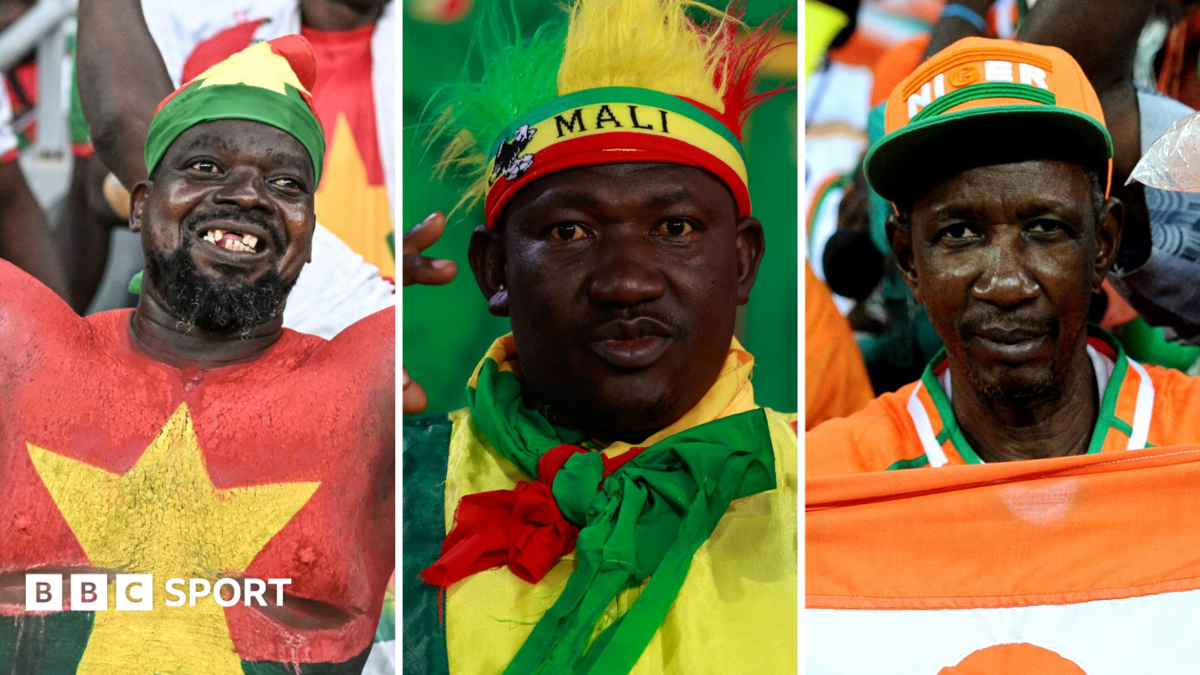
When the football federations of Burkina Faso, Mali and Niger formally submitted a joint bid to host the 2032 Africa Cup of Nations, they did more than enter a continental sporting competition. They placed a direct institutional question before the Confederation of African Football: can a hosting process built on governance, safety and free movement accommodate three states simultaneously navigating military rule, active jihadist insurgencies and a deliberate rupture with West Africa’s principal regional bloc?
The sequence of events that produced this bid stretches back well before last Saturday’s meeting in New York. Its roots lie in the successive coups that brought military governments to power in Mali in August 2020 and May 2021, in Burkina Faso in January and September 2022, and in Niger in July 2023. Each transition deepened a shared political logic: a rejection of the security frameworks and democratic conditionality that ECOWAS and Western partners had long attached to their support.
By January 2025, that logic had crystallised into institutional form. Burkina Faso, Mali and Niger completed their withdrawal from ECOWAS, the 15-member bloc that has governed West African economic and political integration since 1975, and formally activated the Alliance of Sahel States (AES), a tripartite pact centred on security cooperation, infrastructure linkage and economic coordination. The departure was the most significant structural fracture in West African regional architecture in decades, stripping ECOWAS of three contiguous Sahelian members and raising immediate questions about the coherence of the community’s free movement protocols, its common external tariff and its collective defence commitments.
It was within this reconfigured political geography that the Malian Football Federation, Femafoot, began coordinating a joint Afcon hosting proposal with its counterparts in Ouagadougou and Niamey. The framing chosen by Femafoot was deliberate: the bid would embody “solidarity, regional integration and sustainable development of African football.” The language consciously mirrors the rhetoric of continental institution-building, positioning the AES as a legitimate regional integration project rather than a military compact of convenience.
CAF opened applications for the 2028, 2032 and 2036 editions of the tournament in a single process, creating a competitive field across multiple cycles simultaneously. The Femafoot president, alongside his Burkinabe and Nigerien counterparts, met CAF president Patrice Motsepe in New York on 19 July 2025, on the sidelines of the 2026 FIFA World Cup final, to formally present their candidacy. Colonel-Major Djibrilla Hima Hamidou, a FIFA Council member and honorary president of Niger’s football federation, attended the meeting, lending the delegation a degree of institutional weight within global football governance.
Motsepe’s response was carefully calibrated. He confirmed that the three countries “will have as good a chance as everybody else” of hosting the finals, and explicitly stated they would not be “disadvantaged or prejudiced by the fact that they are military juntas.” Yet he also acknowledged, in the same breath, that questions of safety and security “are questions that we will have to address.” He announced his intention to visit the three countries personally to assess the football infrastructure dimension of the bid.
The tension embedded in Motsepe’s remarks reflects a genuine governance dilemma for CAF. The confederation’s hosting criteria rest on verifiable standards: free movement of fans and spectators, police protection, adequate infrastructure, and an operating environment that meets what Motsepe described as “global best practices.” These are not aspirational benchmarks. They are the conditions that determine whether a tournament of Afcon’s scale can function safely and commercially. Against that standard, the security environment across the Sahel presents concrete, documented risks. Armed jihadist groups affiliated with al-Qaeda and the Islamic State operate across large portions of Burkina Faso, Mali and Niger, with the United Nations and multiple humanitarian agencies recording sustained displacement, civilian casualties and restricted access across all three territories.
Motsepe was direct on the broader political dimension. “Of course, democracy and freedom of speech and regular elections, that’s non-negotiable. And that’s critical,” he said, while stopping short of making those conditions explicit disqualifiers for the hosting bid. CAF’s executive committee, he clarified, holds the final decision-making authority on host selection, a point he made with evident intent to distribute institutional responsibility and signal that the process would follow collective governance rather than presidential discretion.
The bid also arrives at a moment when the AES is actively constructing its own institutional infrastructure. On 22 July 2025, Burkina Faso’s transitional parliament approved the creation of Daande Liptako Radio and Tafouk TV, joint media platforms designed to serve the alliance’s three member states and promote regional coordination in information and communication. The media initiative, like the Afcon bid, signals that the AES is building the visible architecture of a regional bloc, generating shared institutions that can project legitimacy and coherence to both domestic audiences and external observers.
For ECOWAS and its remaining 12 member states, the bid carries a pointed subtext. The AES countries are effectively seeking continental recognition of their regional integration project through football, one of Africa’s most powerful soft-power instruments. A successful hosting bid would confer a form of institutional validation that ECOWAS membership, and the diplomatic pressure that came with it, had denied them. Côte d’Ivoire, which hosted the 2023 Afcon and maintains strong ECOWAS alignment, and Senegal, a peer democratic reformer currently managing its own political transition, will observe the CAF process with close interest.
The tournament’s structural context adds further complexity. CAF confirmed in December 2025 that Afcon will revert to a four-year cycle from the 2028 edition onward, aligning the continental championship with the FIFA World Cup calendar. The 2028 and 2036 bids are also under active consideration, and CAF is still evaluating whether to expand the finals from 24 to 28 teams. The 2032 bid from Burkina Faso, Mali and Niger therefore enters a competitive field where infrastructure capacity, logistical readiness and governance credibility will all carry weight in the executive committee’s deliberations.
Both Burkina Faso, which hosted Afcon in 1998, and Mali, which hosted in 2002, carry prior experience of tournament organisation, a credential that Femafoot and its partners will deploy prominently in the formal bid documentation. Niger has not previously hosted the tournament. The precedent of multi-host editions, with the 2027 Afcon in Kenya, Tanzania and Uganda marking the first three-country co-hosting arrangement, provides a structural template the AES bid can reference, though the logistical and security conditions across East Africa differ substantially from those in the Sahel.
CAF’s executive committee will ultimately weigh a question that extends beyond football administration: whether the institutional criteria for hosting a continental tournament can be met by states whose governance trajectories currently diverge from the democratic and rule-of-law standards that continental bodies, including the African Union, formally uphold. Motsepe’s planned visits to Ouagadougou, Bamako and Niamey will produce an assessment of infrastructure and football capacity. The harder institutional judgment, on safety guarantees, free movement and the political legitimacy of the host environment, will fall to the executive committee in a process that Motsepe has framed, with deliberate emphasis, as one of collective governance and transparent criteria rather than individual discretion.