
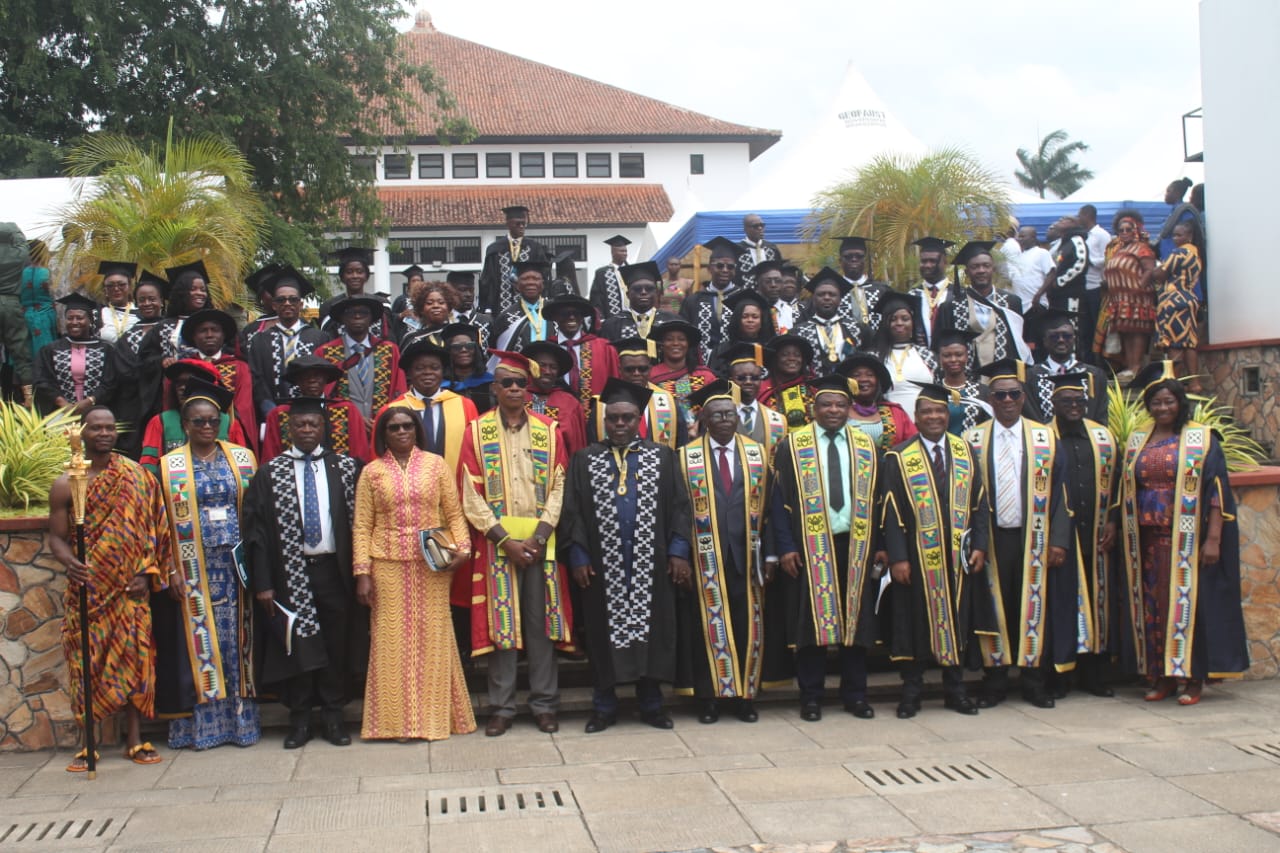
At its July 2026 congregation ceremonies, the University of Ghana conferred degrees on 1,884 students and issued a pointed institutional directive: that its graduates treat Artificial Intelligence not as a career accessory, but as a governance and development instrument with consequences for Ghana and the wider West African region.
The graduating cohort comprised 157 doctoral candidates, 1,429 master’s degree holders, and 298 undergraduates, representing one of the university’s largest single-cycle conferrals in recent memory. The scale of the cohort reflects a deepening investment in graduate-level human capital at a moment when regional economies are competing to position themselves as knowledge-economy anchors within the AfCFTA framework.
Speaking on behalf of Vice-Chancellor Professor Nana Aba Appiah Amfo, the Pro Vice-Chancellor for Research, Innovation and Development, Professor Felix Ankomah Asante, framed the address around institutional responsibility rather than personal ambition. “Use your knowledge not only for personal advancement but to improve the lives of others, to contribute to the development of Ghana and the larger world,” Professor Asante said, urging graduates to treat their degrees as a mandate for applied public contribution.
The address explicitly named Artificial Intelligence and emerging technologies as fields demanding urgent graduate engagement, citing the pace at which these tools are restructuring labour markets, public administration, and service delivery across the continent. Professor Asante called on graduates to “harness AI and new technologies which are reshaping industries and transforming the workplace,” adding that global challenges require collaborative and innovative thinking rather than siloed professional practice.
The University also called on its newest alumni to reinvest in the institution itself, urging them to mentor incoming students and sustain the academic ecosystem that produced them. Professor Asante was direct: “I urge you to contribute your expertise, experience and resources to sustaining the institution that shaped you.” This appeal to institutional reciprocity signals a governance posture within the University of Ghana, one that frames alumni not merely as beneficiaries but as stakeholders in the long-term credibility and capacity of Ghana’s premier research university.
That framing carries weight within a regional context where university-to-industry knowledge transfer remains structurally underdeveloped. Across ECOWAS member states, the gap between tertiary education output and productive economic absorption continues to constrain growth. Ghana, alongside Senegal and Côte d’Ivoire, has positioned itself as a regional hub for higher education, but the translation of academic credentials into applied innovation, particularly in AI-adjacent sectors, remains inconsistent and under-institutionalised.
The University of Ghana’s congregation message arrives as West African governments grapple with how to integrate AI governance into national development planning. Nigeria’s National Information Technology Development Agency has advanced frameworks for digital economy regulation, while Rwanda, outside the ECOWAS zone, has moved aggressively to position Kigali as a continental AI and fintech centre. Ghana’s ability to retain and deploy its doctoral and master’s-level graduates in high-value technology sectors will determine whether Accra consolidates or cedes its status as a regional knowledge economy node.
The congregation’s emphasis on lifelong learning and upholding values of excellence and integrity also speaks to a deeper governance deficit that higher education institutions across the region must confront. Institutional integrity, within universities as within public agencies, is a precondition for the kind of credible, evidence-based policymaking that attracts foreign direct investment and sustains domestic reform momentum. When the University of Ghana invokes integrity as a core graduate value, it implicitly acknowledges that the professional environments its graduates will enter do not always reward it.
For investors and development finance institutions tracking West Africa’s human capital trajectory, the composition of this graduating class offers a concrete data point. A cohort weighted toward postgraduate degrees, with 157 PhDs alone, suggests that Ghana’s research pipeline is deepening. The question is whether domestic institutions, both public and private, can absorb that expertise at a rate that prevents the region’s familiar brain drain dynamic from reasserting itself. Competitive salaries, functional research infrastructure, and transparent procurement in public institutions are the mechanisms through which graduate retention is secured, not exhortation alone.
The University of Ghana, as the country’s flagship institution, carries an obligation to model the governance standards it asks its graduates to uphold. That means transparent research funding allocation, merit-based faculty advancement, and active industry partnership frameworks that give graduates a credible pathway from academic achievement to applied impact. The congregation address pointed graduates outward, toward Ghana and the world. The institution itself must ensure the inward architecture matches that ambition.