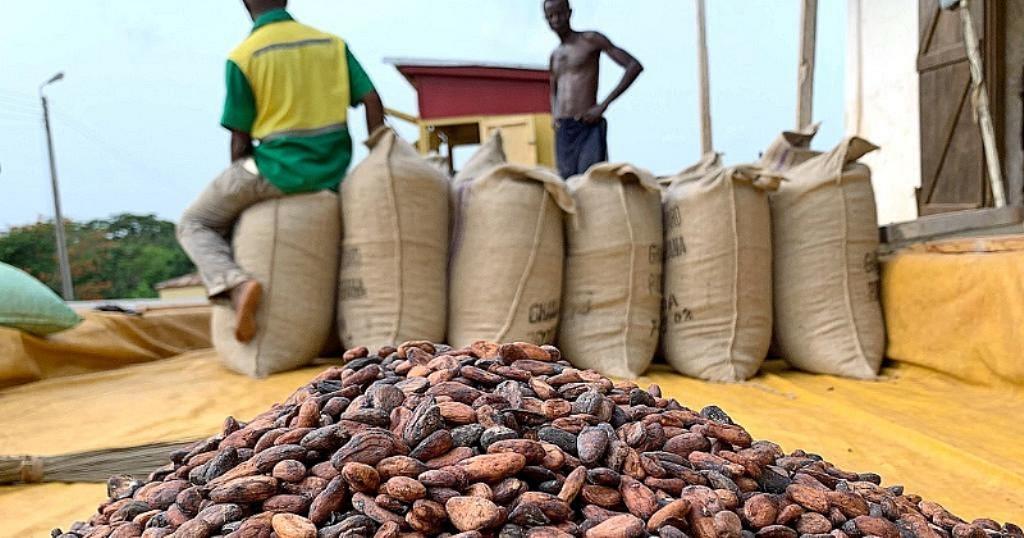
When Ghana’s cocoa regulator COCOBOD confirmed a projected output decline of at least 16% for the 2026/27 season, the announcement was more than a seasonal weather advisory. It crystallised a convergence of governance failures, environmental degradation, and structural neglect that has been quietly eroding one of West Africa’s most strategically significant agricultural sectors, and one that underpins Ghana’s fiscal position, rural livelihoods, and standing within the region’s broader commodity export architecture.
COCOBOD, responding to questions from Reuters, attributed the projected decline to a combination of El Niño-related weather conditions, excessive rainfall recorded in May and June 2025, and the cocoa tree’s natural physiological cycle of alternating high- and low-yield years. The regulator pointed specifically to a low cherelle load, the number of small pods that survive to full maturity, in the Western and Western North regions, which together account for more than half of Ghana’s total cocoa output. That these two regions are simultaneously experiencing the convergence of climatic stress, swollen shoot disease, ageing farm stock, and the encroachment of illegal artisanal gold mining, known locally as galamsey, is not coincidental. It reflects a decade of inadequate investment in rural agricultural infrastructure and a persistent failure of regulatory enforcement at the farm level.
The galamsey problem deserves particular scrutiny, because it is not simply an environmental nuisance. It represents a direct failure of land governance, property rights enforcement, and rural economic policy. When illegal miners occupy cocoa farms, they are not filling a vacuum that the state has adequately contested. They are exploiting institutional gaps that have widened under successive administrations, despite repeated pledges to crack down on the practice. The result is that productive agricultural land, much of it cultivated over generations by smallholder families, is rendered permanently unfit for farming. The cocoa trees that take years to mature and bear fruit cannot simply be replanted once the topsoil has been stripped and the water table contaminated. The economic damage is therefore not cyclical but structural, and no fertiliser programme, however well-resourced, can reverse it while the underlying land tenure and enforcement failures persist.
COCOBOD has responded to the immediate crisis with a package of mitigation measures: farm rehabilitation in the Western North Region, expanded insecticide and fungicide spraying programmes, and the reintroduction of a nationwide free fertiliser distribution scheme for the 2026/27 crop year. These interventions reflect genuine institutional responsiveness, and they should be acknowledged as such. But they also illustrate the limits of a regulatory model that remains heavily oriented toward managing decline rather than transforming the structural conditions that produce it. Fertiliser distribution addresses input deficits; it does not resolve the ageing farm profile, where a significant share of Ghana’s cocoa trees are well past their peak productive years and have not been systematically replaced. Spraying programmes combat disease vectors, but they cannot substitute for the sustained farm-level investment, extension services, and land security that would incentivise smallholders to undertake multi-year replanting cycles.
The regional dimension of this production contraction sharpens its significance considerably. Ivory Coast, the world’s largest cocoa producer and Ghana’s most direct regional competitor, is itself projecting an output decline of more than 10% for the coming season. When the two countries that together supply roughly 60% of the world’s cocoa both register simultaneous contractions, the implications extend well beyond bilateral competition. They affect global chocolate supply chains, commodity price dynamics on the London and New York futures markets, and the fiscal revenues of two states that remain heavily dependent on cocoa export earnings. For Ghana, which has been navigating a demanding IMF-supported fiscal adjustment programme since 2023, a significant drop in cocoa export receipts compounds pressure on the current account and foreign exchange reserves at precisely the moment when macroeconomic stabilisation requires sustained export performance.
Within the ECOWAS framework, the cocoa sector’s fragility also raises questions about regional agricultural policy coordination that have not been adequately addressed. Both Ghana and Ivory Coast have pursued largely parallel, nationally-siloed approaches to cocoa governance, from price-setting mechanisms to disease control to farmer support schemes. The Abidjan-Accra Cocoa Initiative, launched in 2019 to establish a floor price for cocoa and reduce the excessive dependence of both economies on volatile commodity markets, represented a meaningful step toward coordinated producer power. But its implementation has been uneven, and the structural investments it was meant to catalyse, in farm renewal, climate adaptation, and rural infrastructure, have not materialised at the scale the initiative implied. A more institutionally robust ECOWAS agricultural policy framework, one with binding commitments on land governance, disease surveillance, and climate-adaptive farming support, could provide the coordination architecture that neither country has been able to build domestically.
For investors and development finance institutions active in West African agriculture, the COCOBOD projection is a signal that the sector’s risk profile is shifting in ways that demand a reassessment of where capital is most productively deployed. The cocoa value chain has historically attracted significant downstream investment in processing and chocolate manufacturing, with both Ghana and Ivory Coast seeking to capture more value-added revenue rather than exporting raw beans. That ambition remains strategically sound, and it aligns with the AfCFTA’s broader objective of building intra-African industrial capacity. But downstream processing investment becomes harder to justify when upstream production is declining and structurally unstable. The more urgent capital allocation, therefore, is in farm-level renewal: financing replanting programmes, supporting land titling and tenure security for smallholders, funding climate-resilient cocoa varieties, and building the extension service infrastructure that translates agronomic knowledge into farm-level practice.
Ghana’s government and COCOBOD face a clear policy choice that is not primarily about the 2026/27 season but about the decade ahead. The regulator can continue to manage each season’s shortfall with input subsidies and disease-response programmes, absorbing the costs of structural decline while deferring the harder institutional reforms. Or it can treat the current contraction as the forcing event that finally drives a comprehensive restructuring of cocoa governance: one that resolves the galamsey enforcement failure, accelerates farm renewal financing, integrates climate adaptation into the sector’s regulatory mandate, and coordinates more systematically with Ivory Coast and ECOWAS partners on shared challenges. The cocoa tree’s biology is unforgiving, and a farm not renewed today will not be producing competitively in 2035. The institutional decisions made in Accra over the next eighteen months will determine whether Ghana’s cocoa sector recovers its productive base or continues its gradual contraction into managed irrelevance.