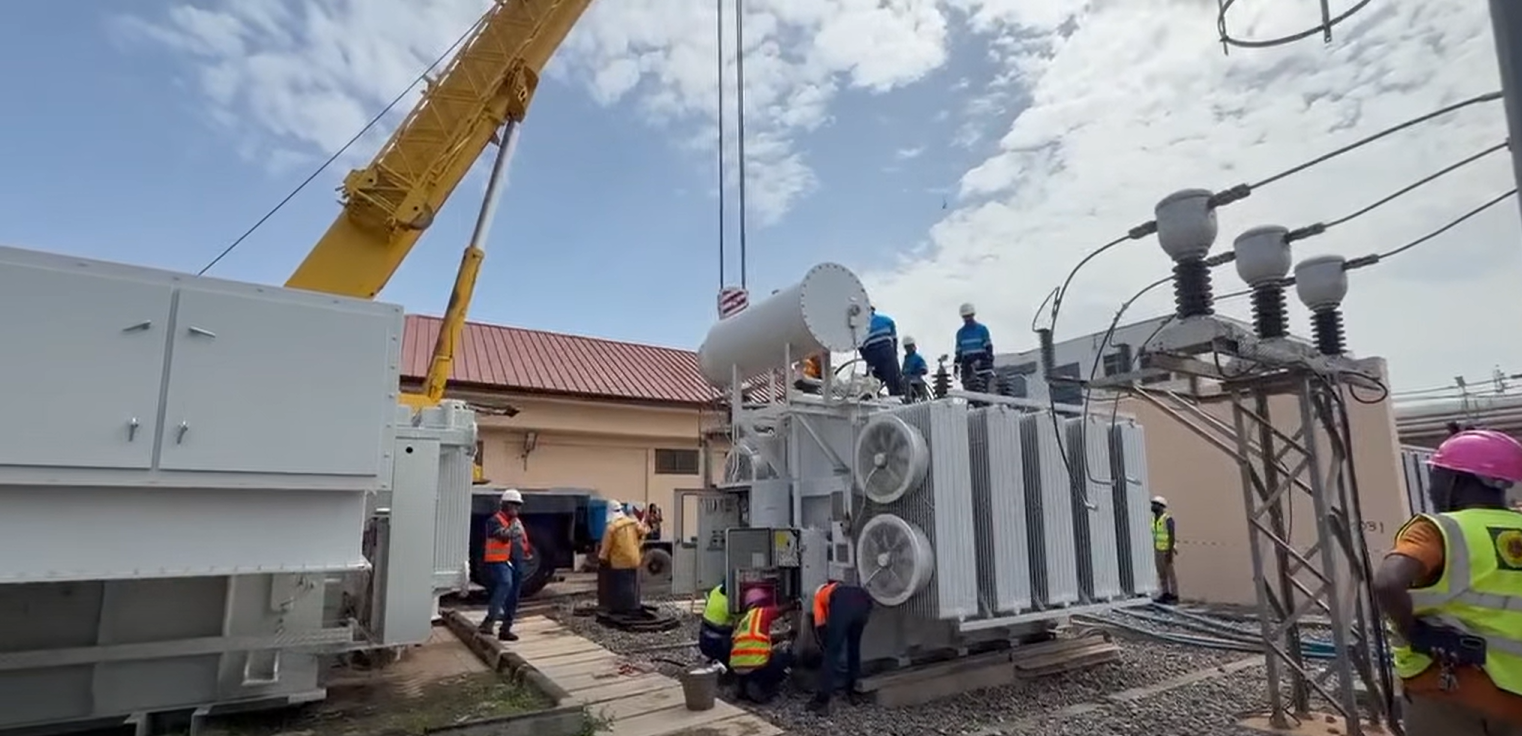
A single transformer failure at the Ghana Grid Company’s Asiekpe Bulk Supply Point has darkened dozens of communities across the Volta and Oti Regions, laying bare the structural fragility of Ghana’s transmission infrastructure at a moment when reliable electricity access remains a prerequisite for meaningful economic integration across West Africa.
The Electricity Company of Ghana (ECG) announced on 2 August 2025 that a technical fault at the GRIDCo Asiekpe Bulk Supply Point had forced the utility to implement a two-phase load management programme affecting a wide arc of communities stretching from Ho to Nkwanta. The first phase ran from 6:00 pm on Sunday, 2 August, to 6:00 am on Monday, 3 August, cutting power to Ho Technical University, SSNIT Flats, Goshen City, the Police Headquarters, Kpando Township, Hohoe, and dozens of surrounding communities including Sokode Lokoe, Abutia, Akrofu, Vakpo, Anfoega, Kpetoe, Jasikan, and Ayeremu, among others. The second phase, scheduled from 6:00 pm on 3 August to 6:00 am on 4 August, extended the disruption to Ho Central Market, the Food and Distribution area, Alavanyo, Nkonya, Worawora, Kadjebi, and Nkwanta, alongside parts of the University of Health and Allied Sciences Main Campus and numerous smaller settlements.
What makes this episode analytically significant is not the outage itself, which utilities across the region manage routinely, but the institutional architecture it reveals. A single fault at one bulk supply point cascaded into a multi-day, multi-district disruption affecting educational institutions, health facilities, commercial markets, and public safety infrastructure simultaneously. That cascade points directly to a transmission network built with insufficient redundancy and a distribution system that lacks the switching capacity to isolate faults before they propagate. ECG’s Public Relations Officer for Volta and Oti Regions, Eunice Tweneboah-Kodua, confirmed that engineers from both ECG and GRIDCo were engaged in repair works, but offered no timeline for full restoration, a gap in communication that itself reflects governance deficits in how Ghana’s energy sector manages public accountability during service disruptions.
Ghana’s electricity sector operates under a bifurcated structure in which GRIDCo holds responsibility for transmission while ECG manages distribution. This institutional separation, designed to introduce competition and clarity of mandate, can in practice diffuse accountability when faults occur at the interface between the two systems. When a GRIDCo transformer fails, ECG bears the public-facing burden of managing customer expectations and implementing load shedding, yet ECG has no direct authority over the pace of GRIDCo’s repair operations. The result is a governance gap that leaves affected communities, including university campuses, hospitals, and market traders, without clear recourse or reliable information. Regulatory oversight by the Public Utilities Regulatory Commission (PURC) theoretically addresses such coordination failures, but enforcement mechanisms remain underdeveloped relative to the scale of infrastructure challenges Ghana faces.
The regional dimension of this failure deserves attention. The Volta and Oti Regions border Togo and sit along trade corridors that connect Ghana’s interior to the coast and to Sahelian markets further north. Reliable electricity in Hohoe, Jasikan, and Nkwanta is not merely a domestic welfare issue; it conditions the competitiveness of small and medium enterprises that participate in cross-border trade flows increasingly governed by the African Continental Free Trade Area framework. Under AfCFTA, Ghana has committed to reducing non-tariff barriers and improving the business environment for intra-African commerce. Persistent infrastructure unreliability functions as precisely such a barrier, raising the effective cost of doing business for traders and manufacturers in border-adjacent regions regardless of what tariff schedules say on paper. Ivory Coast, Ghana’s principal regional competitor, has invested substantially in transmission infrastructure and grid modernization through its state utility CIE and the Compagnie Ivoirienne d’Électricité framework, giving Abidjan-linked commercial zones a structural advantage in attracting manufacturing investment that requires consistent power supply.
Nigeria’s experience offers a cautionary parallel. The Federal Government’s privatization of distribution companies in 2013 was intended to inject capital and managerial efficiency into a chronically underperforming sector. A decade later, the DisCos remain financially distressed, technically constrained, and unable to deliver reliable supply, in large part because transmission infrastructure under the Transmission Company of Nigeria was never adequately capitalized or reformed alongside the distribution privatization. Ghana risks a comparable trajectory if regulatory and investment frameworks continue to treat transmission and distribution as separable problems rather than as an integrated system requiring coordinated governance. The Ghana Energy Commission and PURC hold the statutory authority to compel GRIDCo and ECG toward greater operational coordination and public reporting standards; whether political will exists to exercise that authority consistently is a governance question that this week’s outages bring into sharp relief.
For investors evaluating Ghana’s energy sector, the Asiekpe fault reinforces concerns about the bankability of distribution infrastructure projects in secondary cities and regional corridors. International Finance Corporation guidelines on infrastructure investment in sub-Saharan Africa consistently identify transmission reliability as a primary risk factor for private capital deployment in off-grid and grid-adjacent projects. The communities affected by this week’s outages, many of them agricultural processing hubs or border-trade nodes, represent exactly the economic geography where targeted infrastructure investment could generate the highest developmental returns within ECOWAS’s broader regional integration agenda. ECOWAS’s own Energy Protocol, which commits member states to developing interconnected and reliable electricity systems, provides a normative framework that Ghana’s domestic regulatory institutions could invoke more assertively when prioritizing capital allocation within the national transmission network.
ECG’s apology to affected customers and its assurance that engineers are working toward rapid restoration are necessary but insufficient responses to a structural problem. What the Volta and Oti outages demand is a public accounting from GRIDCo on the maintenance status of bulk supply points across the network, a PURC-mandated review of fault-response protocols and inter-agency coordination procedures, and a Ministry of Energy commitment to ring-fenced capital expenditure for transmission redundancy in regions where single-point failures can disable essential services across multiple districts. Ghana built its reputation as a regional governance leader in part on the credibility of its institutions. Maintaining that reputation requires those institutions to treat a transformer fault not as an isolated operational inconvenience, but as diagnostic evidence of systemic investment and regulatory gaps that carry real costs for citizens, traders, and the broader project of West African economic integration.