
Kenya is preparing to receive two new submarine fibre optic cables before 2027, a development that raises a concrete governance question: who controls the digital infrastructure underpinning East Africa’s economic future, and how do investment decisions made in California or Paris shape the continent’s connectivity architecture?
The first cable, spanning 4,108 kilometres from Oman to Mombasa, is being developed under a partnership between Meta (Facebook’s parent company) and Safaricom. The second, known as Africa-1, stretches 10,000 kilometres from France through the Middle East and into Africa, and is expected to land in Kenya in 2026, according to TeleGeography, a Washington-based telecom research consultancy. Both projects arrive as global technology firms accelerate investment in AI and cloud infrastructure, treating high-capacity submarine networks as foundational assets rather than ancillary services.
Submarine cables carry more than 95 percent of the world’s international internet traffic. They are not peripheral utilities. They are the physical layer of the global digital economy, transmitting financial transactions, government communications, trade data, and consumer services across continents at speeds no satellite network currently matches. Starlink and comparable low-earth orbit systems offer meaningful rural connectivity, but remain substantially more expensive per unit of data transferred at scale, making them commercially unsuitable as primary bandwidth infrastructure for data centres or high-volume digital trade.
Where does Kenya sit within the continental connectivity hierarchy?
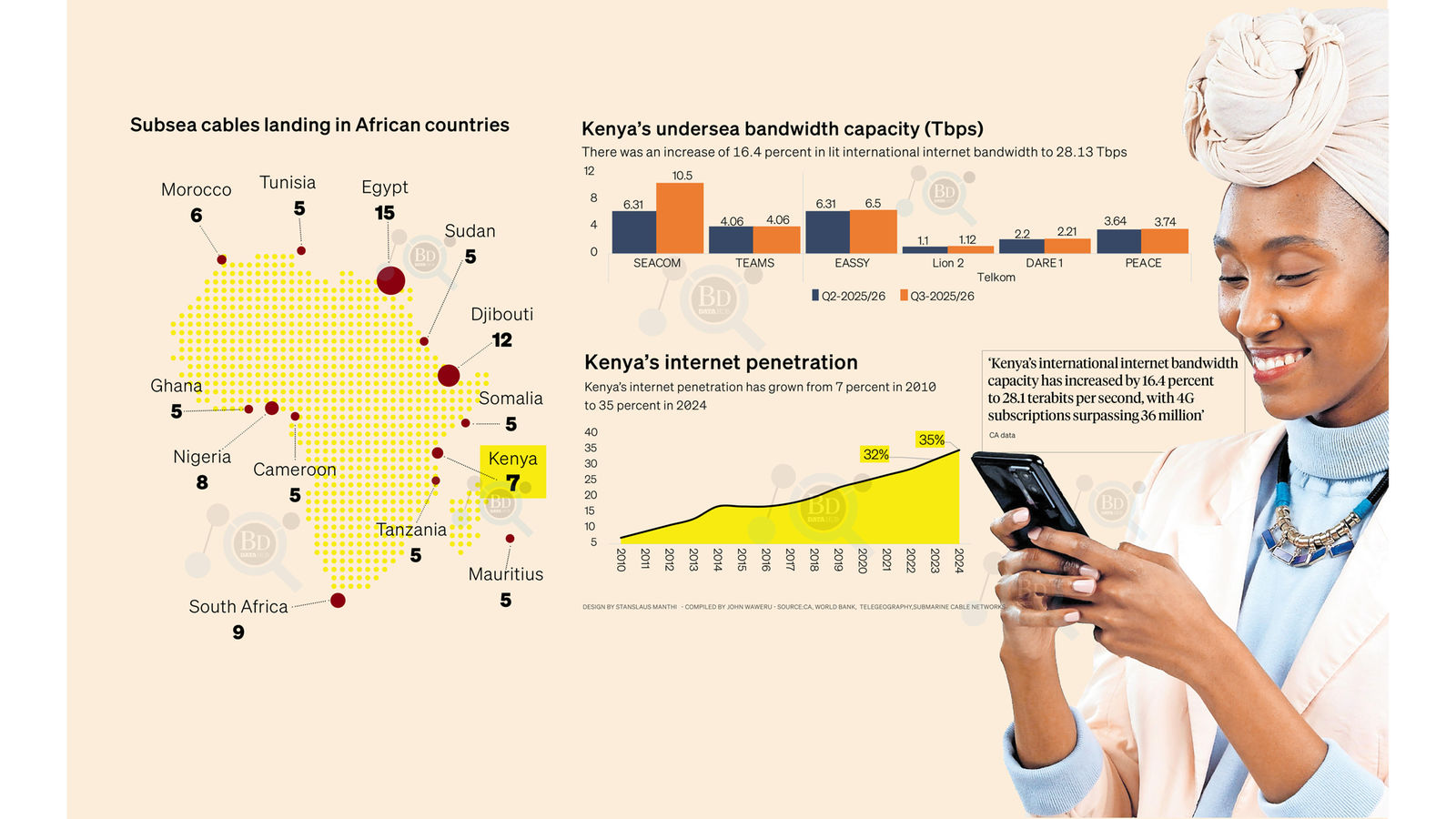
Kenya currently hosts seven subsea cable landings, placing it fifth in Africa. Egypt leads with 15 landings, followed by Djibouti (12), South Africa (9), and Nigeria (8). That ranking reflects both geography and historical investment patterns. Egypt and Djibouti benefit from their positions along the Red Sea corridor, one of the world’s most trafficked submarine cable routes. South Africa anchors the southern Atlantic and Indian Ocean routes. Nigeria draws investment as West Africa’s largest economy and population centre.
Kenya’s position as East Africa’s primary digital hub is more contested than its current ranking suggests. Ethiopia is expanding its digital infrastructure under a liberalisation agenda that opened its telecoms sector in 2021. Tanzania holds its own coastal landing points. Rwanda has pursued aggressive data centre and tech hub investment despite being landlocked. The addition of two new cables before 2027 would materially strengthen Nairobi’s claim as the region’s preferred gateway for data routing and cloud services.
Kenya’s international internet bandwidth capacity reached 28.1 terabits per second by early 2026, a 16.4 percent increase year-on-year. Active 4G subscriptions surpassed 36 million by March 2026. These figures indicate a domestic market generating genuine demand, not merely a transit corridor for regional traffic. The convergence of rising local consumption and incoming infrastructure investment creates conditions for Kenya to function as a substantive digital economy node, rather than simply a relay point.
What governance mechanisms determine who benefits from this infrastructure?
The ownership structure of submarine cables matters as much as their physical capacity. The Meta-Safaricom partnership on the Oman-Mombasa cable illustrates a model in which a global technology platform co-invests with a domestic operator, creating shared but asymmetric control. Meta’s strategic interest is in securing low-latency, high-capacity routes to serve its own platforms across the African market. Safaricom’s interest is in capacity access and positioning within Kenya’s competitive telecoms landscape. The Kenyan state’s interest, and by extension the public interest, lies in ensuring that this infrastructure serves broad economic development rather than primarily optimising traffic for a single platform’s commercial needs.
Regulatory frameworks governing cable landing rights, open-access requirements, and wholesale pricing remain the primary instruments through which governments can shape these outcomes. Kenya’s Communications Authority holds licensing authority over submarine cable landings, but the adequacy of its open-access provisions, and their enforcement in practice, determines whether new capacity translates into competitive wholesale markets or consolidates advantage among a small number of vertically integrated operators.
The African Union’s Digital Transformation Strategy for Africa (2020-2030) explicitly targets harmonised regulatory frameworks across member states to prevent fragmentation of the continental digital market. The AfCFTA’s digital trade protocols, still under negotiation, will eventually govern cross-border data flows, e-commerce rules, and digital services trade. Kenya’s infrastructure expansion is therefore not simply a national connectivity story. It intersects directly with whether East Africa can present a coherent, integrated digital market to investors and trading partners, or whether each country negotiates separately from a position of structural weakness.
Google’s parallel investment in its own subsea cable network, which the company describes as providing “industry-leading connectivity” across five continents to support its AI operations, underscores the strategic logic driving private sector participation. These are not philanthropic infrastructure projects. They are supply chain investments by firms whose revenue depends on low-cost, high-speed data movement at continental scale. African governments that understand this dynamic are better positioned to extract regulatory concessions, tax revenues, and skills transfer commitments as conditions of landing rights.
For Kenya specifically, the policy pathway is clear enough in outline, if demanding in execution. The Communications Authority should publish transparent open-access terms for both incoming cables before they become operational. The Ministry of Information, Communications and the Digital Economy should coordinate with COMESA and the East African Community to align data governance standards, reducing the regulatory arbitrage that currently allows firms to route data through whichever jurisdiction offers the least scrutiny. And Kenya’s Investment Promotion Authority should link cable landing approvals to binding commitments on local data centre investment and technical workforce development, converting infrastructure access into structural economic benefit rather than transit fees.
The cables will arrive. The bandwidth will increase. Whether that capacity translates into distributed economic development, a competitive regional digital market, and genuine African agency over critical digital infrastructure depends on the regulatory architecture Kenya and its regional partners build around it before the first fibre goes live.