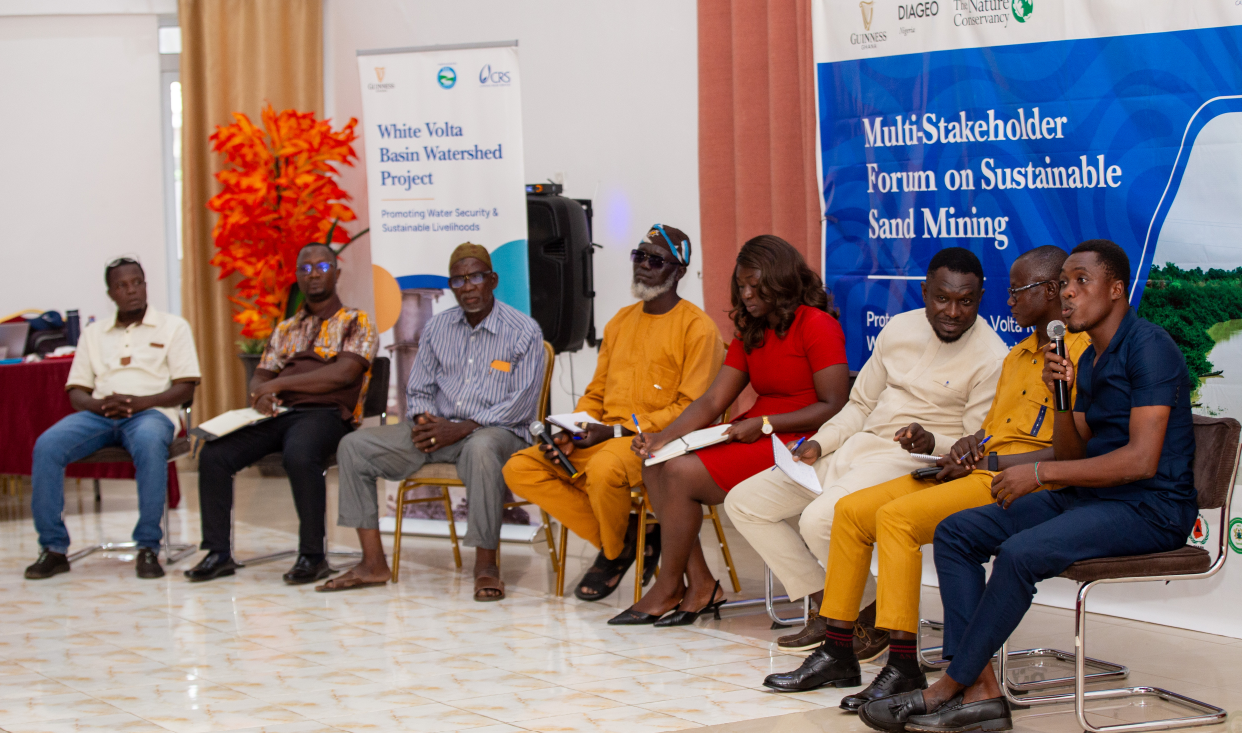
The sand that lines the banks of the White Volta River has long been both a resource and a fault line. For communities in Northern Ghana’s Nawuni sub-catchment, it represents income, construction material, and a livelihood that thousands of families depend upon. For the river itself, unregulated extraction has meant accelerating erosion, declining water quality, and the slow degradation of a watershed that supplies drinking water to millions across the northern savannah. On 28 and 29 July 2026, in Tamale, more than 120 representatives from district assemblies, traditional councils, regulatory bodies, academic institutions, civil society organisations, sand miners, and transport unions gathered to do something that Northern Ghana’s extractive sector has rarely seen: agree, formally, on rules.
The second Regional Stakeholders Forum on Sustainable Sand Mining, convened by Catholic Relief Services (CRS) in partnership with the Northern Regional Coordinating Council (NRCC), the Water Resources Commission (WRC), and the Minerals Commission, concluded with the validation of a Draft Integrated Regulatory Framework for sustainable sand mining across the White Volta River Basin. The document, produced by a Technical Working Group on Sustainable Sand Mining, is designed to institutionalise environmentally responsible and community-grounded extraction practices. Its endorsement marks a procedural milestone, but the harder work, translating consensus into enforceable governance, begins now.
A Basin Under Pressure
The White Volta River Basin is not a peripheral concern. It functions as a primary water source for a significant portion of Ghana’s Northern Region, feeding agricultural systems, supporting pastoral communities, and underpinning local food security in an area already vulnerable to climate variability and desertification. According to CRS, the basin faces compounding threats: illegal and unregulated sand mining, unsustainable farming encroachment on riparian lands, and the broader degradation of watershed vegetation. Each of these stressors interacts with the others. Riparian land clearance accelerates bank erosion; unregulated sand extraction deepens river channels and disrupts sediment flows; weakened watershed integrity reduces the basin’s resilience to seasonal flooding and drought. The result is a resource base that is being drawn down faster than it can regenerate, with downstream consequences that extend well beyond Ghana’s borders into Burkina Faso, where the White Volta originates before crossing into Ghanaian territory.
That transboundary dimension is not incidental. The White Volta is a shared resource governed, in principle, by the framework of the Volta Basin Authority, a regional institution established under the ECOWAS umbrella to coordinate water management across the six riparian states. Ghana’s capacity to regulate extraction activities within its portion of the basin carries direct implications for Burkina Faso’s water security and, by extension, for the credibility of ECOWAS-backed transboundary resource governance. Weak domestic regulation does not stay domestic.
What the Framework Actually Does
The Draft Integrated Regulatory Framework, as validated at the Tamale forum, operates across several institutional layers. At the district level, it provides the basis for by-laws that would bring sand mining operations under formal local government oversight, giving district assemblies the authority to license, monitor, and sanction extractors within their jurisdictions. At the community level, it recognises the role of traditional authorities, who in Northern Ghana exercise considerable practical influence over land and resource use, as enforcers and legitimisers of the regulatory regime. At the sectoral level, it aligns with the mandates of the WRC and the Minerals Commission, the two national bodies with statutory authority over water resources and mineral extraction respectively, creating a coordination mechanism that has historically been absent.
Francis Gumah, Head of Programming at CRS Ghana, framed the validation exercise as foundational rather than conclusive. “By validating the draft regulatory framework and engaging diverse stakeholders, we are laying the foundation for resilient watershed management and sustainable livelihoods,” he told participants. The language is careful and deliberate: a foundation, not a finished structure. Eric Ofori Arthur, representing the Northern Regional Minister in his capacity as Principal Development Planning Officer, went further in signalling institutional intent, reaffirming the NRCC’s commitment to combating illegal sand mining and to driving effective implementation of the framework. Commitments of this kind, made publicly before a multi-stakeholder audience that includes civil society and media, carry a degree of accountability that purely administrative pronouncements do not.
Funding Architecture and Its Governance Implications
The forum sits within a broader restoration programme for the White Volta River Basin financed by Guinness Ghana, Diageo Nigeria, and The Nature Conservancy. That funding architecture raises questions worth examining. Private-sector financing of environmental regulation, even when channelled through credible intermediaries like CRS, creates dependencies that public institutions must eventually absorb if the regulatory framework is to outlast the project cycle. Ghana’s experience with donor- and NGO-driven governance initiatives is instructive: frameworks that are not domesticated into statutory instruments and backed by public budgetary allocations tend to fade when external funding concludes. The WRC and the Minerals Commission will need to integrate the validated framework into their operational mandates, not merely endorse it as a stakeholder document.
The involvement of Diageo Nigeria alongside Guinness Ghana also points toward a regional corporate interest in watershed health that is commercially rational: Guinness’s brewing operations depend on water, and a degraded White Volta Basin represents a supply-chain risk. That alignment of commercial and environmental interests is not inherently problematic; it can provide durable financing where public budgets fall short. But it underscores the need for Ghana’s regulatory institutions to maintain ownership of the framework’s governance architecture, ensuring that enforcement priorities reflect public interest rather than corporate water security alone.
The District Assembly as the Critical Node
Ghana’s decentralisation architecture places district assemblies at the centre of local resource governance, and the framework’s viability depends substantially on their capacity and political will to act. District assemblies in Northern Ghana operate with constrained fiscal resources and, in many cases, limited technical staff. The consensus reached in Tamale on district-level by-laws is a necessary condition, but it is not sufficient without accompanying investments in monitoring capacity, legal support for enforcement actions, and interagency coordination between assemblies, the WRC, and the Minerals Commission. Ivory Coast’s experience with artisanal mining regulation in its northern regions offers a partial comparison: Abidjan has repeatedly produced regulatory frameworks for small-scale extraction that foundered at the sub-national implementation level because district-equivalent bodies lacked enforcement tools and faced political pressure from local economic interests.
Ghana can avoid that pattern, but doing so requires treating the Tamale validation not as an endpoint but as the opening of a governance process. The sand miners and transport union representatives who participated in the forum represent organised economic interests with the capacity to resist or circumvent regulation they perceive as threatening their livelihoods. Their presence in the room, and their formal commitment to support implementation, is significant precisely because it creates a basis for accountability. If the framework is implemented in ways that genuinely accommodate sustainable livelihoods, rather than simply restricting extraction without providing alternatives, that buy-in is more likely to hold. If it is not, the validated document will join a long shelf of West African environmental frameworks that achieved consensus and then achieved very little else.
The White Volta Basin’s future as a functional watershed, capable of sustaining communities on both sides of the Ghana-Burkina Faso border through an increasingly volatile climate, rests on whether the institutions that gathered in Tamale can convert a validated framework into a living regulatory system. The river does not wait for administrative timelines.