What is actually happening at Kenya’s political rallies?
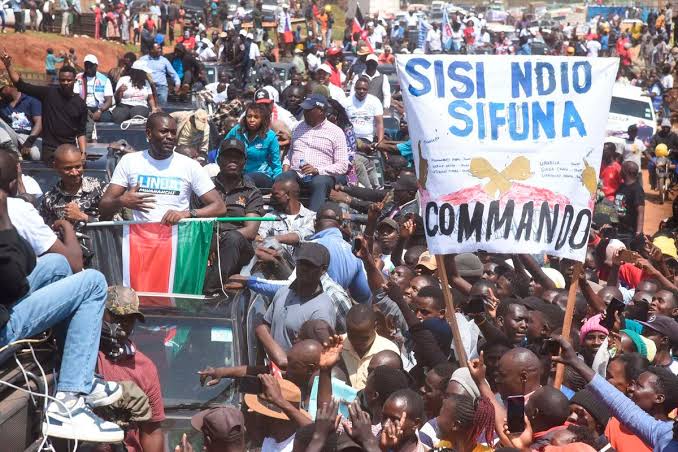
Kenya’s political gatherings have undergone a structural transformation. What were once forums for policy debate and civic mobilisation have become transactional exchanges, where crowds demand cash payments before listening to speeches, allowing convoys to pass, or permitting helicopters to take off. This is not peripheral disorder. It is a governance crisis with measurable consequences for democratic accountability across East Africa’s most institutionally complex state.
The phenomenon has a name in Dholuo: gonya, meaning “untie me” or “give me something.” It captures the transactional logic precisely. Citizens no longer arrive as constituents; they arrive as creditors.
On 28 June 2025, Dr Oburu Oginga, leader of the Orange Democratic Movement, reported that attendees at a Kenya Union of Post Primary Education Teachers fundraising event in Siaya County extracted KSh 200,000 directly from his bag while his bodyguards attempted to intervene. The incident was not exceptional. It was symptomatic.
How did Kenya arrive at this point?
The trajectory is traceable. What began as modest transport reimbursements and lunch allowances, standard informal compensations in economies where attendance at public events carries a real opportunity cost, gradually formalised into an expectation structure that politicians themselves engineered.
Politicians deployed cash handouts as a mobilisation tool precisely because they worked: crowds were larger, cheering more reliable, and rival events more effectively disrupted. The logic was rational at the individual level and catastrophically corrosive at the systemic level. Each election cycle raised the baseline expectation, compressing the space for ideological or programmatic politics.
In Malava, women who spent the day dancing at a political event complained of being underpaid. The complaint is instructive: it reflects not gratitude for an unexpected gift, but grievance over a contractual shortfall. The political gift has become a wage, and a disputed one at that.
The Odinga countermodel and what it reveals
The late Raila Odinga, who died in October 2025, built a political career explicitly rejecting this model. His response to gonya demands was characteristically blunt: “In dher ng’a mondo agonyi?” — “Whose cow are you that you are demanding to be untied?” The question reframed the relationship: citizens as autonomous agents, not livestock awaiting release.
Odinga was accused of stinginess. His gatherings were disciplined. In retrospect, his refusal to participate in handout politics reads as an institutional choice, one that preserved the deliberative function of political assembly even as it cost him popularity in certain constituencies.
His approach demonstrates that alternatives exist. They require political will and a sufficiently organised base to sustain mobilisation through ideas rather than cash. That combination is rare, and its rarity explains why the patronage model has proved so durable.
What does this mean for democratic institutions?
The implications for Kenya’s governance architecture are direct. When political participation is monetised, several institutional functions break down simultaneously.
Kenya’s Independent Electoral and Boundaries Commission (IEBC) operates within a legal framework that formally prohibits vote-buying. But the enforcement gap between that prohibition and ground-level practice is wide. Handouts at rallies occupy a legal grey zone that prosecutors rarely enter and courts have not systematically addressed.
Where does the regional governance context fit?
Kenya is not alone. Patronage politics is documented across West and East Africa, from Nigeria’s “stomach infrastructure” discourse to the cash-distribution practices that shaped Côte d’Ivoire’s 2020 electoral cycle. What distinguishes the Kenyan case is the degree to which the practice has become formalised and demand-driven rather than supply-driven. Crowds are no longer passive recipients of elite largesse; they are active extractors operating with organised expectations.
Within the East African Community (EAC) and the broader African Union framework, governance benchmarks increasingly tie regional integration benefits, including market access and development financing, to democratic quality indicators. The African Peer Review Mechanism (APRM), to which Kenya is a signatory, explicitly evaluates political governance, including the integrity of electoral processes and the functionality of political institutions.
A political culture that systematically monetises civic participation degrades those indicators. It also signals to regional and international investors that political risk in Kenya carries a specific texture: not merely instability, but institutional capture by patronage networks that can redirect public resources toward electoral maintenance.
The economic driver that politicians cannot ignore
Analysts consistently point to unemployment and household economic stress as structural enablers of handout politics. For a young person without formal employment, KSh 200 for attending a rally represents real income. The politician who refuses to pay loses the crowd. The politician who pays reinforces the expectation. Neither outcome advances governance quality.
This dynamic does not exonerate political actors. It contextualises their choices within an economy where the state has failed to generate sufficient formal employment, where social protection systems remain underdeveloped, and where political events function, however perversely, as informal redistribution mechanisms. The problem is simultaneously a governance failure and a market failure, and it cannot be addressed by electoral law reform alone.
What policy pathways exist before 2027?
Kenya’s 2027 General Election arrives with handout expectations that have been inflated by successive cycles of competitive patronage. Several institutional levers could constrain the practice, though none is sufficient on its own.
The IEBC could pursue more aggressive enforcement of existing prohibitions on vote-buying, including treating rally payments as campaign finance violations subject to audit and sanction. Political parties, whose internal governance remains weak by comparative regional standards, could adopt binding codes of conduct with real penalties. Civil society organisations with credible civic education mandates could reframe the public conversation around what political participation is for.
More structurally, Kenya’s devolution framework, which transferred significant fiscal authority to county governments after 2013, created a layer of political competition at the local level that intensified patronage demands rather than dispersing them. Reviewing how county-level political incentives interact with national electoral cycles is a governance question the National Assembly’s relevant committees have not adequately addressed.
The cycle Dr Oginga described, politicians complaining about handout costs while continuing to meet them, will not break without coordinated institutional action. Individual politicians who defect from the patronage model, as Odinga demonstrated, pay a short-term cost. The architecture that makes defection costly is what requires reform. Kenya’s democratic institutions have the mandate to build that architecture. The question is whether the political will to use it materialises before the next election renders the question academic.