
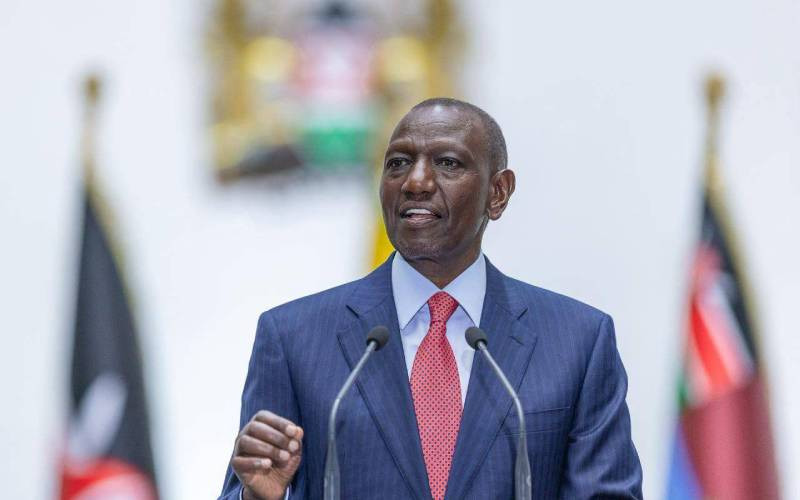
President William Ruto’s call for Kenyans to begin designing a national development framework beyond Vision 2030 has triggered the predictable cycle of partisan endorsement and reflexive opposition, but the deeper institutional question it raises goes largely unaddressed: whether Kenya possesses the governance architecture to translate long-term planning into durable policy across successive administrations.
The proposal, floated in a recent presidential address, invites broad public participation from government officials, academics, professionals, and civil society. Supporters frame it as visionary statecraft. Critics dismiss it as political theatre. Neither response engages the structural problem at its core.
Kenya’s Vision 2030, launched in 2008, was designed as a nationally owned development blueprint. Its implementation record is uneven at best. Flagship projects stalled, financing gaps widened, and successive governments rebranded priorities without formally revising the framework. The question is not whether Kenya needs a new long-term vision. It almost certainly does. The question is what institutional conditions would make such a vision function differently from its predecessor.
The Governance Architecture Behind Successful Long-Term Planning
The historical record here is instructive and specific. South Korea’s industrial transformation from the 1960s onward was anchored in the Economic Planning Board, a technocratic institution with genuine authority to coordinate ministries, allocate capital, and enforce sectoral targets across political cycles. Singapore’s development trajectory was similarly protected by institutions insulated from short-term electoral pressures. Rwanda’s Vision 2050, adopted in 2020, builds on an earlier Vision 2020 that achieved measurable outcomes in health coverage, digital infrastructure, and export diversification, not because the vision document was well-written, but because the National Institute of Statistics, the Rwanda Development Board, and a performance-contracting system called imihigo created accountability at every level of government.
Kenya has institutions on paper. What it has lacked is the political consensus to protect them from instrumentalisation. The Kenya National Planning Commission, the Kenya Institute for Public Policy Research and Analysis, and the Devolution framework under the 2010 Constitution all carry genuine constitutional or statutory mandates. None has been consistently empowered to hold the executive to measurable long-term commitments.
This is the governance deficit that a post-2030 vision must address before it addresses anything else.
Regional Stakes and the ECOWAS Parallel
Kenya’s planning challenge resonates well beyond its borders. Across West Africa, the same dynamic plays out repeatedly: ECOWAS member states adopt regional integration commitments, including the Common External Tariff, the Trade Liberalisation Scheme, and the ECOWAS Monetary Cooperation Programme, only to see implementation collapse when domestic political cycles shift priorities. Nigeria’s periodic suspension of ECOWAS trade protocols, Ghana’s inconsistent alignment with WAEMU monetary benchmarks despite not being a member, and Senegal’s selective application of AfCFTA tariff schedules all reflect the same underlying failure: the absence of domestic institutional anchors capable of binding governments to long-term commitments.
AfCFTA, headquartered in Accra, depends precisely on what Kenya’s Vision 2030 debate exposes as scarce: the institutional capacity of African states to sustain policy commitments across electoral transitions. A continental free trade area functions only if member states can guarantee regulatory continuity, predictable tariff schedules, and enforceable dispute resolution. That requires the same long-term planning discipline that Ruto’s proposal, at least in theory, is trying to build.
The international development community has already begun structuring the post-SDG framework, with the United Nations preparing successor goals for adoption around 2030. African states that arrive at those negotiations without coherent domestic long-term strategies will, once again, be responding to externally designed frameworks rather than shaping them. That is not a hypothetical risk. It is the pattern that defined the MDG and SDG cycles for most of the continent.
Any serious post-2030 Kenyan vision should be benchmarked against three institutional tests. First, does it establish an independent monitoring body with statutory authority, published indicators, and a mandate that survives changes of government? Second, does it embed county governments, not merely as consultative actors, but as co-owners of specific targets under the devolution framework? Third, does it articulate Kenya’s positioning within AfCFTA and the East African Community with enough specificity to bind trade and investment policy across administrations?
Absent those features, the exercise risks producing another document that generates diplomatic goodwill and donor interest at launch, then quietly fades as political priorities shift.
Kenya’s universities, law societies, private sector federations, and civil society organisations carry real institutional weight. Their role is not to validate a government-designed vision but to interrogate its assumptions publicly, propose alternative frameworks, and demand that whatever emerges contains enforceable accountability mechanisms. Constructive pressure of that kind is not opposition. It is the condition under which long-term planning actually works.
The partisan noise surrounding Ruto’s proposal will subside. What Kenya needs to resolve, before the next election cycle consumes the agenda, is whether its institutions are strong enough to hold any government accountable to a 30-year horizon. That is a governance question. And it has a regional answer.