
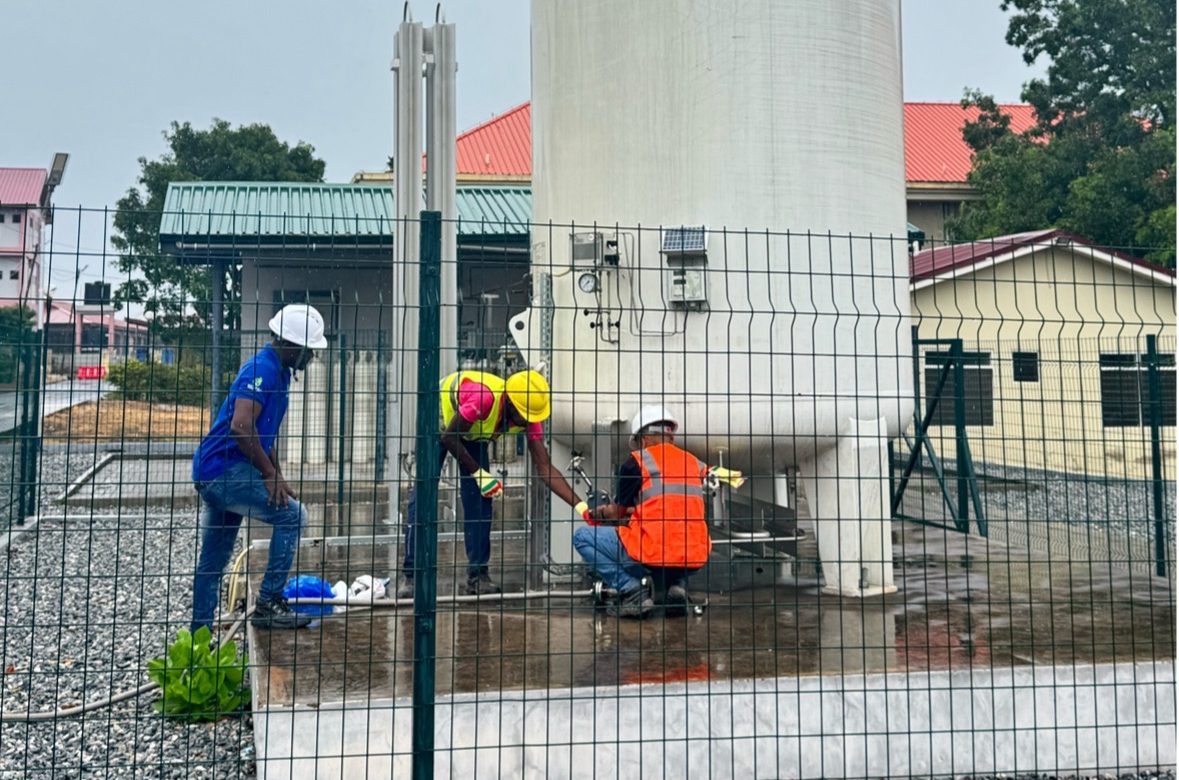
When a hospital runs out of oxygen cylinders, the margin for error collapses fast. That is the operational reality Indo-Ghana Industries Limited is attempting to dismantle through locally produced liquid medical oxygen, a supply-chain shift with implications that extend well beyond one facility in Accra.
The company delivered its first consignment of made-in-Ghana liquid oxygen to Lekma Hospital in late 2024, installing a cryogenic storage tank that connects directly to the facility’s ward pipeline network. The question this raises is not simply whether liquid oxygen is better than cylinders — it is — but whether Ghana’s healthcare infrastructure, financing systems, and energy grid can sustain the transition at scale.
Why does the cylinder model fail, and what does liquid oxygen actually change?
Medical oxygen in cylinder form has dominated West African healthcare logistics for decades, and the economics are punishing. Indo-Ghana’s Managing Director, Varun Tyagi, puts it plainly: “The packaging material, the cylinders, are much more expensive than the product itself. In Africa, distribution costs are too high.” Cylinders must be physically transported to production sites, refilled, and returned — a cycle that breaks down under poor road conditions, fuel shortages, or simply high demand.
Liquid oxygen restructures that logic entirely. A single cryogenic storage tank holds the equivalent of approximately 1,000 gaseous oxygen cylinders. At Lekma Hospital, the first delivery is projected to sustain the facility for at least three months, compared to the near-continuous replenishment cycle the cylinder model required. The system also feeds oxygen directly into hospital pipelines, eliminating manual cylinder handling and the human error that accompanies it.
The clinical difference is also measurable. Lekma’s Head of Clinical Engineering, Saviour Demordzie, confirmed that the hospital’s previous oxygen concentrators delivered purity levels of 90 to 92 percent. Liquid oxygen delivers purity closer to 99 percent — a meaningful margin in critical care settings where oxygen concentration directly affects patient outcomes. “Our frequent calls for oxygen have reduced. There is a constant pressure and flow of oxygen at the facility,” Demordzie said.
Before the new system was installed, the hospital operated in a state of managed anxiety. “Initially, you had to call vendors when the oxygen was finishing, and if you were not fortunate, the unfortunate could happen,” Demordzie noted. That phrase — understated, precise — captures the governance failure embedded in a supply chain that left hospitals dependent on last-minute vendor calls.
What does this mean for Ghana’s health infrastructure governance and regional positioning?
Indo-Ghana began operations in Ghana in 2010, initially producing gaseous oxygen. The COVID-19 pandemic exposed the fragility of cylinder-dependent supply chains across West Africa, accelerating the company’s pivot to liquid oxygen production at its Apollonia Industrial Enclave facility. Current output stands at approximately 10 tonnes per day, with expansion planned.
The transition required not only production capacity but recipient infrastructure — hospitals needed cryogenic tanks before they could accept liquid oxygen deliveries. Development partners filled that gap in the short term: USAID, CHAI, and JHPEIGO supported tank installations at roughly 10 hospitals, with five additional facilities equipped through separate programmes. That brings the current total to approximately 15 hospitals with liquid oxygen capability, out of a national hospital network that runs into the hundreds.
The infrastructure deficit is significant. Indo-Ghana’s planned hub-and-spoke distribution model — centralised production feeding regional filling stations closer to hospitals in areas like Yendi in the Northern Region — is the right structural answer, but it depends on financing that the company says remains constrained. Delayed payments from hospitals, limited access to long-term capital, and electricity costs that account for 42 to 45 percent of production costs all compress the company’s capacity to invest and expand.
The electricity cost burden is particularly acute. Ghana’s power tariff trajectory has been upward and volatile, and Indo-Ghana’s Tyagi has called for oxygen producers to be classified as critical service providers — a status that would entitle them to advance notice of load-shedding and protection from abrupt disconnections. This is not an unusual arrangement globally; several countries formally designate medical gas manufacturers as essential infrastructure operators. Ghana has not done so yet, and the absence of that regulatory recognition creates operational risk that ultimately lands on patients.
The Ministry of Health’s national medical oxygen policy, currently under development, offers a governance mechanism to address some of these gaps. Indo-Ghana is engaged in that process, and the company’s deployment of telemetry systems in newly installed tanks — which allow real-time monitoring of consumption patterns — provides exactly the kind of data infrastructure that a functioning national oxygen policy requires. Policymakers tracking demand spikes, anticipating shortages, and coordinating with producers need granular consumption data; telemetry makes that possible.
Within the ECOWAS region, Ghana’s move toward locally manufactured liquid oxygen carries competitive and integrative significance. Nigeria, the regional hegemon, has struggled with medical oxygen access at scale, as the COVID-19 crisis made visible. Senegal and Côte d’Ivoire have invested in health manufacturing capacity as part of broader industrial policy. A Ghana that develops a reliable, locally produced medical oxygen supply chain — and exports that model regionally — strengthens its position within the ECOWAS health governance architecture and contributes to the African Union’s Pharmaceutical Manufacturing Plan for Africa, which explicitly targets local production of essential medical supplies.
The AfCFTA framework adds a further dimension. If Indo-Ghana scales to regional export capacity, liquid oxygen produced in Ghana could move across ECOWAS borders under preferential tariff conditions, reducing the continent-wide dependence on imported medical gases. That is a structural development outcome, not merely a commercial one.
The immediate policy ask from Indo-Ghana is targeted and actionable: formal critical-infrastructure status for medical oxygen producers, reliable power tariff frameworks, and faster payment cycles from public hospitals. These are not large-scale structural reforms — they are specific regulatory adjustments that the Ministry of Health and the Energy Commission could implement within existing mandates. The national oxygen policy, if it incorporates these provisions, would give Ghana a governance model worth replicating across the region.
What Indo-Ghana has demonstrated at Lekma Hospital is proof of concept. The harder work — financing 15 hospitals into 150, building regional hubs, securing the energy supply that makes production viable — is a governance problem as much as a commercial one. The infrastructure exists. The policy architecture to sustain it is still being written.