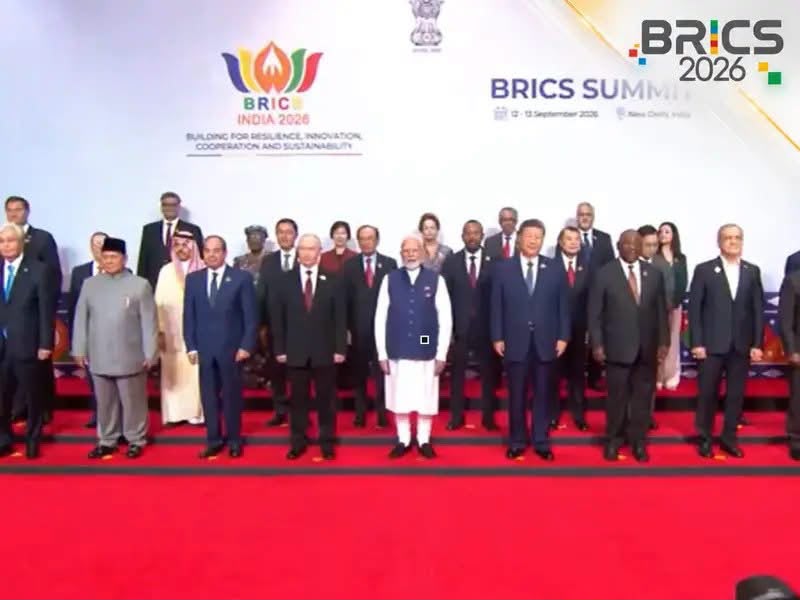
At the 18th BRICS Summit in New Delhi, Chinese President Xi Jinping did not merely call for unity among emerging economies — he outlined a structural challenge to the post-1945 multilateral order, one whose reverberations extend directly into the governance calculus of West African states balancing continental integration with shifting global alignments.
A Bloc Marking Two Decades, Redefining Its Weight
BRICS turns twenty as a grouping that has moved well beyond its original framing as an investment thesis for fast-growing emerging markets. The New Delhi Declaration, adopted at the close of the summit, reaffirms member commitments to multilateralism, free trade, sovereign equality and a more inclusive international order — language that resonates with the founding architecture of the African Union and the treaty obligations underpinning ECOWAS. For West African states, the declaration is not abstract: it signals that the institutional environment in which they negotiate trade, seek capital and manage debt is being actively contested at the highest levels of global politics.
Xi’s address positioned BRICS as a “pioneering force for innovation, peace, cooperation and global governance reform.” That framing matters because it claims institutional legitimacy — not merely economic weight — for a grouping that now includes states representing a substantial share of global GDP and population. With China assuming the BRICS chairship ahead of the 19th Summit, Beijing will set the agenda for a bloc whose stated ambitions increasingly overlap with those of the AU’s Agenda 2063 and AfCFTA’s structural transformation goals.
The Governance Architecture at Stake
Xi’s call to “uphold the authority of the United Nations and strengthen the voice of developing countries” is, on its surface, consistent with positions long held by African states at the UN General Assembly. West African governments, from Accra to Abuja to Dakar, have consistently advocated for UN Security Council reform and greater representation in Bretton Woods institutions. What BRICS now offers is an organized, politically coordinated platform for that advocacy — one with material resources behind it, including the New Development Bank (NDB), of which South Africa is a founding member and several African states have since joined as shareholders.
The governance dimension, however, carries internal tensions that West African policymakers cannot afford to overlook. Xi’s explicit call for “an end to bloc confrontation and interference in the internal affairs of sovereign states” is a formulation that simultaneously challenges Western conditionality frameworks and shields authoritarian governance from external scrutiny. For ECOWAS, which has spent the past three years managing constitutional crises in Mali, Burkina Faso, Guinea and Niger — and which suspended those states precisely on governance grounds — the BRICS non-interference doctrine creates a structural friction. The regional bloc’s own legitimacy rests on the premise that sovereignty does not immunize governments from accountability to their populations or to regional integration commitments.
Artificial Intelligence and Industrial Policy: A New Dependency Risk?
Xi’s most technically specific proposal at New Delhi was the BRICS initiative on AI-empowered new industrialization, targeting cooperation in research, applications and industrial supply chains. The initiative calls for “greater openness, collaboration and sharing in AI development” — language that, in practice, would likely channel Chinese AI platforms, standards and infrastructure into participating economies.
For West Africa, this raises a governance question that goes beyond technology transfer. The region’s digital economy is already shaped by competing infrastructure investments: Chinese-built data centers and subsea cables, European regulatory frameworks exported through development partnerships, and American platform dominance in mobile commerce. An AI industrialization initiative anchored in BRICS cooperation would add another layer of standard-setting competition to an environment where West African states have limited capacity to set their own terms.
The structural risk is not Chinese technology per se, but the consolidation of dependency relationships that replicate, rather than dismantle, the extractive dynamics that AfCFTA was designed to overcome. West African governments need AI governance frameworks built on their own industrial policy logic, not retrofitted to external bloc architectures.
What BRICS Expansion Means for West African Multilateral Positioning
The expansion of BRICS membership — which now includes states across Africa, the Middle East, Latin America and Southeast Asia — changes the political geometry of global South solidarity in ways that affect West Africa’s negotiating position in multiple forums simultaneously.
In AfCFTA negotiations, where rules of origin, services liberalization and dispute resolution remain contested, the positions of BRICS-affiliated African states carry weight. South Africa, Egypt and Ethiopia are all BRICS members or partners; their preferences on continental trade architecture are not formed in isolation from their broader multilateral alignments. Nigeria, West Africa’s largest economy and ECOWAS hegemon, is not a BRICS member but has observer-level engagement with the grouping’s economic discussions — a positioning that reflects Abuja’s characteristic hedging between Western and non-Western institutional frameworks.
Ghana, meanwhile, sits at an inflection point. Its IMF program, signed in 2023 following a sovereign debt restructuring process that engaged Chinese creditors through the G20 Common Framework, illustrates precisely the kind of multi-bloc navigation that defines contemporary West African economic governance. Accra needed Beijing’s participation in debt relief negotiations to unlock IMF disbursements — a dynamic that made Chinese cooperation not optional but structurally necessary. The BRICS platform, by institutionalizing coordination among major creditor and debtor states, could either streamline such processes or introduce new conditionalities of its own.
People-to-People Exchanges and the Soft Power Dimension
Xi’s call for deeper cultural, tourism and educational exchanges across BRICS nations reflects a well-established Chinese soft power strategy that West Africa already experiences at scale. Chinese-funded Confucius Institutes operate at universities in Ghana, Nigeria, Senegal and Côte d’Ivoire. Chinese scholarship programs send thousands of West African students annually to Chinese institutions. The Belt and Road Initiative’s cultural components have layered onto infrastructure investments to build familiarity with Chinese institutional norms among a generation of African professionals and administrators.
The governance implication is subtle but real. Educational and cultural exchanges shape the professional formation of future policymakers, judges, central bankers and regulators. When those exchanges are systematically channeled through a single external partner’s institutional framework, they influence the normative preferences of the technocratic class responsible for implementing regional integration commitments. ECOWAS and the AU have their own human capital development programs — the African Development Bank’s institutional capacity initiatives, the Pan-African University network — but these operate at a scale that does not yet match the volume of Chinese bilateral programming.
Policy Pathways for West African Institutions
The New Delhi Declaration and Xi’s address at the 18th BRICS Summit together constitute a governance signal that West African institutions should read with analytical precision rather than either reflexive alignment or reflexive suspicion.
ECOWAS, as the region’s primary integration institution, should clarify its own position on the non-interference doctrine as it applies to constitutional governance — not by antagonizing BRICS members, but by articulating that regional integration norms and bilateral sovereignty claims are not interchangeable. The suspension mechanisms ECOWAS has deployed against coup governments derive their legitimacy from treaty obligations freely entered into; that legitimacy must be defended institutionally, including in multilateral forums where BRICS framing might otherwise crowd it out.
On technology governance, West African states should accelerate the operationalization of the ECOWAS regional data protection framework and engage AfCFTA’s digital trade protocol as a vehicle for setting indigenous standards before external blocs establish defaults. The AU’s Digital Transformation Strategy provides the continental anchor; what is needed is the political will among ECOWAS member states to translate that strategy into binding regional regulation with enforcement capacity.
On financing and debt, the G20 Common Framework’s performance in Ghana’s restructuring — slow, contested, ultimately functional — demonstrated both the necessity and the limitations of multi-creditor coordination. West African finance ministries and central banks should push for institutionalized BRICS engagement with the Common Framework, not as supplicants but as parties with legitimate standing to demand transparent, timely and equitable debt resolution processes.
China’s assumption of the BRICS chairship next year will test whether the grouping’s governance reform rhetoric translates into concrete institutional proposals or remains a geopolitical positioning exercise. West Africa’s most effective response is not to choose sides in that contest, but to build the institutional depth — in its courts, its central banks, its regional secretariats — that allows it to engage any external partner from a position of regulatory coherence and sovereign credibility.