The scene was unremarkable by the standards of a busy Accra street: a police patrol team, uniformed and armed with institutional authority, stopping a civilian. What allegedly followed, however, cut to the heart of a governance problem that West African security sector reform has long struggled to resolve. According to the Ghana Police Service, the officers did not stop at demanding money from their victim. They escorted him to an ATM and compelled him to make a withdrawal.
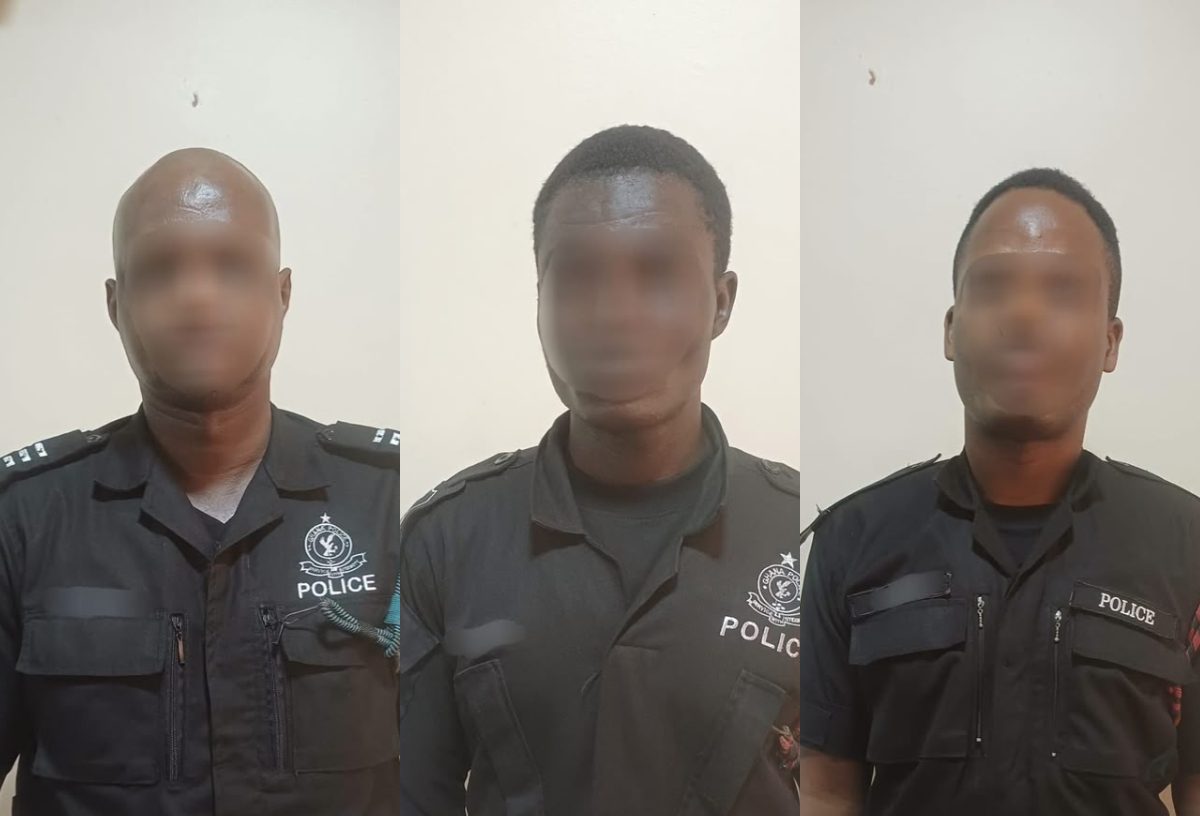
On 16 September, the Ghana Police Service announced the interdiction of seven personnel implicated in the incident: Inspector Courage Boateng, General Sergeant Stephen Addo, General Corporal Moses Anyravi, General Corporal Prosper Adiabo, General Lance Corporal Samuel Anolcye, General Constable Henrietta Coleman, and General Constable Bernard Amoako. Their suspension from active duty, the Service stated, creates the procedural space for the Police Professional Standards Bureau (PPSB) to conduct a thorough investigation into the allegations.
That procedural detail matters more than it might initially appear. The PPSB is Ghana’s primary internal accountability mechanism for police conduct, and its activation in this case signals that the institution is, at minimum, willing to subject itself to formal scrutiny. Whether that scrutiny produces meaningful consequences is a separate question, and one that Ghanaian civil society has pressed for years without consistent satisfaction.
Police extortion is not a phenomenon unique to Ghana. Across ECOWAS member states, security forces operating with limited oversight and inadequate pay structures have created conditions in which predatory interactions with civilians become normalized. In Nigeria, the now-disbanded Special Anti-Robbery Squad became the symbol of precisely this dynamic, triggering the 2020 #EndSARS protests that reverberated across the continent. Senegal and Côte d’Ivoire have faced their own recurring episodes of documented abuse by security personnel, with accountability outcomes that reform advocates consistently describe as insufficient. Ghana’s institutional response in this case, swift public disclosure and formal interdiction, compares favorably on process, even as the underlying structural conditions that enable such conduct remain largely unaddressed.
What distinguishes Ghana’s situation is the existence of a named, functioning oversight body with a defined mandate. The PPSB was established specifically to investigate complaints against police personnel and enforce professional standards. Its credibility, however, depends on the consistency and transparency of its findings, not merely on its formal existence. Public trust in police institutions across West Africa has eroded significantly in recent years, and restoring it requires demonstrated outcomes rather than procedural announcements.
The economic dimension of this case also warrants examination. Ghana is navigating a demanding IMF-supported fiscal adjustment program, and the government has staked considerable political capital on projecting institutional stability to international investors and development partners. Incidents of documented state predation, even at the level of individual officers, contribute to a broader perception of governance fragility that carries real costs. The World Bank’s governance indicators consistently identify rule of law and control of corruption as binding constraints on private investment in sub-Saharan Africa. An ATM extortion by uniformed officers is not a macroeconomic event in isolation, but it feeds a cumulative narrative that investors and regional partners absorb.
Within the ECOWAS framework, member states have committed to security sector governance standards that include civilian oversight, professional conduct codes, and accountability mechanisms. Ghana has generally been positioned as a relative institutional anchor in a region experiencing democratic turbulence, with military takeovers in Mali, Burkina Faso, and Guinea reshaping the regional governance landscape since 2020. Maintaining that positioning requires the country’s civilian institutions, including its police service, to demonstrate functional accountability rather than simply assert it.
The Ghana Police Service’s statement committed to full investigation and “appropriate action based on the outcome.” That formulation is deliberately non-specific, and appropriately so at this stage of proceedings. What the PPSB investigation must establish, beyond the immediate facts of the alleged extortion, is whether the conduct represents isolated misconduct or reflects systemic conditions within the patrol unit involved. The distinction matters for the institutional response: individual discipline addresses individual wrongdoing, while systemic failure requires structural intervention in training, supervision, compensation, and command accountability.
Police reform advocates in Accra have long argued that Ghana’s security sector suffers from a structural pay deficit that creates incentive conditions for petty extortion, particularly among lower-ranked personnel. General Constables and Lance Corporals, the ranks represented among the seven interdicted officers, sit at the base of a pay scale that has not kept pace with Accra’s rising cost of living, particularly as the cedi depreciated sharply during the 2022 to 2023 fiscal crisis. Addressing misconduct through discipline alone, without revisiting the structural conditions that generate it, tends to produce episodic accountability rather than durable reform.
For Ghana’s broader governance trajectory, the handling of this case carries weight beyond its immediate facts. The speed of the interdiction and the public naming of the officers involved represent a higher standard of transparency than many comparable incidents across the region have produced. If the PPSB investigation concludes with published findings and proportionate consequences, it will strengthen the institutional argument that Ghana’s accountability mechanisms function under pressure. If the case quietly disappears into procedural ambiguity, it will confirm the skepticism that many Ghanaians already hold about internal police oversight. The officers named on 16 September are suspended. The institution that suspended them is now under a different kind of scrutiny, one measured not in weeks but in the credibility of what comes next.