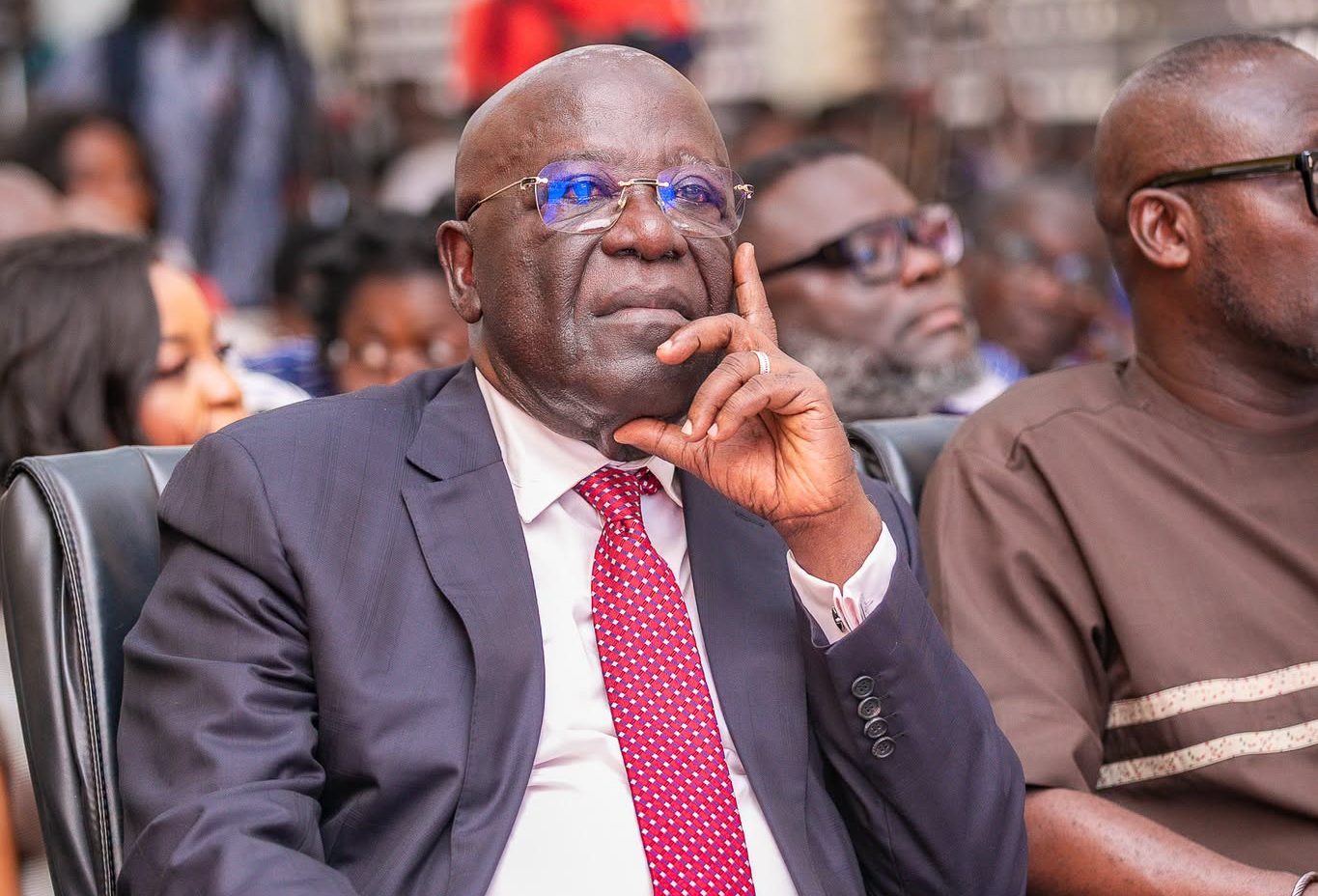
At the 15th Kwame Nkrumah Memorial Lectures held at the University of Cape Coast on 17 September 2026, Sir Sam Jonah, the institution’s Chancellor, posed a question that cuts to the heart of Ghana’s post-independence governance record: why has a country so richly endowed with the symbolic capital of its founding era produced so little of the institutional and infrastructural substance that era promised? His answer was pointed — Ghana has substituted political argument for the harder, less glamorous work of building.
The lecture’s theme, “Kwame Nkrumah, Yesterday, Today and Tomorrow: Perspectives on Constitutionalism, Development and Pan-Africanism,” offered a fitting frame for Sir Jonah’s critique, which was less an exercise in historical revisionism than a governance indictment. Nkrumah, he argued, should be understood not primarily as a political symbol to be claimed or contested across partisan lines, but as a builder — someone who converted sovereignty into concrete national assets. “Nkrumah built. Akosombo. Tema. The motorway. The Ghana Education Trust schools. The universities, including this one,” Sir Jonah said, cataloguing an infrastructure legacy that remains, seven decades later, foundational to Ghana’s economy. The Akosombo Dam still supplies a substantial share of Ghana’s electricity. The Tema industrial corridor remains the country’s primary manufacturing and port hub. These were not accidents of history; they were deliberate acts of developmental statecraft.
The governance question Sir Jonah raises is therefore not sentimental. It is structural: what institutional mechanisms allow a state to translate political independence into sustained physical and human capital formation, and where have those mechanisms broken down in Ghana’s case? “We have spent sixty years arguing about Nkrumah and rather less time doing what he actually did, which was to build things,” he said. That observation points toward a recurring failure in post-independence African governance — the tendency to concentrate political energy on the legitimacy of founding narratives rather than on the delivery systems, regulatory frameworks, and public investment strategies that determine whether a state actually functions for its citizens.
What does Nkrumah’s development model actually tell us about Ghana’s current governance gaps?
The infrastructural catalogue Sir Jonah invoked is instructive precisely because it reveals a development philosophy grounded in state capacity — the deliberate construction of institutions capable of executing complex, long-horizon projects. Nkrumah’s Ghana built a dam, a planned industrial city, a national road network, and a university system within a single decade of independence. Whatever the political controversies of his administration, that record reflects a government with functioning procurement systems, engineering capacity, and a coherent theory of how public investment creates the conditions for private economic activity. The contrast with subsequent decades is difficult to ignore: Ghana’s infrastructure deficit, its chronic energy supply instability, and its dependence on imported manufactured goods all reflect the erosion of exactly the state capacity that Nkrumah’s era assembled.
Sir Jonah’s framing — “independence without industry is a flag without a factory” — maps directly onto contemporary debates within ECOWAS about the conditions necessary for regional economic integration to generate real productive transformation rather than simply expanded trade in primary commodities. Ghana’s position within West Africa’s integration architecture depends substantially on whether it can develop the industrial base and logistics infrastructure to compete with Côte d’Ivoire as a regional manufacturing and services hub, and to complement Nigeria’s market scale with value-added production. That competitive positioning requires precisely the kind of deliberate, institution-backed investment that Sir Jonah identifies as Nkrumah’s distinguishing contribution — and that Ghana’s post-independence political economy has struggled to sustain across successive administrations and governance cycles.
The AfCFTA framework, headquartered in Accra, gives Ghana a particular institutional stake in demonstrating that African states can build the domestic productive capacity necessary to make continental free trade meaningful. A trade agreement without factories, logistics networks, and skilled labour pipelines produces trade diversion rather than trade creation. Sir Jonah’s critique of Ghana’s nation-building deficit is therefore not merely a domestic governance concern; it speaks directly to whether Ghana can credibly anchor the continental integration project it formally hosts.
What role should universities and knowledge institutions play in closing that gap?
Sir Jonah’s second argument concerned the institutional responsibilities of universities themselves, and it deserves to be read as a governance claim rather than an academic platitude. “A university is the one place in any country where silence is not an option — where knowing is supposed to become saying, and saying is supposed to become doing,” he told the UCC audience. This is a direct challenge to the tendency of African higher education institutions to operate as credentialing bodies rather than as engines of applied research, policy analysis, and institutional innovation. The distinction matters enormously for development outcomes.
Across West Africa, the governance institutions that function most effectively — whether central banks, revenue authorities, or regulatory agencies — tend to be those with the strongest links to research communities capable of generating the evidence base for policy design and reform. The Bank of Ghana’s monetary policy credibility, for instance, depends in part on the quality of macroeconomic research informing its decisions. WAEMU’s fiscal convergence framework depends on national statistical agencies producing reliable data. These are not abstract points: they describe concrete institutional linkages between knowledge production and governance capacity that determine whether states can manage their economies effectively. Sir Jonah’s argument is that Ghanaian universities have an obligation to inhabit that role actively, generating analysis that informs the kind of long-term, project-oriented development planning that he identifies as Nkrumah’s lasting contribution.
The practical implications for Ghana’s governance architecture are significant. A university system oriented toward applied policy research and institutional problem-solving would produce graduates equipped to staff the planning agencies, regulatory bodies, and public investment institutions that sustained infrastructure delivery requires. It would generate the independent analysis that holds government accountable for delivery failures. And it would contribute to the regional knowledge networks — within ECOWAS, the African Development Bank’s research ecosystem, and the AU Commission’s policy apparatus — that give West African states the analytical capacity to negotiate effectively with international partners and design domestically appropriate development strategies.
Sir Jonah’s remarks at the Nkrumah Memorial Lectures ultimately make a case for institutional seriousness — for treating the machinery of governance, public investment, and knowledge production as the real substance of national independence, rather than as secondary concerns to be addressed once the political arguments are settled. Ghana’s development trajectory over the next decade will be shaped less by how it resolves its debates about Nkrumah’s legacy than by whether its planning institutions, its universities, its regulatory agencies, and its investment frameworks can deliver the kind of tangible, compound-interest nation-building that the founding era briefly demonstrated was possible. The flag, as Sir Jonah implied, was never the point. The factory was.