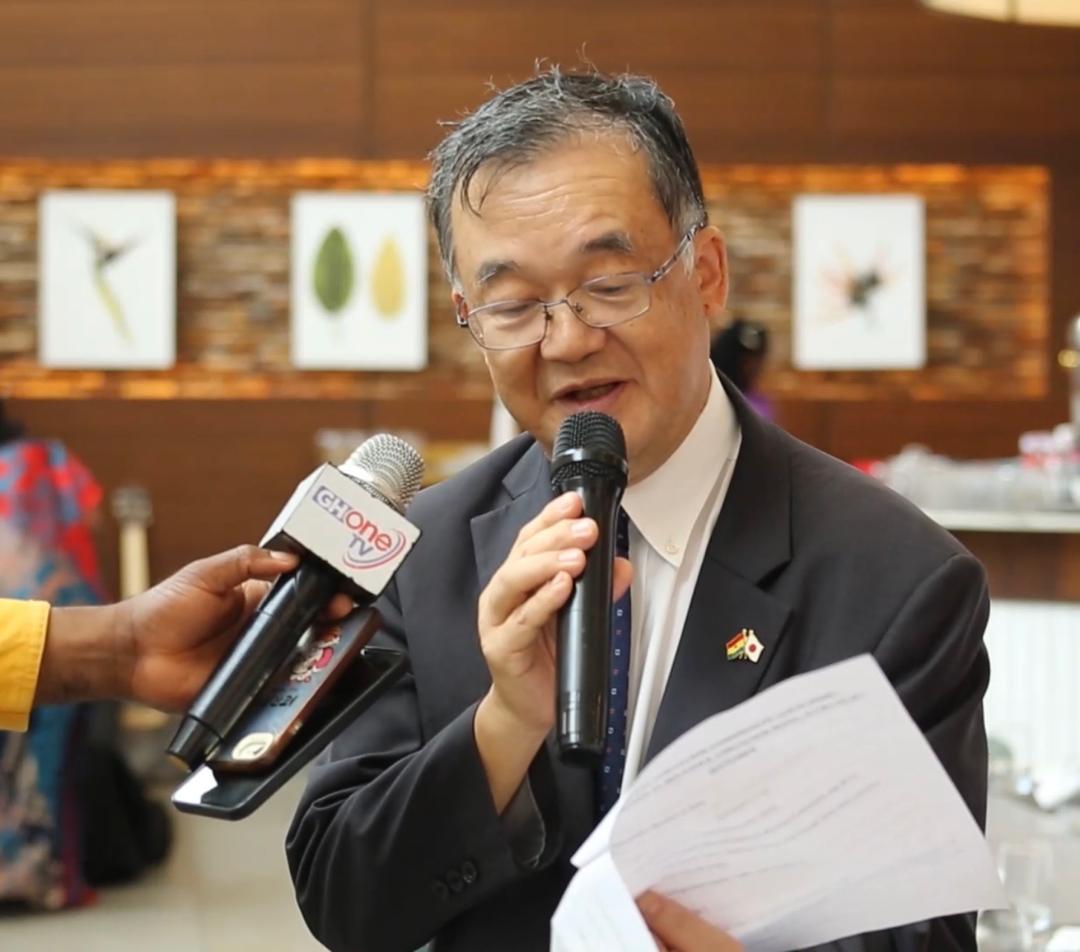
Eleven Japanese companies gathered in Accra recently to showcase their products, technologies, and business operations in Ghana, an event that Japanese Ambassador Hiroshi Yoshimoto used to reframe the bilateral relationship in explicitly developmental terms. The central question the exhibition raised was not whether Japan and Ghana trade, but whether the structure of that engagement builds lasting institutional and productive capacity within Ghana’s economy, or whether it replicates the asymmetric patterns that have historically defined Africa’s external economic partnerships.
Ambassador Yoshimoto was direct. “Japanese companies are not just doing trade; they are actively investing in the country’s economy, transferring key technology, creating good jobs, and building local capacity,” he said at the event. That framing matters. It positions Japan’s commercial presence not as extractive or transactional, but as structurally embedded in Ghana’s development trajectory. Whether the data bears that out requires scrutiny.
Ghana sits at a pivotal moment in its economic governance. Having exited its International Monetary Fund programme obligations in stages and working to stabilise the Cedi following the 2022 debt restructuring, Accra is actively courting diversified foreign investment as a hedge against the commodity-price volatility that repeatedly destabilises its fiscal position. Japanese capital, which tends to arrive with longer time horizons and stronger technology-transfer commitments than purely financial flows, represents a qualitatively different kind of partnership than portfolio investment or short-term trade finance.
Japan’s engagement with West Africa has never matched the scale of Chinese investment, which the Johns Hopkins China-Africa Research Initiative estimated at over US$60 billion across the continent between 2000 and 2020, nor the institutional depth of European Union trade arrangements under the Economic Partnership Agreements. Yet Japan has cultivated a distinct niche: infrastructure quality, environmental standards, and corporate governance practices that align more closely with OECD norms. For Ghana, which is simultaneously navigating AfCFTA commitments, ECOWAS trade liberalisation obligations, and domestic industrial policy ambitions, that alignment carries real institutional value.
The AfCFTA Secretariat, headquartered in Accra, has made technology transfer and industrial upgrading central to its implementation agenda. Japanese firms operating in Ghana, if genuinely transferring skills and technology, could serve as proof-of-concept nodes for the kind of value-added manufacturing the AfCFTA framework is designed to incentivise. The 11 companies at the exhibition represented sectors including agriculture, infrastructure, and consumer goods, precisely the areas where Ghana’s National Industrial Policy seeks to deepen domestic value chains.
Context matters here. Ghana’s manufacturing sector contributes roughly 10 percent of GDP, a figure that has remained stubbornly flat for over a decade despite successive governments’ industrialisation rhetoric. Peer economies tell a sharper story: Côte d’Ivoire has expanded its agro-processing sector significantly by attracting targeted foreign investment with clear local-content requirements, while Senegal’s emerging oil and gas governance framework explicitly mandates technology transfer and local employment thresholds. Ghana’s investment incentive architecture, administered through the Ghana Investment Promotion Centre, has historically been less prescriptive on these dimensions, offering generous tax holidays without equivalent performance conditionalities.
That regulatory gap is where the policy stakes become concrete. Japan’s own development cooperation philosophy, articulated through the Japan International Cooperation Agency and the Tokyo International Conference on African Development framework, emphasises “quality infrastructure” and human capital development. But diplomatic rhetoric and corporate behaviour do not always converge. Without binding local-content agreements, skills-transfer benchmarks, or sectoral employment targets attached to Japanese investment licences, the developmental gains Ambassador Yoshimoto described remain aspirational rather than contractual.
The exhibition itself was modest in scale. Eleven companies, cultural displays of origami, ikebana flower arrangement, and matcha tea do not constitute a foreign direct investment inflection point. But diplomatic signalling functions differently from capital flows. The event served as a public reaffirmation of the bilateral relationship at a moment when Ghana is actively repositioning its external economic diplomacy following the debt crisis. Japan’s willingness to stage a visible commercial showcase in Accra signals institutional confidence in Ghana’s medium-term stability, a signal that carries weight for other investors calibrating country risk.
Within the ECOWAS framework, Ghana’s ability to attract quality investment has regional implications. The 15-member bloc’s Common Investment Policy, adopted in 2018, seeks to harmonise investment standards and create a more predictable regional business environment. Japanese firms that establish operational precedents in Ghana, particularly around corporate governance, environmental compliance, and labour standards, contribute to raising the floor of investor expectations across the sub-region. Nigeria, the bloc’s dominant economy, attracts the largest volumes of FDI but often on terms that prioritise speed over structural conditionality. Ghana has an opportunity to differentiate itself as a higher-standard destination.
The Bank of Ghana and the Ministry of Finance will be watching the composition of incoming investment closely. Ghana’s post-restructuring economic framework prioritises foreign exchange generation, employment, and technology acquisition over raw capital inflows. Japanese investment, if concentrated in export-oriented manufacturing or high-skill services, aligns better with those priorities than speculative financial flows. The central bank’s reserve management strategy and the Ministry’s medium-term expenditure framework both depend on a stable, diversified investment base to reduce the sovereign’s vulnerability to external shocks.
What Accra should now pursue is a structured bilateral investment treaty with Tokyo that goes beyond the existing general framework, one that specifies sectoral priorities, technology-transfer obligations, local procurement thresholds, and dispute resolution mechanisms aligned with ECOWAS arbitration standards. Such an agreement would transform the goodwill on display at the Accra exhibition into a legally enforceable architecture that serves Ghana’s industrial policy objectives while giving Japanese firms the regulatory certainty they need to commit capital at scale. The diplomatic groundwork exists. The institutional follow-through is what remains to be built.