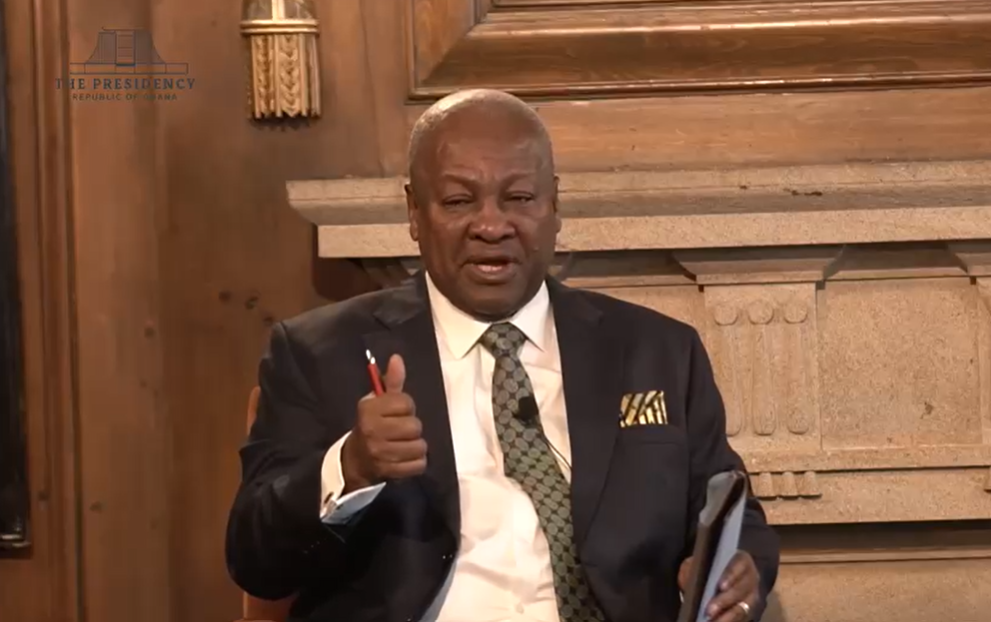
When President John Dramani Mahama announced at the Council on Foreign Relations in New York, on the sidelines of the United Nations General Assembly, that Ghana intends to list 10 state-owned enterprises on the Ghana Stock Exchange, the headline figure was straightforward enough. But the policy logic underneath it raises a more fundamental question about the relationship between capital market exposure and institutional reform in a West African economy still navigating the structural legacies of politically managed public enterprise.
The core argument Mahama advanced is that public listing creates a governance constraint that political will alone cannot sustain. “If we list more of these companies, it makes it difficult for government to interfere and sack the management and dissolve the boards and all that,” he told his New York audience. The mechanism he is pointing to is real: listed companies must meet disclosure requirements, answer to minority shareholders, and operate under securities law frameworks that sit outside the direct reach of the executive. In theory, this insulates management from the cycle of board dissolutions and politically motivated appointments that have historically hobbled Ghana’s SOE sector.
What has actually gone wrong with Ghana’s state-owned enterprises?
The governance failures of Ghana’s SOEs are well-documented and structurally embedded. For decades, these entities operated as extensions of the patronage architecture of successive governments, with boards appointed and dissolved according to electoral cycles rather than performance metrics, and with compensation structures that rewarded affiliation over results. Mahama himself acknowledged this dynamic bluntly: “Even when they’re making losses, they’re asking for salary increments and asking for bonuses when you’ve made a loss.” That observation captures a deeper institutional pathology, one in which accountability to the state as owner was effectively severed from accountability to any performance benchmark.
The State Interests and Governance Authority, established under the State Interests and Governance Authority Act of 2019, was designed to address precisely this gap by centralising oversight of state-owned enterprises and introducing performance agreements and reporting standards. The results, at least by headline metrics, have been significant. SIGA’s 2025 State Ownership Report records a net profit after tax across the SOE sector of GHS 19.8 billion, a reversal from the collective losses that characterised earlier reporting periods. Mahama cited a figure of approximately GHS 19 billion in his New York remarks. Whether this improvement reflects genuine operational reform or is partially inflated by currency depreciation effects on asset valuations and revenue reporting in cedis remains a question that independent analysts have not yet fully resolved, but the directional shift is notable.
The government’s decision to proceed with the listing plan despite improved financial performance is itself instructive. It signals that Accra views capital market integration not merely as a crisis response mechanism but as a structural governance tool, one that embeds external accountability into the operating architecture of public enterprises on a permanent basis rather than contingent on political will. That framing aligns with a broader liberal-institutional logic: markets as disciplining mechanisms where regulatory capacity is constrained or politically compromised.
Does listing on the Ghana Stock Exchange actually deliver the governance outcomes Mahama promises?
The empirical record on partial privatisation and SOE governance reform across comparable markets is mixed, and Ghana’s specific context introduces complications that the president’s remarks did not fully address. The Ghana Stock Exchange remains a relatively shallow market by regional standards, with total market capitalisation and daily trading volumes that limit the price discovery and liquidity functions that give listed status genuine disciplinary force. If the SOEs are listed but thinly traded, the accountability mechanisms Mahama is invoking, shareholder pressure, disclosure obligations, board independence requirements, may exist formally without generating the behavioural change he anticipates.
Comparisons within West Africa are instructive here. Ivory Coast’s Bourse Régionale des Valeurs Mobilières, which serves the eight-member WAEMU monetary union, operates with greater depth and cross-border investor participation than the Ghana Stock Exchange, partly because it benefits from the institutional architecture of the West African Economic and Monetary Union and the CFA franc zone’s relative monetary stability. Senegal and Côte d’Ivoire have both used partial public listings to attract institutional investors into formerly state-dominated sectors, with varying degrees of governance improvement depending on the strength of the underlying regulatory framework and judicial enforcement capacity. Nigeria’s experience with listed state-linked enterprises, including the Dangote-adjacent infrastructure plays and the partial privatisation of power distribution companies, illustrates how listing without robust regulatory oversight can replicate rather than resolve governance deficits.
The question for Ghana, then, is whether the Securities and Exchange Commission and the Ghana Stock Exchange have the regulatory capacity and institutional independence to enforce the disclosure and governance standards that would give the listings real teeth. The Ghana Stock Exchange has previously engaged SIGA on potential SOE listings and capital-raising modalities, suggesting that the technical groundwork is being laid, but the regulatory framework governing board appointment, related-party transactions, and minority shareholder protections will determine whether the reform delivers substance or symbolism.
There is also a regional integration dimension that deserves more attention than it has received in the domestic political conversation. Ghana is a member of ECOWAS, and the Economic Community of West African States has long-standing ambitions toward a common investment space and eventual monetary union that would require harmonised standards for public enterprise governance and capital market regulation. If Ghana’s SOE listing programme develops its own bespoke governance architecture, the question of alignment with ECOWAS-wide frameworks and the eventual ECOWAS common investment market becomes relevant for both investors and regional policymakers. The AfCFTA’s investment protocol, still in the process of ratification and operationalisation across African Union member states, adds another layer: Ghana’s ability to attract pan-African institutional capital into its listed SOEs will depend partly on whether its governance standards are legible and credible to investors operating across multiple African jurisdictions.
Mahama’s point that listing would allow Ghanaians in the diaspora to invest in state enterprises through the Ghana Stock Exchange has genuine policy merit, connecting the reform to the broader agenda of mobilising diaspora capital for domestic development. Ghana’s diaspora remittances consistently rank among the highest in sub-Saharan Africa relative to GDP, and creating regulated, transparent investment vehicles in productive state assets represents a more structurally sound mechanism for channelling that capital than bond issuances or informal flows. The governance credibility of the listed entities will, however, determine whether diaspora investors treat these instruments as genuine investment opportunities or as instruments to be avoided given historical concerns about political interference in SOE management.
What the listing plan ultimately tests is whether institutional design can substitute for political culture change, or whether it requires both simultaneously. Listing 10 SOEs on the Ghana Stock Exchange creates the architecture for external accountability, but the architecture functions only if the Securities and Exchange Commission enforces disclosure requirements without political interference, if the courts enforce shareholder rights without delay, and if successive governments accept that listed status genuinely constrains their ability to manage these entities as political assets. Those conditions are governance outcomes in themselves, not preconditions that can be assumed. The Bank of Ghana, the SEC, and the Ghana Stock Exchange will need to demonstrate, through consistent enforcement action, that the regulatory perimeter around these listed entities is real. That demonstration, more than the listing announcement itself, will determine whether this reform changes how Ghana’s public enterprises are actually governed.