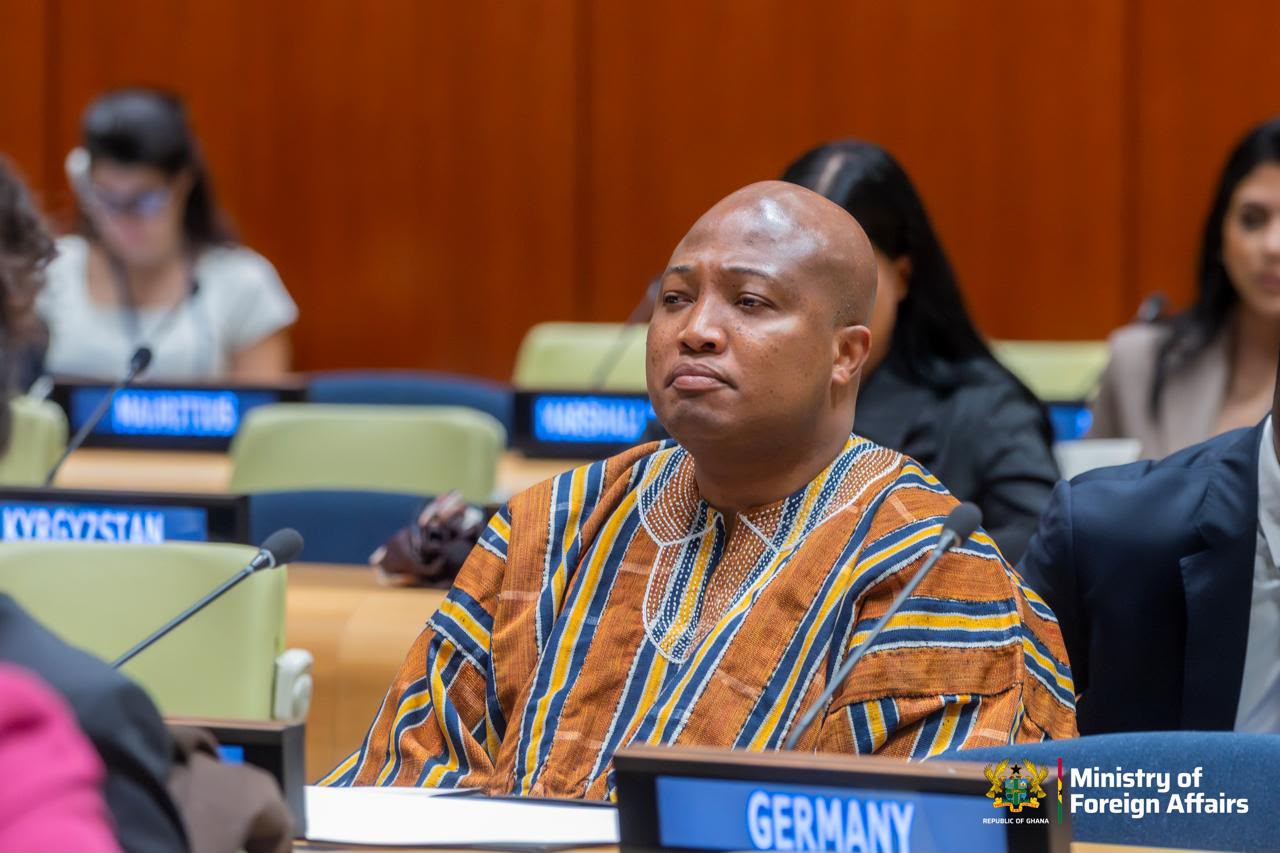
Ghana’s Foreign Affairs Minister Samuel Okudzeto Ablakwa took a pointed stand at the United Nations General Assembly last week, declaring Accra’s firm opposition to any move to dismantle the International Criminal Court and calling for a structural overhaul of global governance institutions that have long marginalized African states. The speech, delivered on the occasion of the 25th anniversary of the Durban Declaration and Programme of Action, was more than ceremonial. It articulated a coherent, if ambitious, governance thesis: that accountability mechanisms, permanent multilateral representation, and reparatory justice are not separate demands but interlocking components of a reformed international order.
The thesis deserves scrutiny, not because it is wrong, but because the distance between its ambition and current institutional reality is vast, and the path between them runs through some of the most contested terrain in international law and geopolitics.
The ICC as an African Governance Instrument
Ablakwa’s defense of the ICC carries a particular institutional weight. The court has long been a source of tension across the continent. The African Union repeatedly accused it of disproportionately targeting African leaders, and several member states, including South Africa, Burundi, and Gambia, initiated or completed withdrawal proceedings in the mid-2010s. That a senior West African minister is now publicly calling for the court’s protection, rather than its reform or abandonment, marks a notable shift in the diplomatic register coming out of Accra.
“The ICC needs our protection, not our condemnation,” Ablakwa told the General Assembly, framing the court not as an instrument of Western judicial imperialism but as a necessary mechanism for accountability where national jurisdictions fail. This reframing is analytically significant. The ICC’s founding Rome Statute, which Ghana ratified in 1999, operates on the principle of complementarity: it intervenes only when domestic courts are unwilling or unable to prosecute. In West Africa, where institutional capacity in the justice sector remains uneven across ECOWAS member states, that complementarity principle is not an abstraction. It is a live governance question.
The ECOWAS Court of Justice itself has expanded its human rights mandate over the past two decades, yet its enforcement mechanisms remain limited and its relationship with national judiciaries in member states is frequently contested. Ghana’s defense of the ICC can therefore be read as an implicit argument about the entire architecture of accountability: that regional and international courts must be reinforced rather than hollowed out, precisely because domestic institutions cannot always be relied upon to deliver justice against powerful actors.
The Security Council Seat and the Structural Deficit
Ablakwa’s question about Africa’s absence from a permanent seat on the UN Security Council is not new, but its placement within a speech about the Durban Declaration gave it additional analytical texture. Africa, with 1.4 billion people and 54 UN member states, holds no permanent seat on the body that authorizes the use of force and shapes the international legal order. The African Union’s Ezulwini Consensus, adopted in 2005, called for two permanent seats with veto rights for Africa, yet the proposal has made no substantive progress in the two decades since.
The governance implications are direct. Decisions on peacekeeping mandates in Mali, the Sahel, and Sudan have been taken by a body in which African states hold only rotating, non-permanent positions with no veto power. The AU’s Peace and Security Council operates in parallel, but its resolutions carry no binding authority under international law. This structural deficit means that the very conflicts Ablakwa cited, in Palestine and Sudan, are being managed through institutions that systematically exclude the voices of the states most affected by their consequences. For West Africa specifically, where ECOWAS has deployed peacekeeping missions and mediation frameworks under its own authority, the gap between regional institutional capacity and global institutional access remains a persistent constraint on effective governance.
Reparatory Justice and the Durban Framework
The most politically charged dimension of Ablakwa’s speech concerned reparatory justice. He cited the adoption this year of a Ghana-led UN resolution designating the trafficking of enslaved Africans as the gravest crime against humanity, and outlined four demands: a sincere apology, the restitution of looted cultural and material wealth, repair for continuing structural harm, and a binding commitment against future atrocities.
The resolution is a meaningful diplomatic achievement. Winning consensus language at the UN General Assembly on a subject this politically sensitive required sustained coalition-building, and Ghana’s leadership of that effort reflects a degree of multilateral influence that belies the country’s size. But the resolution is non-binding. Its practical effect depends entirely on whether it generates sustained political pressure on former colonial powers and whether it is institutionalized within frameworks such as AfCFTA negotiations or bilateral trade and investment treaties.
Here the governance challenge becomes concrete. Reparatory justice, if it is to move beyond declaratory politics, requires institutional mechanisms: arbitration bodies, restitution protocols, and development finance instruments that can operationalize the principle of repair. The AU’s reparations agenda has identified these needs but has not yet produced the institutional architecture to pursue them. Ghana’s diplomatic offensive at the UN creates political capital that the AU and ECOWAS could channel into specific institutional proposals, but that translation from declaration to mechanism has historically been where African multilateral ambitions stall.
The Durban Declaration itself illustrates the problem. Adopted in 2001 and reaffirmed in subsequent review conferences, it has generated substantial normative language on racism, racial discrimination, and xenophobia, yet 25 years later Ablakwa was compelled to acknowledge that anti-Black racism and xenophobic violence remain acute. The declaration’s failure to produce measurable outcomes is not simply a product of bad faith among signatories. It reflects a deeper institutional weakness: the absence of monitoring mechanisms with real enforcement authority and the tendency of multilateral commitments to dissipate without domestic implementation frameworks.
What Accra’s Position Means for Regional Integration
Ghana’s stance at the UN has implications that extend well beyond the immediate diplomatic moment. For West African integration, Accra’s alignment with a rules-based international order, its defense of multilateral accountability institutions, and its demand for structural reform of global governance collectively reinforce a governance posture that is broadly consistent with the institutional logic of ECOWAS and the AU. States that undermine international legal norms create friction within regional frameworks that depend on shared governance standards.
For investors and development partners, Ghana’s position signals institutional predictability. A state that publicly defends international courts and demands accountability for crimes against humanity is signaling, at minimum, a commitment to the normative architecture that underpins contract enforcement, dispute resolution, and the rule of law. That signal matters in a regional investment environment where governance risk remains a primary concern for foreign capital allocation.
The real test, however, is whether Ghana can translate its multilateral advocacy into concrete institutional proposals. Calling for the ICC’s protection is politically meaningful. Designing the reforms that would make the court more effective, more representative, and less vulnerable to accusations of selective prosecution is the harder institutional work. Similarly, leading a UN resolution on the trafficking of enslaved Africans is a significant diplomatic achievement, but building the AU-level mechanisms that could give reparatory justice operational meaning would represent a qualitatively different order of governance ambition. Accra has identified the right institutional questions. The answers require architecture, not only advocacy.