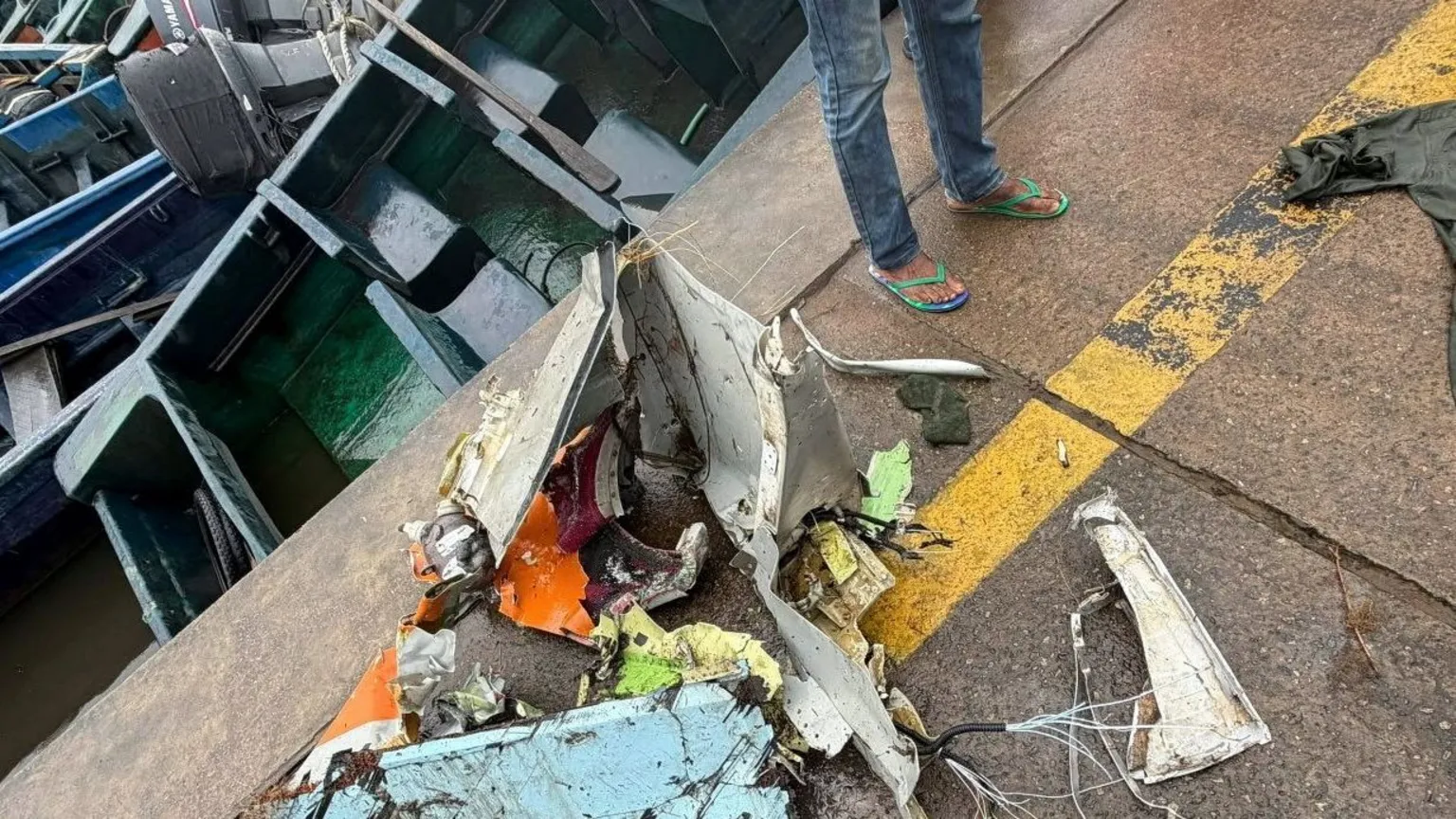
The Cessna of swamp grass and still water near Igbokoda told the story before any official statement could. On a Monday morning in Ondo State, southern Nigeria, a Nigerian Air Force ATR-42 turboprop disappeared from radio contact at 09:13 hours, en route from Benin City to Lagos on what commanders described as a routine mission. By the time search teams reached the site, the aircraft — tail number NGR 931 — lay submerged beneath the surface of a swamp adjacent to a naval base, carrying 25 people to their deaths: five crew members and 20 passengers, 19 of them military personnel.
It is the deadliest crash involving a Nigerian military aircraft since 1992, a grim statistical marker that frames the tragedy not merely as a moment of national grief, but as a pointed question about the state of defence aviation governance in West Africa’s most populous nation and its most consequential military power.
President Bola Tinubu declared three days of national mourning and ordered flags flown at half-mast across the country. “This is a painful moment for our Armed Forces and for the entire nation,” he said in a formal statement. “Our Air Force personnel put their lives on the line every day to secure Nigeria. Their sacrifice will never be forgotten.” The president also ordered a full and immediate investigation into the cause of the crash, tasking the Air Force with producing findings that could prevent recurrence.
The initial public communication surrounding the disaster itself raised institutional questions. Aviation Minister Festus Keyamo announced on Monday that 32 people had died; the Nigerian Air Force corrected that figure on Tuesday, confirming 25 fatalities. The discrepancy, though eventually resolved, pointed to the kind of information management gaps that undermine public trust in crisis moments — a governance concern that extends well beyond any single incident.
Keyamo had described being informed “of the disappearance of a military aircraft with tail number NGR 931, enroute Lagos from Benin at 0913 hours earlier today,” and confirmed that “efforts to raise the aircraft on radio proved abortive” before the crash site near Igbokoda was located. Search and rescue operations were deployed to a terrain that compounded the logistical difficulty: a swamp environment that delayed both recovery and the early establishment of facts.
The ATR-42, a twin turboprop regional aircraft manufactured by the Franco-Italian consortium ATR, is designed to carry between 30 and 50 passengers. Its use in military transport roles across West Africa reflects both the versatility of the platform and the broader reliance of regional air forces on aging or repurposed civilian aircraft. Nigeria’s military aviation fleet has long operated under budgetary and maintenance pressures that analysts have flagged in defence policy reviews, even as the Air Force has expanded its operational mandate to include counterinsurgency missions in the northeast, anti-banditry operations in the northwest, and maritime security in the Niger Delta.
That operational breadth matters here. The Nigerian Air Force is not a ceremonial institution. It is actively deployed across some of the most demanding and resource-intensive security environments on the continent, and its capacity to sustain those operations depends directly on the airworthiness of its fleet. When a routine inter-city transfer mission ends in a swamp, the question is not only what failed mechanically or procedurally on that particular flight, but what systemic conditions — procurement cycles, maintenance protocols, crew training standards, oversight mechanisms — produced the vulnerability.
Nigeria’s defence aviation record over the past several years provides a troubling backdrop. In February 2021, seven people died when a military aircraft crashed short of the runway in Abuja. Three months later, in May 2021, the Chief of Army Staff, Lieutenant General Ibrahim Attahiru, was killed alongside 10 senior officers when their aircraft went down in Kaduna State amid adverse weather conditions. Each of those crashes prompted official pledges of investigation and reform. The recurrence of a fatal military aviation incident — now the deadliest in over three decades — invites scrutiny of whether those investigations produced structural change or remained confined to reports.
Within the West African regional context, Nigeria’s military aviation governance carries weight that extends beyond its own borders. As the de facto security anchor of ECOWAS, Nigeria’s Air Force contributes to regional peacekeeping frameworks and has historically provided air support to multinational operations across the Sahel and the Gulf of Guinea littoral. A fleet whose airworthiness is in question does not merely threaten Nigerian service members; it potentially constrains the collective security architecture that smaller ECOWAS member states depend upon.
Comparisons with regional peers are instructive. Ghana’s Air Force, operating a smaller and more tightly managed fleet, has invested in structured maintenance partnerships and pilot training programmes that align with international civil aviation standards adapted for military use. Senegal, whose air force has maintained a close technical relationship with France, benefits from maintenance protocols embedded in bilateral defence agreements. These are not wealthier air forces than Nigeria’s — they are, in several respects, more constrained by resources — but their institutional frameworks for airworthiness management offer reference points worth examining.
The Nigerian Air Force’s release of the names of those killed represents a measure of institutional transparency that should be acknowledged. Naming the dead is not a bureaucratic formality; it is an act of accountability to families and to the public that funds and trusts the military. That transparency, however, must be matched by equal rigour in the investigation that follows. Independent technical expertise, access for Nigeria’s Accident Investigation Bureau, and a public findings report with binding recommendations would constitute a governance standard commensurate with the scale of the loss.
For investors and development partners watching Nigeria’s institutional trajectory, the crash lands at a sensitive moment. The Tinubu administration has staked significant political capital on projections of economic stabilisation and governance reform, seeking to attract both foreign direct investment and multilateral financing. Defence sector governance — long treated as a domain insulated from civilian oversight — increasingly features in risk assessments conducted by institutional investors and rating agencies evaluating sovereign exposure. A credible, transparent investigation would signal that accountability norms apply across government, not selectively.
Near the swamp in Igbokoda, recovery teams worked through conditions that the terrain made deliberately difficult. The aircraft was found submerged, its wreckage a technical and human puzzle to be extracted from water and silt. Twenty-five people did not return from what was logged as a routine flight. The investigation that follows must be as rigorous as the mission was ordinary — because it is precisely in the routine that systemic failure hides, and it is precisely in the investigation that institutions either prove their credibility or confirm their limits.