A civil society petition calling for a permanent military base in Ghana’s Central Region has brought into sharp focus a governance failure that extends well beyond a single district: the state’s inability to enforce its own land legislation against organised armed groups, even as the Accra-Cape Coast corridor attracts growing investment and development pressure.
The Center for Human Advancement and Empowerment (CHAE Ghana) submitted a formal petition to President John Dramani Mahama on 3 October 2026, requesting that the Ministry of Defence and the Ghana Armed Forces (GAF) conduct a feasibility assessment for a military installation in Gomoa East. The petition identifies five affected districts, namely Gomoa East, Gomoa West, Gomoa Central, Awutu Senya East and Awutu Senya West, as a contiguous security zone where land-guard violence has outpaced civilian law enforcement capacity.
The petition’s central argument is institutional: that police operations and administrative bans on digging fees have repeatedly failed to produce lasting security, and that a permanent, visible military presence is required to enforce the Land Act, 2020, which explicitly criminalises land-guard activities. This framing shifts the conversation from reactive crisis management to a structural question about which state institutions bear responsibility for property rights enforcement, and whether Ghana’s current security architecture is calibrated for the scale of the problem.
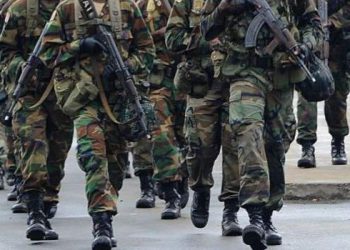
The gravity of that problem is illustrated by a specific incident CHAE Ghana places at the centre of its case. In April 2024, Lance Corporal Michael Danso was killed at Millennium City in Gomoa Fetteh in circumstances the Ghana Armed Forces attributed to a land dispute. A suspect was arrested and charged, but the killing of a uniformed soldier in a land-related confrontation signals a level of impunity that ordinary policing has not contained. CHAE Ghana also documents armed attacks on traditional authorities, shootings and disruptions to development projects across communities including Gomoa Fetteh, Fetteh Kakraba, Toansah, Awutu Papaase and Dampase.
What makes the Gomoa corridor particularly significant is its economic geography. Lying between Accra and Cape Coast, the five districts sit along one of Ghana’s most actively developing real estate and infrastructure corridors. Rising land values, speculative acquisition and competing customary claims have created conditions in which land guards, armed groups contracted or tolerated by various claimants, operate as de facto enforcement mechanisms in the absence of reliable state arbitration. A 2024 Supreme Court record referencing allegations of trespass and land-guard activity on disputed lands in Gomoa Fetteh Kakraba confirms that these disputes reach the highest levels of Ghana’s judiciary, yet violence on the ground persists.
CHAE Ghana’s proposal for joint military-police patrols as an interim measure, alongside the longer-term base, reflects a pragmatic sequencing. The petition explicitly links the proposed installation to enforcement of the Land Act, 2020, positioning the military not as a substitute for civilian governance but as a force multiplier for institutions that currently lack deterrent capacity. The organisation also notes the base could support disaster response and generate local economic activity, arguments designed to broaden the political coalition behind the proposal.
The governance question this petition raises is not unique to Ghana. Across West Africa, rapid urbanisation and rising land values have intensified disputes between customary tenure systems and statutory land administration, producing conditions in which armed non-state actors fill enforcement vacuums. In Nigeria’s Lagos hinterland and Côte d’Ivoire’s peri-urban zones, analogous dynamics have required sustained institutional responses combining judicial reform, land registry modernisation and security deployment. Ghana’s Land Act, 2020 represented a significant legislative step toward rationalising land administration, but legislation without enforcement infrastructure produces exactly the gap CHAE Ghana is describing.
Within the ECOWAS framework, land governance and property rights enforcement carry direct implications for the operationalisation of the African Continental Free Trade Area (AfCFTA). Investor confidence in cross-border real estate, agribusiness and infrastructure projects depends on predictable property rights adjudication. When armed groups can disrupt development projects in districts adjacent to Ghana’s main coastal highway, the signal to regional and international investors is that physical security for fixed assets cannot be guaranteed by civilian institutions alone. Ghana’s reputation as West Africa’s most stable investment destination, a distinction it has held through successive peaceful electoral transitions, is partly built on the credibility of its rule-of-law institutions. Persistent land-guard violence in a high-growth corridor erodes that credibility at a moment when Ghana is competing with Côte d’Ivoire and Senegal for FDI in logistics, real estate and agro-processing.
CHAE Ghana’s Executive Director Bright Botchway signed the petition and indicated the organisation’s readiness to work with traditional authorities, district assemblies and community leaders to identify suitable land for the proposed installation and support the feasibility assessment. That cooperative posture is significant: it acknowledges that any military installation would itself require navigating the customary land tenure arrangements that are at the root of the broader dispute. A military base established through contested land acquisition would compound rather than resolve the governance problem.
The petition’s submission through the Minister for Defence rather than directly to the Ghana Police Service or the Lands Commission reflects a deliberate escalation of institutional level. CHAE Ghana is signalling that the problem has exceeded the mandate of the agencies ordinarily responsible for land and security administration. Whether the Mahama administration responds with a feasibility study, a reinforced police deployment or a broader inter-agency land security task force, the petition establishes a clear accountability marker: the state has been formally notified of a specific, documented security failure in five named districts, and its response will be on record.
What a durable solution requires is not only a security presence but a functioning land dispute resolution system capable of adjudicating competing claims before they escalate to violence. Ghana’s Lands Commission and the Office of the Administrator of Stool Lands hold statutory mandates relevant to this function, but their operational capacity and geographic reach in peri-urban and rapidly developing districts remain limited. Strengthening those institutions, alongside whatever security deployment is authorised, would address the structural conditions that make land-guard recruitment rational for claimants who see no credible alternative enforcement mechanism. That combination, regulatory capacity paired with security deterrence, is the institutional architecture the Gomoa corridor needs.