A Landmark Agreement With a Long Road to Completion
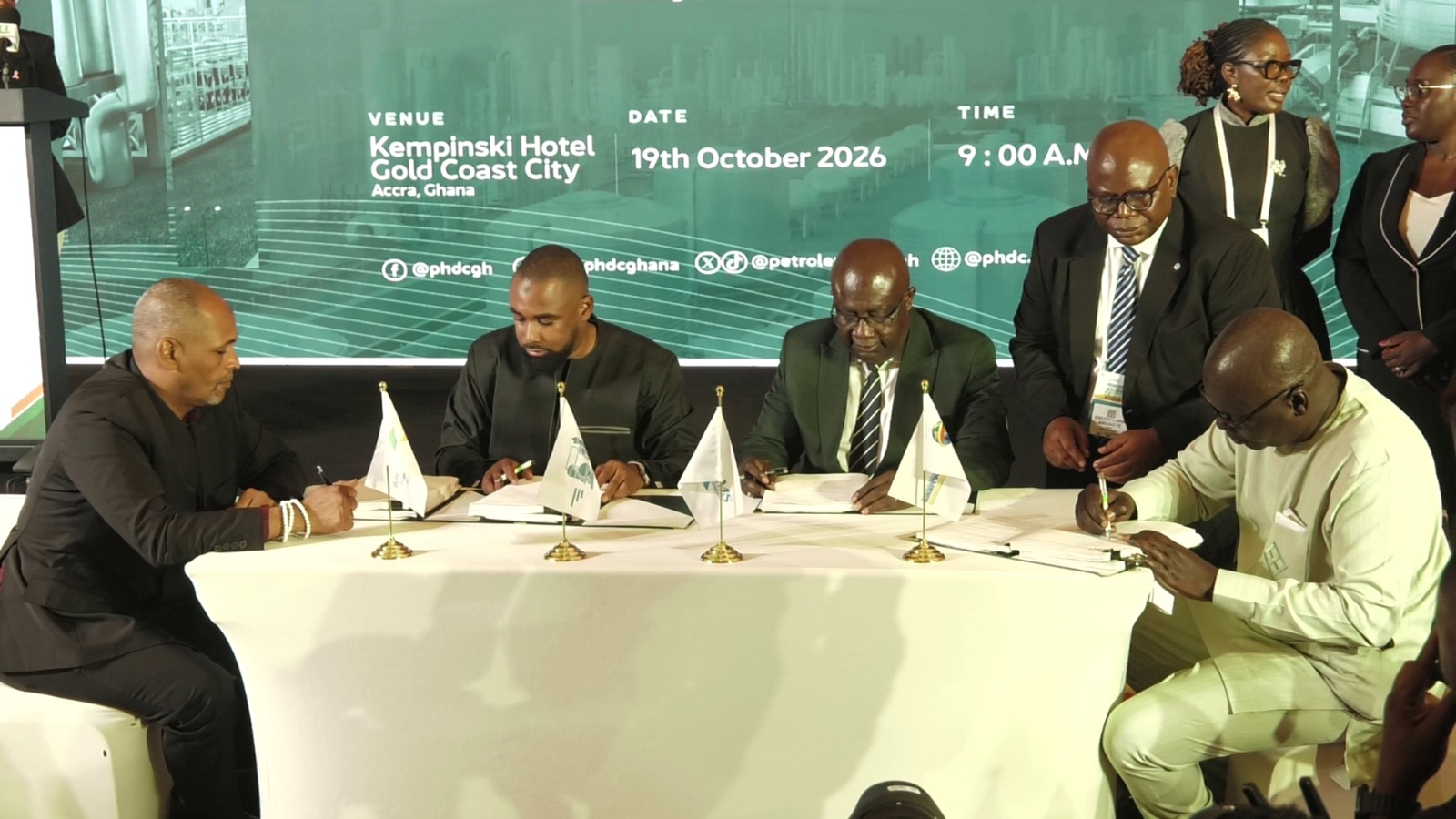
On paper, the numbers are striking. The Petroleum Hub Development Corporation (PHDC) has signed a $28 billion Build-Operate partnership agreement with a consortium led by Global Sphere for the development of Lot Two of Ghana’s Petroleum Hub, a sprawling industrial project sited at Jomoro in the Western Region. The consortium draws investors and technical partners from South Korea, the United Arab Emirates and Mali. If realized, the investment would rank among the largest single industrial commitments ever mobilized on Ghanaian soil.
The question that matters most to governance analysts, regional investors and ECOWAS policymakers is not whether the deal was signed. It is whether the institutional architecture surrounding it can convert a framework agreement into functioning infrastructure.
That distinction is not trivial. West Africa’s industrial history is littered with headline-generating investment announcements that stalled at the permitting stage, collapsed under financing gaps or dissolved when political transitions disrupted project continuity. Ghana itself has navigated its share of such disappointments. The PHDC agreement therefore demands scrutiny not as a celebration, but as a governance test.
What Lot Two Actually Proposes to Build
The scope of Lot Two is substantial by any regional benchmark. Under the signed terms, the development will include a refinery with a processing capacity of 300,000 barrels per stream day, two petrochemical plants, storage infrastructure rated at four million cubic metres and a multi-berth jetty to handle export and import flows. The PHDC has indicated that initial construction at Jomoro is scheduled to begin in the first quarter of 2027, contingent on the completion of preparatory requirements that include land clearance, environmental permitting and financing close.
A 300,000 barrels-per-day refinery would be transformative for West Africa’s downstream energy sector. Nigeria’s long-delayed Dangote Refinery, which reached partial operations in 2024 after years of setbacks, processes up to 650,000 barrels per day and has already begun reshaping regional fuel pricing dynamics. Ghana’s proposed facility, smaller but strategically positioned, could serve as a complementary node rather than a competing one, particularly if it emphasizes petrochemical output that Dangote does not prioritize.
The four million cubic metre storage capacity is equally significant. West Africa’s chronic fuel supply vulnerabilities, driven in part by inadequate storage infrastructure, have repeatedly translated into pump shortages and price spikes that disproportionately burden lower-income households and small enterprises. Structural storage capacity at scale addresses a real market failure in the sub-region.
Governance Architecture: Who Holds the PHDC Accountable?
The PHDC was established under Ghanaian law as the state vehicle mandated to develop the Petroleum Hub. Its legal framework, enabling legislation and oversight mechanisms deserve as much attention as the investment figures it announces. Build-Operate agreements of this magnitude require robust institutional safeguards: transparent procurement processes, independent auditing, parliamentary oversight and clear dispute resolution mechanisms aligned with international arbitration standards.
Ghana’s track record on large infrastructure governance is mixed. The country’s institutions, including the Public Accounts Committee of Parliament, the Public Procurement Authority and the Ghana Audit Service, have demonstrated capacity to scrutinize public contracts when political will and civil society pressure align. The PHDC deal will test whether those institutions can operate proactively rather than reactively.
PHDC CEO Dr Tony Aubynn has framed the agreement in terms of economic transformation, describing it as “a powerful vote of confidence in our country’s stability, leadership and long-term economic prospect.” That framing is politically useful but analytically incomplete. Investor confidence is a necessary condition for large-scale FDI, not a sufficient one. The sufficiency conditions include regulatory certainty, land tenure security, grid connectivity, port access and a skilled labor pipeline, each of which requires coordinated institutional action across multiple Ghanaian ministries and agencies.
The Preparatory Requirements Question
The PHDC’s own announcement conditions the 2027 construction start on “the completion of agreed preparatory requirements.” This phrasing is significant. It signals that the signed agreement is a commitment framework, not a financial close. The gap between those two stages has historically been where large West African industrial projects lose momentum. Financing syndication, environmental impact assessments, community resettlement protocols and grid connection studies each carry their own timelines and political sensitivities.
Jomoro District, where the hub is sited, is a coastal constituency with active fishing communities and agricultural land use patterns. Community consultation processes, if conducted superficially, carry reputational and legal risk that can delay construction by years. Ghana’s Environmental Protection Authority and the Minerals Commission’s land administration functions will be central to whether the 2027 target holds.
Regional Integration Dimensions: ECOWAS, AfCFTA and the Energy Trade Architecture
Ghana’s Petroleum Hub ambition is explicitly regional in its stated logic. Dr Aubynn has described the project as positioning Ghana as “a strategic centre for energy, manufacturing, logistics and industrial development in West Africa and beyond.” That aspiration maps directly onto two continental frameworks that Ghana has ratified and that carry real policy weight.
Under the African Continental Free Trade Area (AfCFTA), whose Secretariat is headquartered in Accra, Ghana holds a symbolic and substantive stake in demonstrating that continental trade liberalization can generate industrial investment. A functioning petroleum hub that exports refined products and petrochemicals across ECOWAS borders would generate concrete data on intra-African trade flows, strengthen the case for harmonized energy tariffs and validate AfCFTA’s industrial protocol provisions.
Within ECOWAS, the energy trade dimension is particularly acute. The ECOWAS Regional Electricity Access Project and the West African Power Pool have struggled to mobilize private capital at scale. A $28 billion private-led industrial investment in Ghana’s downstream energy sector, if it reaches financial close, would represent a qualitative shift in the region’s ability to attract non-sovereign industrial capital. It would also intensify competitive pressure on Côte d’Ivoire, which has positioned its own Abidjan port corridor as the preferred logistics hub for Sahelian trade, and on Senegal, whose emerging LNG sector competes for the same category of energy-sector FDI.
Technology Transfer and the Skills Development Obligation
The consortium’s composition, drawing technical partners from South Korea and the UAE alongside Malian investors, raises specific questions about technology transfer terms. South Korean engineering firms have extensive refinery construction expertise, but the governance of knowledge transfer in Build-Operate structures requires explicit contractual provisions. Without enforceable local content requirements tied to measurable skill development benchmarks, the risk is that Ghanaian participation remains concentrated in low-value construction labor rather than extending into engineering, operations and management.
Dr Aubynn has invoked the Singapore and Malaysia models to frame the hub’s potential contribution to President John Dramani Mahama’s 24-hour economy initiative. The comparison is instructive but demands precision. Singapore’s Jurong Island petrochemical cluster succeeded because it was embedded within a broader industrial policy framework that included world-class technical education, an independent regulatory authority with genuine enforcement power and a sovereign wealth fund capable of absorbing long-term infrastructure risk. Ghana’s institutional ecosystem differs substantially. Acknowledging that gap is not pessimism; it is the starting point for closing it.
Investment Confidence, Financing Structure and Sovereign Risk
The $28 billion figure covers the full projected investment envelope, not an upfront capital commitment. Build-Operate structures typically involve phased equity injection, project finance debt and, in some configurations, government offtake guarantees or sovereign support letters. The specific financing architecture of the Global Sphere-led consortium has not been publicly disclosed, which limits independent assessment of project viability.
Ghana’s macroeconomic context adds a layer of complexity. The country completed a $3 billion IMF Extended Credit Facility program in 2023 following a severe debt crisis and currency depreciation that eroded investor confidence across multiple sectors. The cedi’s stabilization and the government’s fiscal consolidation efforts have partially restored Ghana’s creditworthiness, but sovereign risk ratings remain below investment grade with major agencies. Large infrastructure projects that depend on government guarantees or public land concessions will be priced accordingly by international lenders.
For the PHDC deal to reach financial close, the consortium will need to demonstrate to project finance banks, likely including development finance institutions such as the African Development Bank, the International Finance Corporation or export credit agencies from South Korea and the UAE, that Ghana’s regulatory environment, offtake market and political continuity provide sufficient security for a 20-to-30-year investment horizon.
What Delivery Actually Requires
Dr Aubynn’s own closing formulation is worth holding: “The true measure of our success will not be the agreement we sign, but the infrastructure we build, the investment we realize, the jobs we create, the industries we establish, and the lasting value we deliver to the people of Ghana.” That standard is correct. It is also demanding.
Meeting it requires Ghana to do several things simultaneously: maintain macroeconomic stability through the construction period, ensure that the PHDC operates with transparent governance and independent audit, enforce local content provisions with measurable targets, complete community consultation and land administration in Jomoro without displacing livelihoods, and coordinate across the Ministries of Energy, Finance, Lands and Natural Resources, and Environment to prevent inter-agency bottlenecks from stalling construction timelines.
The $28 billion headline is the beginning of the story. The governance quality of the next five years will determine whether it becomes a model for West African industrial policy or another cautionary chapter in the region’s long experience with announced but unrealized transformation.