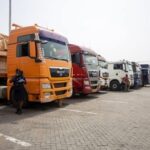
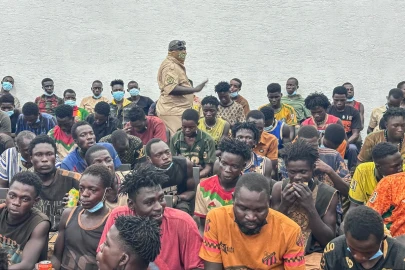
A convoy of 44 vehicles crossed into Mali at the Kouremale border post on a Saturday morning, carrying more than 1,500 foreign nationals expelled from Guinea. Most had come from Burkina Faso and Mali, drawn to the gold-bearing soils of Guinea’s northeastern Siguiri region by poverty and, in many cases, the violent instability consuming their home countries.
The expulsions did not happen overnight. Guinea’s military-led government had been building toward this moment since the opening of the month, systematically intensifying operations against illegal artisanal mining across the country. Detention sweeps at multiple mining sites preceded the convoy’s departure from Conakry on a Friday, with security forces rounding up foreign nationals caught working outside any formal licensing framework. By the time the convoy reached Kouremale, the scale of the operation had become undeniable: over a thousand workers, sentenced to prison terms ranging from 18 months to two years, then released and placed directly onto deportation vehicles.
Siguiri, the epicentre of Guinea’s artisanal gold economy, has long functioned as a magnet for West African labour. The region sits atop some of the continent’s most productive alluvial gold deposits, and for decades, workers from across the Sahel have made the journey south, often without documentation, to dig in conditions that formal mining companies refuse to replicate. The Guinean state, under successive governments, tolerated this informal economy even as it grew beyond any regulatory reach. That tolerance has now ended, at least in its official expression.
Violence at the Mines Precedes Mass Deportations
Before the convoy departed, Siguiri had already turned deadly. On a Wednesday, at least 10 people died in what the Guinean government described as “violent clashes” between miners and security forces. The government’s announcement came the following Thursday, framed as a security operation gone wrong rather than a systematic use of lethal force. Guinea’s main opposition coalition read it differently. On the same Saturday that the deportation convoy crossed into Mali, opposition leaders publicly denounced what they called an “authoritarian drift” and condemned the use of force as a governing method. The deaths in Siguiri, they argued, were not incidental to the crackdown but constitutive of it.
The political charge carries weight in a country governed since 2021 by a military junta that suspended the constitution and has resisted firm timelines for a return to civilian rule. The junta’s stated rationale for the mining crackdown centres on environmental protection: unregulated artisanal mining causes severe land degradation, mercury contamination of waterways, and the destruction of agricultural land in communities that depend on both farming and mining for survival. These environmental costs are real and documented. But the manner in which Guinea has chosen to address them, through mass detention, sentencing, and forced expulsion of foreign workers, raises questions about proportionality and due process that no environmental justification fully resolves.
A Regional Labour Crisis with Deep Structural Roots
The workers expelled from Guinea did not arrive as isolated opportunists. Tens of thousands of West Africans have cycled through the region’s mining sites over the past decade, a movement driven by the intersection of climate stress, agricultural collapse, and armed conflict across the Sahel. Burkina Faso, which supplied a significant share of those deported, has lost effective government control over large parts of its territory to jihadist insurgencies. Mali, the other primary source country, faces comparable instability. For workers from these contexts, Guinea’s informal gold economy represented not a criminal enterprise but an economic lifeline.
ECOWAS protocols on free movement of persons, to which Guinea remains nominally bound despite its suspension from the bloc’s political structures following the 2021 coup, theoretically protect West African nationals’ right to reside and work across member states. The mass expulsions test the practical meaning of those protocols. When a member state, even one under sanctions, deports over 1,500 citizens of fellow ECOWAS members following criminal sentencing, the bloc’s free movement architecture is not merely inconvenienced. It is structurally challenged. ECOWAS has not yet issued a formal response to the Siguiri operations or the deportations, a silence that itself signals the limits of the bloc’s leverage over a government that has already demonstrated its willingness to operate outside the community’s political norms.
Mineral Governance and the Formalization Deficit
Guinea holds some of the world’s largest reserves of bauxite and significant gold deposits, yet the country ranks among the poorest in West Africa by per capita income. This paradox, resource abundance alongside persistent underdevelopment, is precisely the governance failure that the African Continental Free Trade Area and regional frameworks are designed to address through structured value chains, transparent licensing, and benefit-sharing mechanisms. Artisanal and small-scale mining, known in policy circles as ASM, accounts for a substantial share of gold production across West Africa, including in Guinea, but operates almost entirely outside formal tax and regulatory systems.
Formalizing ASM rather than criminalizing it is a policy pathway that mining governance specialists have advocated across the continent, pointing to partial successes in Ghana’s Community Mining Programme and comparable initiatives in Senegal. Ghana’s approach, imperfect and underfunded as it has been, attempted to channel artisanal miners into licensed zones with access to equipment and basic environmental standards, rather than treating their presence as inherently criminal. Guinea’s current approach inverts this logic: it treats the workers as the problem, sentences them, then removes them, without addressing the structural conditions that drew them to Siguiri in the first place or building the regulatory infrastructure that would allow the sector to generate fiscal revenue and environmental compliance simultaneously.
What Institutions Must Reckon With
Guinea’s government has a legitimate interest in ending environmental destruction caused by unregulated mining. That interest does not justify the deaths in Siguiri, and it does not resolve the governance deficit at the core of the crisis. For the country to translate its mineral wealth into sustainable development, it needs a licensing and taxation regime capable of capturing value from artisanal activity, an environmental enforcement system with legal authority and technical capacity, and a labour policy that distinguishes between criminal exploitation of resources and the survival strategies of workers displaced by conflict and poverty.
For ECOWAS, the episode exposes a gap between the bloc’s free movement commitments and its capacity to protect the rights of its citizens when they cross into a member state governed by a military administration. The bloc’s political sanctions against Guinea have not produced a transition timeline; they have also not produced a mechanism for protecting Burkinabe or Malian workers caught in Guinea’s domestic security operations. Rebuilding that capacity, through bilateral labour agreements, formalized ASM frameworks, and genuine pressure on Conakry to restore constitutional governance, is the institutional work that the Siguiri crisis demands.