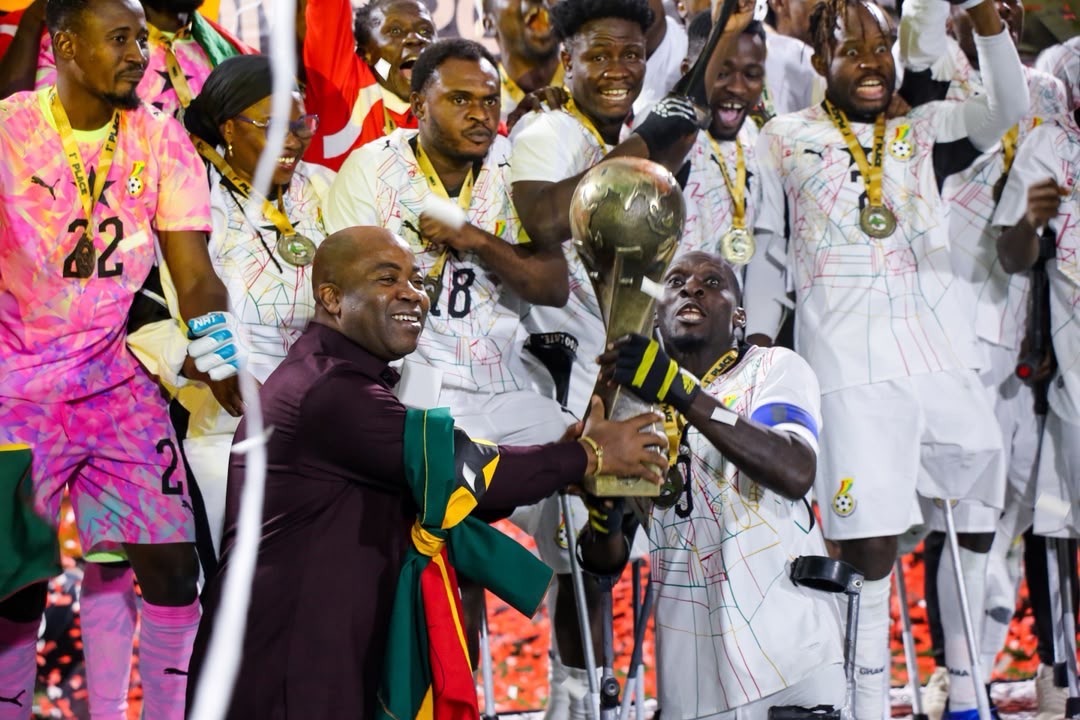
Ghana’s historic victory at the 2026 Amputee Football World Cup represents a defining moment for African disability sport. By defeating Morocco 1–0 in the final in Mexico, the Black Challenge secured their first world title, demonstrating the competitive potential of African athletes on the international stage.
Beyond the celebrations, however, the achievement raises fundamental questions about the governance, financing and development of disability sport infrastructure across West Africa. While athletes continue to deliver exceptional performances, the institutional systems responsible for supporting their development remain insufficiently equipped to sustain such success.
International Success Amid Structural Limitations
Ghana’s victory is not an isolated achievement. The country had already established itself as a continental powerhouse, winning the African Amputee Football Cup of Nations in 2021 and 2024.
Yet these performances have emerged within an environment where access to specialised training facilities, adaptive equipment, professional coaching and predictable funding remains uneven.
Research published in 2025 in Frontiers in Sports and Active Living identified persistent weaknesses within Ghana’s disability sport ecosystem, including fragmented institutional responsibilities, inadequate funding and limited implementation of existing policies.
The challenge is therefore not necessarily the absence of legislation or institutional recognition, but the inability to translate formal commitments into operational capacity.
This disconnect between sporting achievement and institutional support raises concerns about the long-term sustainability of disability sport programmes.
Infrastructure Investment and Political Responsibility
Following Ghana’s World Cup triumph, Samson Deen, president of the African Paralympic Committee and Ghana’s National Paralympic Committee, proposed the development of a $10 million stadium dedicated to disability sport in Accra.
The proposal includes a request for the government to allocate land within the Borteyman Sports Complex, creating an opportunity to establish infrastructure specifically designed around the requirements of athletes with disabilities.
However, constructing a dedicated stadium would address only one dimension of a much broader challenge. Accessible transportation, equipment maintenance, rehabilitation services, regional training centres and qualified technical personnel are equally essential to building a sustainable sporting ecosystem.
Without adequate operational funding and transparent management, even substantial infrastructure investments risk failing to deliver their intended benefits.
The proposed stadium should therefore be considered part of a wider national strategy rather than an isolated response to international sporting success.
Fragmented Governance and Institutional Accountability
Disability sport governance involves multiple stakeholders, including government ministries, national Paralympic committees, sporting federations, local authorities and private sponsors.
While cooperation between these institutions can generate opportunities, overlapping responsibilities and unclear mandates can also create uncertainty surrounding funding, infrastructure ownership and athlete development.
In environments where institutional coordination remains limited, sporting programmes can become excessively dependent on individual leadership, temporary sponsorship agreements and exceptional government interventions.
Establishing clearer institutional mandates, transparent funding mechanisms and measurable development objectives would help strengthen accountability.
Athletes themselves should also be represented in decision-making processes to ensure that infrastructure investments and policy reforms address their practical needs.
A Regional Challenge Across West Africa
The issues highlighted by Ghana’s victory extend beyond its national borders.
Across West Africa, governments have introduced legislation and policy frameworks aimed at improving disability inclusion. Nevertheless, the implementation of accessibility standards remains inconsistent, particularly in public infrastructure and transportation.
The Economic Community of West African States (ECOWAS), through its Regional Action Plan on Disability Inclusion for 2022–2030, has identified shortcomings in accessibility enforcement, infrastructure standards and institutional monitoring.
These limitations have direct consequences for sporting participation. A training facility cannot be considered genuinely accessible if athletes cannot reliably travel to it. Similarly, national federations cannot develop competitive programmes without the resources to identify and support talent beyond major urban centres.
Regional cooperation could provide part of the solution through shared training facilities, common accessibility standards, cross-border competitions and coordinated technical development programmes.
Such initiatives could also reduce the financial burden on individual countries while strengthening the overall competitiveness of West African disability sport.
Moving Beyond Reactive Public Investment
International sporting achievements frequently generate political attention, financial commitments and commercial interest. The challenge lies in maintaining that momentum once public attention shifts elsewhere.
A more sustainable approach would involve integrating disability sport into national infrastructure planning and recurring public expenditure, rather than relying primarily on exceptional funding following major competitions.
Ghana’s National Development Policy Framework for 2026–2029 already acknowledges insufficient accessible sporting facilities and low participation among persons with disabilities.
The World Cup victory provides an opportunity to accelerate these commitments and establish measurable objectives for their implementation.
Private-sector participation could complement public investment through long-term sponsorship agreements, partnerships with equipment manufacturers and support for community sporting programmes.
However, commercial partnerships should reinforce public policy rather than substitute for government responsibility.
From Sporting Achievement to Institutional Transformation
Ghana’s World Cup victory demonstrates that international competitiveness is possible even within an imperfect institutional environment. It also highlights the limitations of a development model in which sporting excellence can advance faster than the infrastructure and governance systems intended to support it.
For West African governments, the central question is whether international sporting success can become a catalyst for structural reform rather than a temporary source of national prestige.
Investing in disability sport infrastructure is not solely a sporting consideration. It is also a matter of public governance, social inclusion and equal access to economic and professional opportunities.
The legacy of the Black Challenge should ultimately be measured not only through trophies and international recognition, but through the opportunities created for future generations of athletes with disabilities.
Ghana has secured a world title. The next challenge is building the institutions capable of making such achievements sustainable.