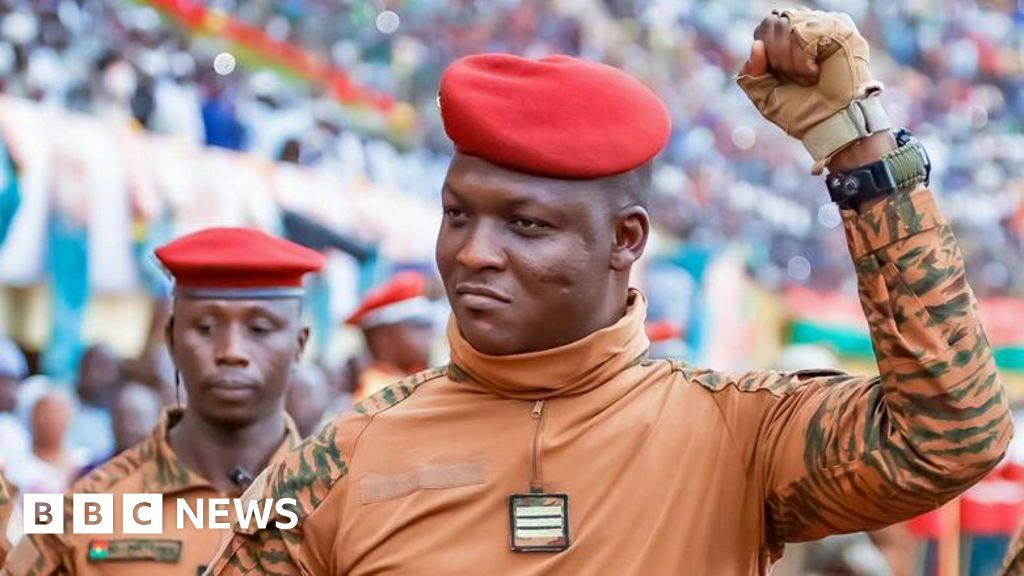
Captain Ibrahim Traoré’s categorical rejection of democratic governance poses a direct challenge to West Africa’s institutional foundations, with implications extending far beyond Burkina Faso’s borders to threaten regional integration frameworks and governance standards across the Economic Community of West African States (ECOWAS).
In a state television interview Thursday, the 38-year-old military leader declared that democracy “kills” and urged his population to “forget” democratic aspirations entirely. This represents a fundamental departure from the transitional commitments Traoré made following his 2022 coup, when he pledged to restore civilian rule by July 2024.
The statements underscore a broader governance crisis within ECOWAS, where military takeovers in Mali, Guinea, Niger, and now Burkina Faso’s entrenchment have created what regional experts describe as a “contagion of authoritarianism” threatening the bloc’s democratic consolidation achievements of the past two decades.
Institutional Breakdown Accelerates Under Military Rule
Traoré’s administration has systematically dismantled Burkina Faso’s democratic institutions since extending military rule for five additional years in 2024. The January ban on all political parties, framed as necessary to “rebuild the state,” effectively eliminated the last vestiges of competitive politics.
Dr. Cyril Musila, governance specialist at the Institute for Security Studies in Dakar, argues that Traoré’s approach represents “institutional vandalism” rather than reform. “When you dismantle parliaments, ban parties, and criminalize dissent, you’re not building alternative governance systems—you’re creating power vacuums that historically benefit only military elites,” Musila said.
The military government has redirected critics and opposition figures to combat zones against Islamic insurgents, effectively using counterterrorism operations as a mechanism for political suppression. This strategy has contributed to a dramatic escalation in civilian casualties, with Human Rights Watch documenting over 1,800 civilian deaths since Traoré assumed power, two-thirds attributed to military and allied militia operations.
Regional Security Architecture Under Strain
Violence in Burkina Faso has tripled under military rule, reaching 17,775 fatalities by May 2025 compared to 6,630 in the previous three-year period. This deterioration directly undermines regional security cooperation mechanisms within ECOWAS and the G5 Sahel framework.
The surge in violence coincides with Burkina Faso’s withdrawal from joint counterterrorism operations with France and its regional partners. Traoré’s emphasis on “military self-reliance” has translated into reduced intelligence sharing and coordinated responses to cross-border insurgent movements affecting Mali, Niger, and northern Ghana.
Security analysts warn that Burkina Faso’s isolation from established regional security frameworks creates operational gaps that Islamic State and al-Qaeda affiliates have exploited. Cross-border attacks into northern Ghana increased 40% in 2024, according to data from the Armed Conflict Location & Event Data Project.
Economic Isolation Threatens Continental Integration
Traoré’s rejection of democratic governance principles places Burkina Faso at odds with African Union and ECOWAS membership requirements, potentially jeopardizing access to regional markets and continental trade frameworks under the African Continental Free Trade Area (AfCFTA).
The military government’s “six or eight-hour work days will not enable us to catch up with richer countries” rhetoric signals potential labor policy changes that could affect regional migration patterns and ECOWAS free movement protocols.
Professor Kwame Boafo-Arthur, political economist at the University of Ghana, notes that Burkina Faso’s cotton and gold exports—crucial to West African value chains—face increasing uncertainty under military rule. “Investors require institutional predictability. When you explicitly reject democratic accountability mechanisms, you’re signaling that contracts and property rights depend entirely on military goodwill,” Boafo-Arthur explained.
Regional financial institutions have begun reassessing Burkina Faso’s creditworthiness, with the West African Development Bank suspending new project approvals pending governance reviews.
Pan-African Rhetoric Versus Institutional Reality
Despite systematic repression domestically, Traoré has cultivated significant popular support across Africa through anti-Western rhetoric and pan-African positioning. His reference to Libya as a cautionary tale about democratic transition resonates with populations frustrated by Western intervention outcomes.
However, regional governance experts argue that Traoré’s “sovereignty” discourse masks fundamental institutional weaknesses. “True sovereignty requires functioning institutions that can deliver services, maintain rule of law, and represent popular interests. Military decree is not sovereignty—it’s institutional collapse,” said Dr. Fatou Sarr, constitutional law specialist at Cheikh Anta Diop University.
The disconnect between Traoré’s pan-African rhetoric and his government’s institutional destruction poses challenges for African Union mediation efforts. AU Peace and Security Council protocols require democratic governance commitments for membership restoration, creating a potential pathway for Burkina Faso’s continental isolation.
Policy Pathways and Regional Response
ECOWAS faces critical decisions about Burkina Faso’s membership status and sanctions effectiveness. Current economic restrictions have failed to pressure democratic restoration, while potentially strengthening military leadership by providing external scapegoats for domestic hardships.
Regional leaders must balance institutional principles with practical security cooperation needs. Burkina Faso’s strategic location makes complete isolation counterproductive for addressing cross-border insurgency, yet accommodating military rule undermines ECOWAS democratic norms.
The most viable approach may involve graduated engagement linking specific governance improvements to sanctions relief, while maintaining security cooperation channels. This requires ECOWAS members to demonstrate unity on democratic principles while acknowledging the complex security dynamics that initially enabled military takeovers.
For continental integration to advance, African institutions must develop more effective mechanisms for preventing democratic backsliding before military interventions occur, rather than simply responding to completed coups with sanctions that often prove ineffective.