Ghana’s Diplomatic Machinery Under Strain as 800 Citizens Await Evacuation from South Africa
Ghana’s Ministry of Foreign Affairs has deferred a planned repatriation of over 800 registered nationals from South Africa, citing procedural and logistical gaps that exposed the limits of bilateral consular infrastructure when confronted with a large-scale humanitarian emergency triggered by recurring xenophobic violence.
A Consular Operation That Outgrew Its Original Scope
The evacuation, initially scheduled to commence on 21 May 2026, was postponed by several days after the number of Ghanaians formally registered for repatriation with the Ghana High Commission in Pretoria surpassed 800, nearly three times the 300 nationals the government had originally planned to repatriate.
The Ministry of Foreign Affairs confirmed the deferral in an official statement, attributing it to mandatory passenger screening requirements under South African law, multi-institutional coordination demands, and the need to secure flight clearances. The operational gap became starkly visible on the day the evacuation was initially set to begin: only one Ghanaian presented at OR Tambo International Airport in Johannesburg, according to AFP correspondents on the ground.
The mismatch between planning capacity and actual demand raises pointed questions about whether Ghana’s consular infrastructure, and that of West African states more broadly, is calibrated to manage diaspora protection at scale during crises.
Xenophobic Violence as a Governance and Integration Problem
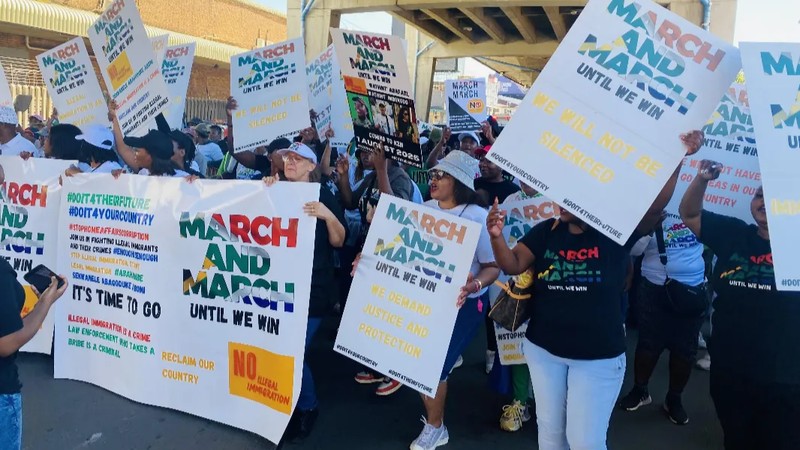
The immediate trigger for the evacuation is a renewed wave of xenophobic attacks in parts of South Africa targeting foreign nationals. Ghanaians, Nigerians, Zimbabweans, Mozambicans, and Somalis have all been affected. Footage of an assault on Emmanuel Asamoah, a Ghanaian resident in South Africa, circulated widely on social media and intensified pressure on Accra to act. Asamoah has since returned to Ghana.
In Durban, the Department of Home Affairs began verifying the legal and refugee status of foreign nationals sheltering at the Diakonia Centre, a facility housing individuals who fled their homes amid fears of intimidation and violence linked to anti-immigration tensions across the city.
South Africa hosts one of the continent’s largest migrant populations. The International Organization for Migration estimated in 2023 that over 2.9 million international migrants resided in South Africa, with substantial communities from West and East Africa. Recurring anti-immigrant violence, often concentrated in townships and informal settlements, has destabilized these communities repeatedly over the past two decades, with major episodes recorded in 2008, 2015, and 2019.
For Ghana, the political stakes are compounded by the profile of its diaspora in South Africa, which includes traders, professionals, and long-term residents with established economic ties. The reintegration package announced by the Ministry of Foreign Affairs, encompassing financial assistance, transportation support, psychosocial counselling, and employment access, signals an awareness that repatriation alone does not resolve the structural vulnerabilities driving emigration in the first place.
Ghana’s AU Engagement and the Free Movement Contradiction
Ghana has escalated the issue beyond bilateral diplomacy. Accra has formally raised concerns about xenophobic violence within African Union deliberations, arguing that recurring attacks against African migrants directly undermine the continent’s free movement architecture and the broader integration agenda anchored in the African Continental Free Trade Area (AfCFTA), whose secretariat is headquartered in Accra.
The argument carries institutional weight. The AU’s Protocol to the Treaty Establishing the African Economic Community Relating to Free Movement of Persons, adopted in 2018, envisions progressive elimination of visa requirements and the right of residence across member states. Thirty-two AU members have signed the protocol, though ratification remains limited. South Africa has not ratified it.
The tension is structural: AfCFTA and its accompanying free movement ambitions require a political environment in which African nationals can operate across borders without facing state-sanctioned or community-level violence. Xenophobic episodes in South Africa, the continent’s most industrialized economy and a critical node in intra-African trade, directly corrode that enabling environment.
For West African states, the stakes are amplified by the ECOWAS Protocol on Free Movement of Persons, which has, since 1979, guaranteed citizens of the fifteen-member bloc the right to enter, reside, and work across member states without a visa. Ghana and Nigeria, two of ECOWAS’s largest economies, have populations with significant presence in southern Africa. The inability to protect these nationals abroad weakens the credibility of free movement as a governance achievement.
Bilateral Mechanisms and the Limits of Diplomatic Engagement
Foreign Affairs Minister Samuel Okudzeto Ablakwa described the safety and welfare of Ghanaians abroad as a “non-negotiable priority” of the Mahama Administration, and confirmed that senior officials from both governments remain engaged on the repatriation exercise. President John Dramani Mahama personally approved the evacuation following appeals from stranded nationals.
The bilateral engagement has produced an agreement on “enhanced and more efficient pre-evacuation modalities,” according to the Ministry, though the operational details of those modalities have not been publicly disclosed. The delay itself, while administratively explicable, carries reputational costs: stranded nationals awaiting evacuation, and a watching diaspora, measure government competence in hours, not communiqués.
Comparisons with regional peers are instructive. Nigeria, which maintains a larger and more institutionally resourced foreign affairs apparatus, has conducted multiple emergency evacuations of its nationals from Libya, Lebanon, and South Africa over the past decade, with varying degrees of operational efficiency. Senegal and Côte d’Ivoire have similarly invested in diaspora engagement infrastructure as remittance flows from abroad have grown into significant fiscal contributors. Ghana’s remittance inflows reached approximately US$4.7 billion in 2023, according to World Bank data, representing roughly 6 percent of GDP, a figure that underscores the economic stakes of diaspora welfare.
Policy Implications: Consular Capacity and Continental Advocacy
The Ghana evacuation episode surfaces three distinct governance gaps that warrant institutional attention.
The Ministry has assured Ghanaians in South Africa that updates will be communicated as arrangements are finalized. The government’s reintegration package, if properly resourced, could serve as a model for how West African states structure post-evacuation support. Whether it translates from policy announcement to implemented program will be the more consequential test of institutional capacity.