A single infrastructure decision can redraw an economy’s internal logic. Ghana’s proposed Accra-Kumasi Expressway, a 198.7-kilometre, six-lane corridor designed to cut travel time between the country’s two largest cities from six hours to two, is precisely that kind of decision — and its governance implications extend well beyond road construction.
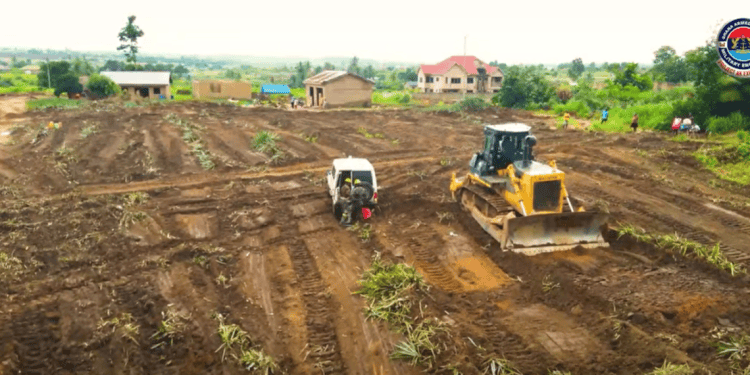
On 14 September 2025, President John Dramani Mahama attended the formal handover of a 175.6-kilometre right-of-way from the Ghana Armed Forces to the state at Kwaso in the Ashanti Region, marking the first concrete institutional step toward a project that has circulated in planning documents for years. The ceremony was not merely symbolic. The transfer of land rights from a military institution to civilian state authority represents a governance milestone: it signals that the project has cleared one of the most persistent bottlenecks in Ghanaian infrastructure delivery, namely the resolution of competing institutional claims over land.
The expressway’s proposed alignment is itself a strategic choice. Rather than upgrading the existing Accra-Kumasi Highway, which stretches approximately 270 kilometres and passes through dense urban and peri-urban settlements, the new route will follow a distinct corridor, reducing the driving distance by nearly 70 kilometres. President Mahama noted that a recommended speed of 120 kilometres per hour would allow motorists to complete the journey in roughly two hours, compared to the five to six hours currently typical on the old highway. At 100 kilometres per hour, the arithmetic still yields a two-hour journey. Three differentiated lanes will accommodate varying vehicle speeds, a design standard consistent with modern expressway engineering and one that distinguishes this project from Ghana’s existing highway stock.
The institutional question that now governs the project’s credibility is not whether the road is desirable — it plainly is — but whether Ghana’s infrastructure delivery apparatus can execute it. Ghana’s record on large-scale road infrastructure is uneven. The country has a documented pattern of project initiation without completion, driven by fiscal constraints, procurement irregularities, and contractor financing gaps. The Ghana Highway Authority and the Ministry of Roads and Highways will need to demonstrate that the financing structure, whether through sovereign borrowing, a public-private partnership, or a hybrid model, is secured and ring-fenced against the budget volatility that has derailed comparable projects. As of the right-of-way handover, no financing closure has been publicly announced, and that gap carries real institutional risk.
Placed within West Africa’s regional integration framework, the corridor’s potential is significant. The Accra-Kumasi axis is not simply a domestic route; it is a critical segment of the broader Trans-West African Coastal Highway network and feeds into trade flows connecting Ghana’s southern ports with landlocked Sahelian economies. ECOWAS’s regional infrastructure agenda, articulated through the ECOWAS Infrastructure Development Programme, explicitly prioritises inter-urban corridors that reduce logistics costs across member states. A functional, high-speed expressway between Accra and Kumasi would lower the cost of moving goods from Tema Port northward, benefiting traders in Burkina Faso and Mali who currently absorb some of the highest transport-cost burdens in the sub-region. Under AfCFTA’s market access logic, reducing those costs is not incidental — it is structural.
The comparison with Côte d’Ivoire is instructive. Abidjan has invested systematically in urban and inter-urban expressway infrastructure over the past decade, including the Abidjan-Grand Bassam corridor and ongoing expansion of the autoroute network radiating from the economic capital. That investment has contributed to Côte d’Ivoire’s consolidation as the sub-region’s most competitive logistics hub, a position Ghana has historically contested. If the Accra-Kumasi Expressway reaches completion on a credible timeline, it would materially strengthen Ghana’s case as an alternative logistics anchor for West African trade, particularly for goods destined for the northern corridor. If it stalls, the governance cost compounds: investor confidence in Ghana’s infrastructure pipeline erodes, and Abidjan’s structural advantage widens.
For domestic economic governance, the expressway’s completion would validate a specific theory of development: that reducing internal transaction costs generates productivity gains that fiscal transfers cannot replicate. The Accra-Kumasi corridor carries a disproportionate share of Ghana’s internal commerce. Agricultural produce from Ashanti and Brong-Ahafo regions moves south; manufactured and imported goods move north. A journey that currently consumes five to six hours imposes real costs on perishable goods, fuel, driver wages, and vehicle depreciation. Compressing that to two hours does not simply save time — it changes the economics of same-day trade, cold-chain logistics, and just-in-time supply chains in ways that could meaningfully improve the competitiveness of Ghanaian producers operating under AfCFTA’s open-market conditions.
President Mahama’s framing at Kwaso — that a resident of Kumasi could leave at 6am and reach Accra by 8am — captures the human dimension accurately, but the governance dimension is harder and more consequential. The right-of-way handover is a necessary condition for the project, not a sufficient one. What Ghana’s institutions must now produce is a transparent procurement process, a credible financing agreement disclosed to parliament, an independent environmental and social impact assessment for the new alignment, and a realistic construction timeline with accountability mechanisms attached. Each of those steps is a governance test in its own right, and each has historically been where comparable Ghanaian infrastructure ambitions have lost traction.
The Accra-Kumasi Expressway, if delivered, would be among the most consequential pieces of infrastructure Ghana has built since independence. The institutional architecture required to deliver it — land rights resolved, financing secured, procurement clean, oversight functional — is the real story. The right-of-way ceremony at Kwaso opened that chapter. Whether Ghana’s governance systems can close it will determine whether this corridor becomes a regional trade asset or another entry in a long inventory of announced but unbuilt ambitions.