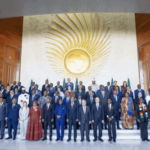
United Nations Secretary-General António Guterres has publicly endorsed the African Union’s demand for permanent representation on the UN Security Council, declaring Africa’s continued exclusion “unjust and indefensible” during his final opening address to the 81st session of the General Assembly in New York on Wednesday — a statement that materially strengthens the continent’s long-standing institutional reform campaign.
The intervention, delivered at the most visible annual forum in multilateral diplomacy, marks the clearest alignment yet between the UN’s chief executive and the AU’s Ezulwini Consensus, the Common Position that commits all 55 African Union member states to demanding at minimum two permanent Security Council seats with full veto rights and two additional non-permanent seats. “A 21st-century Security Council without permanent African representation is unjust and indefensible,” Guterres posted on X following his address, adding that the Council must be reformed “so that it reflects today’s world with the legitimacy and effectiveness that today’s challenges demand.”
Kenya’s President William Ruto, who has made Security Council reform a defining plank of his foreign policy agenda since taking office in 2022, framed the demand in terms that go beyond continental grievance and into systemic institutional logic. “The world must understand that reforming the Security Council is not a favor to Africa or to anybody,” Ruto told the General Assembly. “It is a necessity for the United Nations’ own survival.” His formulation positions African representation not as a concession to be negotiated but as a structural precondition for the UN’s credibility in an era of multipolar geopolitics.
An Institutional Architecture Built for Another Era
The Security Council’s current composition reflects the power settlement of 1945. Its five permanent members — China, France, Russia, the United Kingdom, and the United States — each hold veto power, a privilege that has remained unchanged for eight decades while the General Assembly has expanded from 51 founding members to 193. Africa alone accounts for 54 UN member states, representing more than a quarter of the General Assembly’s voting membership, yet holds no permanent seat and exercises no veto in the body that bears primary responsibility for international peace and security. The structural contradiction is arithmetically stark and politically consequential.
The ten non-permanent seats, elected by the General Assembly for two-year terms, rotate among regional groups and offer African states periodic representation without institutional permanence or veto authority. Kenya itself served as an elected non-permanent member in 2021 and 2022, with its then-Permanent Representative Martin Kimani presiding over the Council in October 2021. Kimani has since been appointed Assistant Secretary-General for Africa in the Departments of Political and Peacebuilding Affairs and Peace Operations, a senior position that signals Kenya’s deepening footprint in UN institutional architecture — though one that operates within, rather than reshaping, the existing power hierarchy.
General Assembly President Philemon Yang of Cameroon’s predecessor at the podium, incoming President Khalilur Rahman of Bangladesh, also addressed Africa’s underrepresentation in his opening statement, lending additional multilateral weight to a reform agenda that African delegations have pursued through successive UNGA sessions without achieving binding structural change. The convergence of the Secretary-General’s voice, the General Assembly President’s platform, and coordinated African bloc diplomacy represents a more consolidated push than previous reform cycles have produced.
Reform Mechanics and the Veto Deadlock
The path from political endorsement to institutional reform runs through Article 108 of the UN Charter, which requires any amendment to be ratified by two-thirds of UN member states, including all five permanent members. That requirement gives each P5 member an effective veto over any reform that would dilute its own structural privilege — a constitutional paradox that has stalled Security Council expansion for decades. Previous reform efforts, including the 2005 High-Level Panel report and the G4 initiative led by Brazil, Germany, India, and Japan, foundered on precisely this mechanism.
The Ezulwini Consensus, adopted by the AU in 2005 and reaffirmed repeatedly since, attempts to navigate this constraint through collective weight rather than bilateral negotiation. With 54 votes in the General Assembly and growing alignment with the Global South on multilateral governance reform, African states argue that the political cost of continued exclusion is rising for P5 members who depend on African diplomatic cooperation across a range of UN bodies, peacekeeping operations, and normative frameworks. The AU’s position is also notable for its insistence on veto rights — a demand that some reform proposals sidestep by proposing new permanent seats without veto power, a compromise the AU has explicitly rejected as insufficient.
The practical implications extend beyond symbolism. Africa hosts the largest number of active UN peacekeeping missions globally, contributes significant troop contingents to UN peace operations, and is the subject of a disproportionate share of Security Council resolutions. The governance anomaly — whereby the continent most directly affected by the Council’s decisions has the least structural power within it — carries direct consequences for the legitimacy of those decisions and for African states’ willingness to sustain cooperation with UN-mandated frameworks over the long term.
For West African states specifically, Security Council reform intersects with active institutional tensions. ECOWAS has faced its most severe legitimacy crisis in decades following the wave of military coups in Mali, Burkina Faso, Guinea, and Niger, with the Council of the Wise and the AU Peace and Security Council both operating in spaces where Security Council authorization shapes the boundaries of permissible collective action. Permanent African representation would alter the terms on which continental bodies engage with UN-sanctioned intervention frameworks — a consideration with direct relevance to ECOWAS’s capacity to enforce its own governance protocols.
Whether Guterres’s endorsement translates into procedural momentum depends on whether member states move from declaratory support to tabling concrete charter amendment proposals — a step that requires political will from governments whose domestic constituencies rarely prioritize multilateral institutional design. What the UNGA 81 session has produced is a higher-profile alignment between the UN’s administrative leadership and the AU’s formal position, narrowing the diplomatic distance between aspiration and institutional agenda.