Nigeria’s South Africa Evacuation Exposes Governance Gaps in African Free Movement Architecture
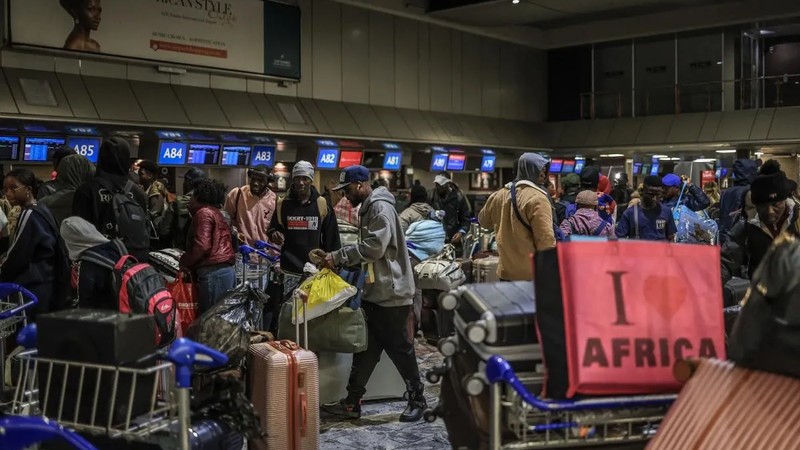
Nigeria’s Federal Government has rescheduled its evacuation of citizens from South Africa to Wednesday 11 June, after logistical delays pushed back a Monday departure. The operation, approved by President Bola Tinubu for five Air Peace flights, will transport over 1,000 screened Nigerians from Johannesburg to Lagos, and throws into sharp relief the structural contradictions between Africa’s continental free movement ambitions and the political economy of host-country nationalism.
A Diplomatic Rupture With Regional Consequences
The evacuation follows weeks of anti-immigrant violence in South Africa, where a citizen-led ultimatum demanding the expulsion of undocumented migrants by 30 June has reignited fears of organised xenophobic unrest. South Africa’s unemployment rate, which exceeds 32% by the expanded definition, has historically functioned as the primary political fuel for anti-immigrant mobilisation, with foreign nationals concentrated in informal trade and service sectors that absorb unemployed South Africans.
Nigeria’s Minister of Foreign Affairs, Bianca Odumegwu-Ojukwu, publicly rejected South African official claims that most affected Nigerians were undocumented, and expressed “strong dissatisfaction” with how South African security agencies have handled the attacks. The Nigerian High Commission in Pretoria separately negotiated immigration waivers allowing Nigerians with administrative offences to board repatriation flights rather than face detention.
Nigeria is not acting in isolation. Ghana has already repatriated hundreds of its own citizens from South Africa in recent weeks, and other West African states are monitoring the situation. The parallel responses from Accra and Abuja signal a coordinated, if informal, West African posture toward the crisis, one that ECOWAS has not yet formalised through any collective diplomatic statement.
The Free Movement Paradox: AU Protocols vs. Political Reality
The crisis directly challenges the African Union’s Protocol on Free Movement of Persons, a flagship instrument of Agenda 2063 that envisions visa-free movement across member states. South Africa is a signatory to the AU’s Constitutive Act and participates in continental integration frameworks, yet the domestic political pressure to restrict and expel foreign nationals operates in direct tension with those commitments.
South Africa hosts more than three million foreign nationals, representing 5.1% of its population, according to Statistics South Africa. Over 63% originate from within the Southern African Development Community (SADC), whose own Protocol on the Facilitation of Movement of Persons was designed to reduce barriers across the 16-member bloc. The recurring gap between protocol ratification and domestic enforcement is not unique to South Africa, but the scale and visibility of Pretoria’s enforcement crackdown makes it a test case for whether continental free movement frameworks carry any practical authority.
For West African states operating under ECOWAS‘s 1979 Protocol on Free Movement, the South African situation offers a cautionary precedent. ECOWAS free movement rights are more operationally embedded than their AU equivalents, but they too face pressure when domestic unemployment spikes and political actors find electoral advantage in targeting foreign traders and workers. The Nigerien, Ivorian, and Ghanaian communities across the ECOWAS zone are not immune to analogous dynamics.
Institutional Accountability and the Limits of Bilateral Diplomacy
Nigeria’s evacuation response, while operationally competent, represents a reactive, bilateral solution to what is structurally a multilateral governance problem. The negotiation of immigration waivers by the Nigerian High Commission in Pretoria, and the approval of five state-facilitated evacuation flights, demonstrate that Abuja retains the institutional capacity to protect citizens abroad when political will is mobilised. However, the absence of a coordinated AU or SADC response mechanism means each sending country must negotiate separately, absorb the logistical cost independently, and rely on ad hoc diplomacy rather than binding protection frameworks.
President Cyril Ramaphosa’s national address on Sunday, in which he pledged to strengthen migration enforcement while condemning vigilante violence, reflects the dual pressure his administration faces: satisfying a domestic constituency that attributes unemployment and crime to foreign nationals, while maintaining South Africa’s credibility as a continental anchor economy and AU norm-setter. That credibility is materially at stake. South Africa’s role as the continent’s most industrialised economy, now contested by Nigeria on GDP metrics, has historically rested partly on its image as a post-apartheid, rights-respecting democracy open to African mobility.
Repeated xenophobic cycles, in 2008, 2015, and now 2025, have progressively eroded that image and generated measurable diplomatic costs, including trade disruptions, retaliatory boycotts of South African goods in Nigeria and Ethiopia, and reputational damage in multilateral forums.
West African Investment and Trade Exposure in Southern Africa
The human dimension of the crisis intersects with a significant economic exposure. Nigerian and Ghanaian nationals in South Africa are disproportionately concentrated in retail trade, financial services, and the informal economy, sectors where they have built capital and networks over decades. Forced or voluntary repatriation disrupts those economic linkages and represents a loss of remittance flows, market intelligence, and diaspora investment capacity that neither Abuja nor Accra can easily replace.
For investors assessing West Africa’s regional integration trajectory, the South Africa crisis illustrates a broader risk: that intra-African investment and labour mobility, despite AfCFTA’s institutional architecture, remain vulnerable to domestic political shocks in host countries. The African Continental Free Trade Area (AfCFTA), now in its operational phase with tariff liberalisation schedules under negotiation, does not yet include binding labour mobility or investor protection provisions that would cover nationals caught in precisely this type of crisis.
The Secretariat in Accra has not issued any statement on the South Africa situation, a silence that reflects AfCFTA’s current mandate limitations but also points to an institutional gap that member states may need to address as the agreement deepens.
Policy Pathways: From Crisis Response to Structural Protection
Nigeria’s immediate priority is completing the evacuation safely and ensuring that those who remain in South Africa have access to consular protection. The High Commission’s immigration waiver negotiation sets a useful precedent for future crises, but it should be codified rather than improvised.
At the regional level, ECOWAS has standing to raise the treatment of West African nationals in South Africa through AU diplomatic channels, and to formally request that SADC activate its own human rights and protection mechanisms. A joint ECOWAS-AU demarche to Pretoria, coordinated with Ghana, Nigeria, and other affected sending states, would carry more institutional weight than bilateral protests and signal that continental free movement norms carry collective enforcement consequences.
South Africa, for its part, faces a governance test that goes beyond migration policy. Its capacity to distinguish between legitimate immigration enforcement and the toleration of mob violence against foreign nationals will determine whether it can credibly participate in the AU’s free movement agenda while managing domestic political pressures. Ramaphosa’s condemnation of vigilante action is necessary but insufficient without visible prosecutions and security deployments that protect foreign nationals in affected areas.
The 500 Nigerians already screened and the more than 1,000 expected to register for evacuation represent individual decisions made under duress. The institutional frameworks that should have prevented that duress, from AU protocols to SADC agreements to bilateral consular conventions, failed to do so. Fixing that failure requires more than evacuation flights; it requires member states to treat free movement commitments as binding obligations rather than aspirational language.