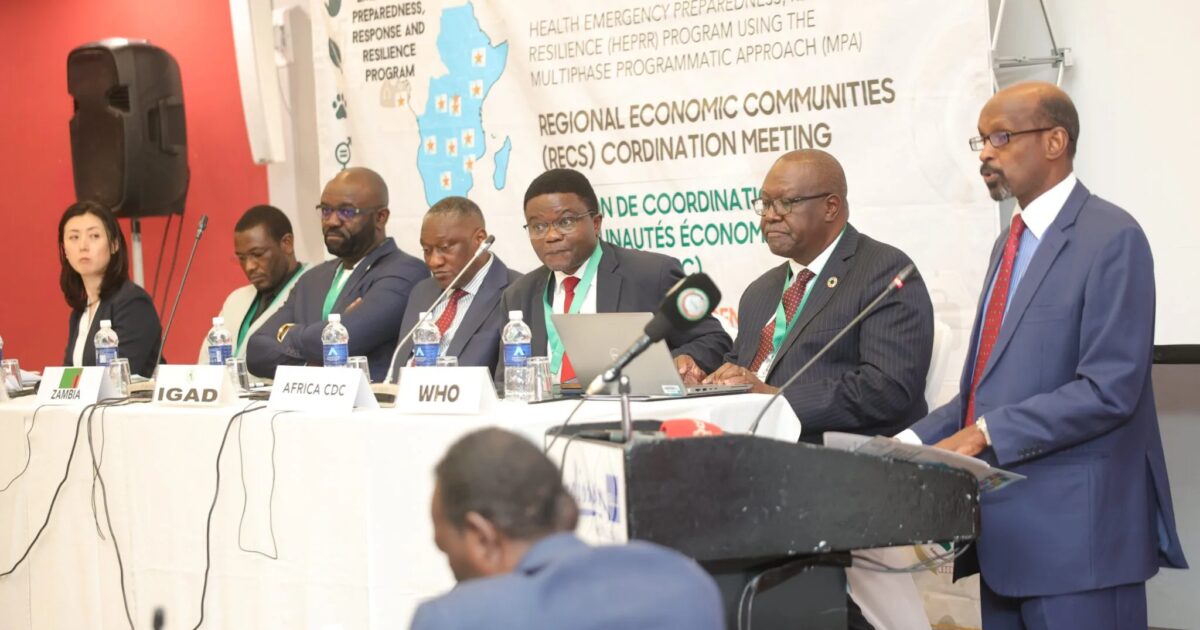
At a three-day convening held from 14 to 16 October in Lusaka, Zambia, five of Africa’s major Regional Economic Communities formally endorsed a set of recommendations that, taken together, represent the most structurally ambitious attempt in recent memory to reframe health emergency preparedness as a governance and financing challenge rather than a humanitarian one. The Intergovernmental Authority on Development (IGAD), the Southern African Development Community (SADC), the Common Market for Eastern and Southern Africa (COMESA), the East African Community (EAC), and the Economic Community of Central African States (ECCAS) collectively called for a joint financing compact, coordinated procurement mechanisms, and a rationalised regional manufacturing base for medical supplies — a package of institutional reforms that, if implemented with fidelity, would materially alter how African states mobilise and deploy health resources during public health emergencies.
The meeting, convened by IGAD in collaboration with the East, Central and Southern Africa Health Community (ECSA-HC) under the Health Emergency Preparedness, Response and Resilience Programme for Eastern and Southern Africa (HEPRRP-AFE), drew together continental and international health partners alongside the five RECs, underscoring the degree to which this agenda now commands multilateral attention. The HEPRRP-AFE programme, which became effective in March 2024 and runs through March 2030, covers eleven countries — Angola, Botswana, Burundi, the Democratic Republic of the Congo, Ethiopia, Kenya, Malawi, Mozambique, Rwanda, São Tomé and Príncipe, and Zambia — and provides the programmatic scaffolding within which these recommendations are expected to take operational form. What distinguishes the Lusaka outcomes from earlier declarations of intent is the specificity of the institutional architecture being proposed: defined responsibilities, timelines, resource commitments, and performance indicators are explicitly cited, which is precisely the kind of accountability language that separates governance reform from aspirational communiqué.
The central institutional proposition is the development of a regional financing compact, supported by the United Nations Economic Commission for Africa and the World Health Organization, designed to sustain health emergency preparedness beyond the lifecycle of individual project funding. This is a pointed acknowledgement of a structural weakness that has undermined African health systems for decades: the tendency for preparedness investments to atrophy once external project cycles conclude, leaving institutions chronically undercapitalised at precisely the moments when surge capacity is most needed. The compact would require RECs to prepare joint funding proposals and coordinate joint engagements with technical and development partners, philanthropists, and private investors, with a particular focus on financing local and regional manufacturing of health products and technologies. The shift from bilateral donor dependency toward a pooled, multi-institutional financing architecture reflects a broader governance maturation that investors and development finance institutions have been pressing African institutions to demonstrate.
On procurement, the recommendations call for pooled mechanisms built on joint demand forecasting, coordinated purchasing, and long-term purchasing agreements — instruments that, in aggregate, are designed to create more predictable market conditions for locally manufactured health products. This is not merely a logistical adjustment; it is a demand-side industrial policy. African manufacturers of pharmaceuticals and medical supplies have long cited market fragmentation and unpredictable public procurement as the primary barriers to commercial viability and investment attraction. By aggregating demand across multiple RECs and eleven-plus countries, the proposed architecture would generate the kind of volume and contract certainty that could, in principle, justify the capital expenditure required to scale domestic production. The African Medicines Agency and regional blocs are expected to strengthen regulatory cooperation, support national regulatory authorities, and promote reliance on assessments conducted by other recognised regulators — a regulatory harmonisation agenda that directly parallels the work WAEMU countries have undertaken in financial services, and that AfCFTA’s pharmaceutical annex has been attempting to advance at the continental level.
The manufacturing dimension of the Lusaka recommendations carries a particular institutional logic that deserves careful scrutiny. The blocs explicitly warned against duplication of facilities and resources across member states, urging countries to build on existing capacities rather than pursue identical investments that may not be commercially viable. This is a governance discipline that African regional institutions have historically struggled to enforce, given the political economy of national prestige projects and the incentive structures that lead individual governments to seek manufacturing mandates for their own territories regardless of comparative advantage. The proposed joint action framework, with shared technical expertise, training institutions, centres of excellence, and regional reference laboratories, would require a degree of inter-state coordination that has proven difficult to sustain in analogous sectors — including energy infrastructure and transport corridors — where ECOWAS, SADC, and EAC have all encountered implementation gaps between political commitment and operational delivery. Africa CDC’s role in identifying priority medical products and coordinating procurement mechanisms gives the continental institution a concrete mandate that could, over time, build the kind of track record needed to anchor investor confidence in the broader system.
The cross-border disease surveillance component of the recommendations addresses a governance failure that the COVID-19 pandemic made unmistakably visible: the absence of harmonised operational procedures, integrated information-sharing systems, and functioning referral networks across national borders meant that early outbreak signals were frequently lost in jurisdictional gaps. The blocs are now calling for coordinated investments at priority border entry points, formal cross-border agreements, expanded field epidemiology training programmes, simulation exercises, and professional exchanges designed to build a multidisciplinary workforce capable of operating across national boundaries. Regional laboratory networks would be strengthened through harmonised quality standards and cross-border sample referrals, and a One Health approach linking human, animal, and environmental health through joint risk assessments and coordinated early-warning systems would provide the epidemiological breadth that single-sector surveillance consistently fails to deliver. The inclusion of a shared learning agenda addressing technology transfer, intellectual property, manufacturing standards, access to finance, and workforce development signals that the blocs are attempting to treat the political economy of knowledge and capability as a governance problem, not merely a technical one.
For the broader West and Central African governance architecture, the Lusaka recommendations carry implications that extend well beyond the health sector. The institutional model being proposed — pooled financing, coordinated procurement, rationalised manufacturing, harmonised regulation — is structurally identical to the integration logic that underpins AfCFTA’s trade facilitation agenda and ECOWAS’s long-stalled monetary union project. If the five RECs can demonstrate that this model delivers measurable outcomes in health security by, say, 2027, the institutional learning would provide a replicable template for other sectors where African regional bodies have committed to integration in principle but struggled to operationalise it in practice. The test, as it has always been, will not be in the quality of the recommendations adopted in Lusaka, but in whether the financing compact is actually capitalised, whether the procurement mechanisms are actually activated, and whether the joint action framework is actually monitored against the performance indicators the blocs have pledged to define. African institutions have the authority and the mandate; the question is whether the political will and the fiscal discipline will follow.