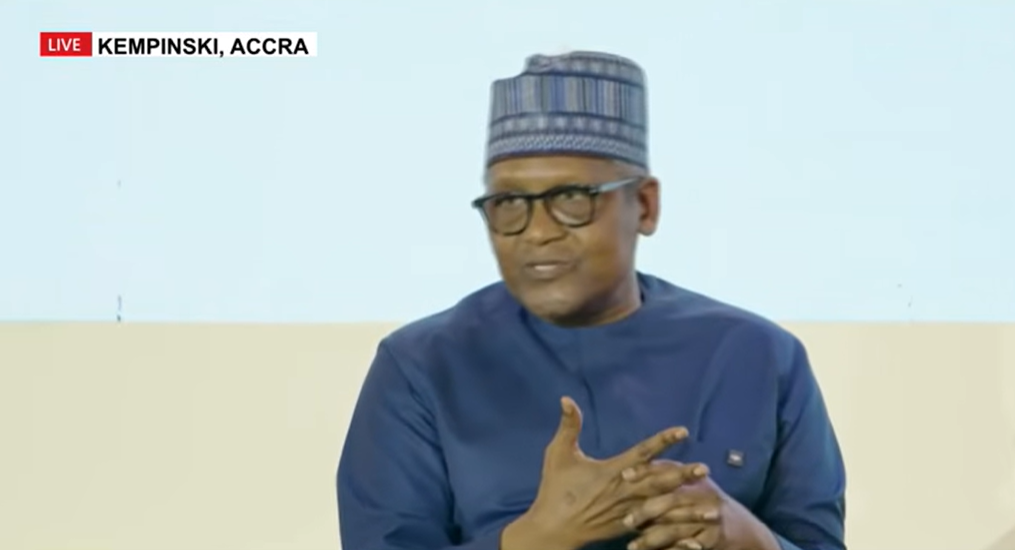
Aliko Dangote, Africa’s wealthiest industrialist and the architect of Nigeria’s largest private-sector conglomerate, delivered a pointed challenge to prevailing development orthodoxy at the inaugural Invest Ghana Summit 2026 in Accra on Monday, 16 November, arguing that restrictive government policy environments, not inadequate financing, represent the primary structural barrier to business growth across the continent.
The intervention carries institutional weight. Dangote’s industrial empire spans cement, fertiliser, and petroleum refining across more than a dozen African countries, giving him direct exposure to the regulatory architectures of multiple West African states. His diagnosis cuts against a narrative that has shaped decades of development finance strategy, from the International Monetary Fund’s SME lending frameworks to ECOWAS-backed trade facilitation programmes that have consistently prioritised capital mobilisation as the entry point for industrial development.
“I think capital is not that difficult,” Dangote told delegates at the summit. “What we need first is the right policies of government and then you have entrepreneurs who are ready to commit their own resources. I don’t think capital is the biggest challenge for businesses because I have heard over and over again that capital is the biggest challenge for businesses. I think the biggest challenge is mainly the policies. If you have the right policies and your own seed capital, then you can move smoothly.”
The argument is not simply rhetorical. Across West Africa, businesses routinely navigate overlapping and contradictory regulatory regimes, discretionary licensing systems, unpredictable tax enforcement, and currency controls that erode investor confidence well before financing constraints become operative. In Ghana specifically, the business environment has been shaped in recent years by acute fiscal instability, a sovereign debt restructuring process completed in 2024, and a cedi depreciation cycle that compressed margins across import-dependent manufacturing sectors. The Bank of Ghana’s benchmark monetary policy rate, maintained at elevated levels to anchor inflation expectations, has made domestic credit prohibitively expensive for most private operators, but Dangote’s framing suggests that even abundant cheap capital would fail to unlock investment without coherent and stable policy architecture beneath it.
The Policy Environment as the Binding Constraint
The distinction Dangote draws between capital access and policy quality maps onto a well-established body of institutional economics research. World Bank Doing Business indicators, before the index was discontinued, consistently showed that sub-Saharan African economies scored lowest not on access to credit in isolation, but on contract enforcement, construction permitting, cross-border trade facilitation, and investor protection, all of which are direct functions of government policy design and bureaucratic execution. Ghana ranked 118th globally on the final 2020 index, trailing regional peers Senegal and Côte d’Ivoire on several governance-adjacent metrics. Nigeria, Dangote’s home market, ranked 131st, a figure that contextualises his experiential critique: he built the continent’s largest cement group not because Nigerian capital markets were deep, but because he operated with sufficient scale and political navigation capacity to absorb policy volatility that would have eliminated smaller operators.
For smaller and medium-sized enterprises operating without that institutional buffer, the policy environment functions as a genuine barrier to entry. Inconsistent value-added tax administration, arbitrary import duty reclassifications, and delayed refund mechanisms under Ghana Revenue Authority procedures have been documented by the Ghana National Chamber of Commerce as recurring operational costs that do not appear in any financing model. The African Development Bank’s 2023 African Economic Outlook noted that regulatory uncertainty ranked among the top three investment deterrents cited by private-sector respondents across the continent, ahead of interest rate levels in several country samples.
Within the ECOWAS framework, the policy fragmentation problem is compounded by incomplete implementation of the bloc’s common external tariff and trade facilitation protocols. Goods moving between Ghana and Nigeria, the two largest economies in the sub-region, still face non-tariff barriers that inflate transaction costs and reduce the commercial logic of regional supply chains. The AfCFTA Secretariat, headquartered in Accra, has identified regulatory harmonisation as the single most consequential unfinished task in making the continental free trade agreement operational for the private sector. Dangote’s fertiliser plant in Lagos, which came online in 2023 with a capacity of 3 million metric tonnes annually, was designed partly to serve West African agricultural markets, but its commercial reach has been constrained by exactly the kind of policy inconsistencies he critiqued at the summit.
Implications for Ghana’s Investment Positioning
The Invest Ghana Summit 2026 was conceived as a platform to rebuild foreign and domestic investor confidence following Ghana’s debt restructuring, and the choice of Dangote as a keynote voice signals an intent to anchor the conversation in private-sector credibility rather than multilateral reassurance. His message carries a specific implication for Ghanaian policymakers: capital, whether from the IMF’s extended credit facility programme, diaspora remittances, or Chinese infrastructure partnerships, will not translate into sustained industrial activity unless the Ministry of Finance, the Ghana Revenue Authority, and sector-specific regulators operate with consistency, transparency, and a predictable legal framework that businesses can price into long-term investment decisions.
Côte d’Ivoire, Ghana’s most direct regional competitor for manufacturing investment, has sustained higher FDI inflows relative to GDP over the past decade in part by maintaining tighter fiscal discipline and more consistent industrial policy signalling. Senegal, buoyed by offshore gas revenues beginning to flow in 2024, is actively constructing an investment code designed to attract downstream processing rather than raw resource extraction, a governance choice that reflects precisely the kind of policy intentionality Dangote described. Ghana’s ability to compete for the same pool of regional and continental capital depends less on the headline interest rate environment and more on whether its institutions can deliver the regulatory predictability that industrial investors require before committing capital at scale.
Dangote did not prescribe specific reforms from the Accra stage, but the institutional logic of his argument points toward a concrete agenda: streamlining business registration and licensing processes, eliminating discretionary tax enforcement, accelerating Ghana’s full implementation of ECOWAS trade protocols, and aligning domestic investment incentives with the AfCFTA’s rules of origin requirements. These are not abstract governance ideals. They are the operational conditions under which private capital, domestic and foreign, converts from latent resource into productive industrial investment.