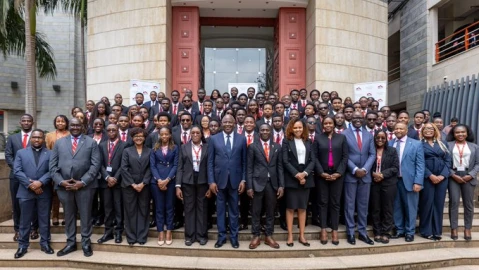
When Aime Iradukunda, a top-performing student from Mityana District in Uganda, received his acceptance letter from Harvard College, he described the moment as one of complete disbelief. He had applied to 14 universities, calibrated his expectations downward, and still arrived at one of the world’s most selective institutions — not by accident, but through a structured pipeline that has quietly become one of East and West Africa’s most consequential education investment vehicles. The Equity Leaders Program, administered by Equity Group Foundation, commissioned 121 scholars this year into universities across 16 countries, securing scholarship packages valued at KSh 3,021,504,435 (approximately US$23.4 million) for the duration of their undergraduate studies.
The scale of this single cohort is not incidental. It reflects a deliberate institutional architecture — one that integrates paid internships, mentorship networks, college counselling, and structured study groups into a talent development model with measurable continental ambitions. Since its inception, the program has placed 1,236 scholars in 247 universities across 40 countries on six continents, with 240 of those scholars admitted to Ivy League institutions to date. Twenty of this year’s cohort alone secured Ivy League placements.
The 121 scholars admitted in this cycle were distributed across 63 universities in North America, Europe, Asia, and Africa. A further 44 scholars, having completed interviews for government-sponsored overseas scholarship schemes, await final confirmation: 23 were interviewed for the Türkiye Government Scholarship and 21 for the Romania Government Scholarship, both channelled through Kenyan government partnerships. The program’s geographic diversification is deliberate, reducing dependence on any single bilateral education corridor and exposing scholars to a range of governance, economic, and institutional environments.
At the commissioning ceremony held at Equity Centre in Upper Hill, Nairobi, Dr. James Mwangi, Executive Chairman of Equity Group Foundation and Group Managing Director and CEO, framed the program’s logic in explicitly continental terms. “The Equity Leaders Program represents our long-term commitment to Africa’s potential and a belief that the continent’s next chapter of growth will be shaped by well-prepared, values-led talent,” he said, urging scholars to “return equipped with world-class knowledge, networks, and confidence to build solutions that expand opportunity, competitiveness, and shared prosperity across Africa.” Ondrej Simek, Deputy Head of Delegation of the European Union to Kenya, attended the ceremony and echoed the call for scholars to build cross-cultural networks alongside academic achievement.
What distinguishes the Equity Leaders Program from conventional scholarship initiatives is the institutional scaffolding that surrounds the placement process itself. Grace Sang’, admitted to New York University Abu Dhabi to pursue Computer Science after scoring an A grade in Kenya’s 2025 KCSE examinations, described how the program’s college counselling component reframed her understanding of her own candidacy. “The Equity College Counselling Program helped me realise that my achievements, interests, and personal story all had value,” she said, recounting how she first encountered the program as a Form Two student listening to alumni testimonials. The journey from aspiration to admission, she noted, involved “countless essays, revisions, and determination” — a process structured and supported rather than left to individual navigation.
That structural support is precisely the governance innovation the program represents. Brian Oweka Otieno, currently a fourth-year Medicine student at Selçuk University in Türkiye and the 2026 Study Group Leader for the Equity College Counselling Program, described the peer-accountability model at the heart of the program’s methodology. “Study groups matter: review essays together, tackle challenging questions together, stay accountable, and celebrate every milestone together,” he said. His own trajectory, he argued, demonstrates that global scholarships are “achievable” when paired with “the right mentorship, structured guidance, and determination.” David Kiiru Kimani, an Equity Global Scholars Board Member and first-year Biology student at Williams College in the United States, reinforced the alumni-to-scholar feedback loop that sustains the program’s community across generations and geographies.
From a governance and institutional development perspective, the program raises important questions about the relationship between private capital, philanthropic infrastructure, and public education systems across the continent. Equity Group Foundation operates as the development arm of Equity Group Holdings, one of East Africa’s largest banking institutions by customer base. The foundation’s ability to mobilise US$23.4 million in scholarship value within a single admissions cycle — leveraging university financial aid systems in the United States, Europe, and Asia rather than disbursing equivalent sums directly — reflects a sophisticated understanding of how institutional leverage can amplify impact beyond what direct expenditure alone could achieve.
For regional integration frameworks, the program’s model carries transferable lessons. The African Continental Free Trade Area (AfCFTA) and ECOWAS’s long-standing protocols on the free movement of persons both depend, at the implementation level, on a critical mass of professionals capable of navigating multi-jurisdictional regulatory environments, understanding comparative institutional design, and building cross-border professional networks. Programs that send African scholars to institutions across four continents and then actively structure their return through alumni boards and mentorship pipelines directly contribute to the human capital substrate that regional integration requires.
The program’s current geographic footprint, while centred in East Africa, carries implications for West African education policy as well. Ghana, Nigeria, Senegal, and Côte d’Ivoire each maintain bilateral scholarship agreements with European and Asian governments, but few have developed the kind of integrated counselling-to-placement pipeline that Equity Group Foundation has institutionalised. Nigeria’s Tertiary Education Trust Fund and Ghana’s scholarship secretariat operate primarily as disbursement mechanisms rather than talent development systems, leaving the gap between raw academic performance and successful international placement largely unfilled for most students outside elite urban networks.
Iradukunda’s account of applying to 14 universities before securing Harvard admission is instructive in this regard. Without structured support, the application process for top global institutions remains opaque, resource-intensive, and systematically biased toward students with prior exposure to international education environments. The Equity Leaders Program’s intervention at precisely this juncture — providing essay coaching, interview preparation, and financial literacy around scholarship structures — democratises access in a way that public scholarship secretariats, operating at scale without individualised support, structurally cannot.
The US$23.4 million secured in this cycle will not appear on any government balance sheet, yet it represents a de facto education investment in African human capital that dwarfs what many national scholarship programmes disburse annually. As African governments and regional bodies consider how to scale talent pipelines capable of meeting AfCFTA’s implementation demands and ECOWAS’s institutional deepening agenda, the Equity Leaders Program offers a replicable, data-supported model worth serious policy attention. The scholars commissioned this year carry more than their families’ aspirations; they carry a proof of concept that African institutions, when properly resourced and structurally designed, can compete for and win access to the world’s best universities at scale.