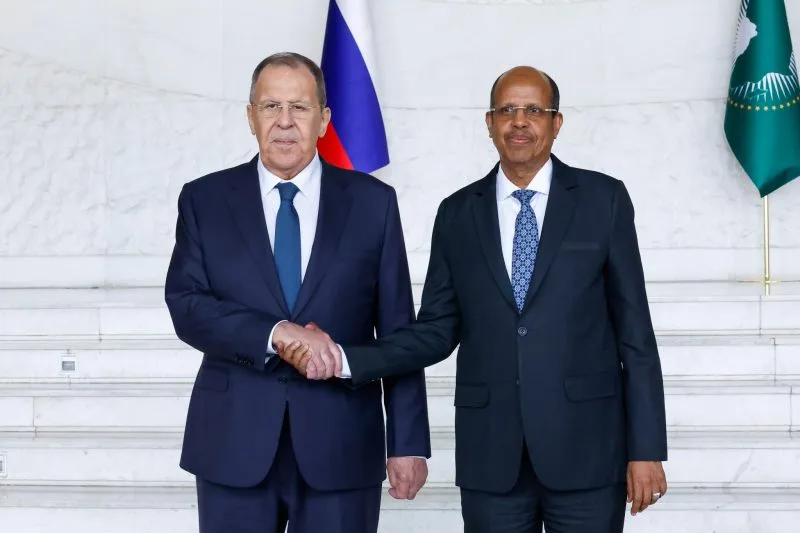
The African Union Commission and the Russian Federation used high-level consultations in Addis Ababa on 7 July to renew a joint push for permanent African representation on the United Nations Security Council, framing the continent’s exclusion as a “historical injustice” that undermines the legitimacy of global governance. The meeting between AUC Chairperson Mahmoud Ali Youssouf and Russian Foreign Minister Sergey Lavrov produced a joint statement and a forward agenda anchored to the third Africa-Russia Summit, scheduled for 28-29 October 2026 in Moscow.
The consultations carried real institutional weight, but they also exposed a persistent tension at the heart of Africa’s multilateral strategy: aligning with a permanent Security Council member that shares the continent’s reform rhetoric does not, by itself, move the procedural levers that govern UN Charter amendment.
The Ezulwini Consensus as Diplomatic Anchor
Russia formally reaffirmed its support for Africa’s Ezulwini Consensus and the Sirte Declaration, the twin pillars of the African Common Position on UN reform. Those documents, adopted in 2005, call for at least two permanent seats with full veto rights and five non-permanent seats for African member states. No P5 member has ever explicitly endorsed the veto component, making Russia’s rhetorical alignment notable, if not yet operationally decisive.
The breadth of the agenda reflects the AU’s deliberate strategy of embedding Security Council reform within a wider governance and development compact, rather than treating it as a standalone diplomatic ask.
Strategic Geometry and Its Limits
Russia’s alignment with African multilateral positions is not new, but the Addis Ababa consultations signal an intensification ahead of the Moscow summit. For the AU, the relationship offers a reliable P5 voice in favour of reform language, access to agricultural and energy supply chains, and political cover for the principle of “African Solutions to African Problems” in conflict theatres from the Sahel to the Horn. For Moscow, deeper AU engagement provides diplomatic legitimacy at a moment when its relations with Western institutions remain severely constrained.
That asymmetry matters. African states have consistently maintained that their multilateral partnerships are non-exclusive and interest-driven, not ideological. The AU’s simultaneous engagement with the European Union, the United States, China and Gulf states on governance and financing questions reflects exactly that posture. The risk, which African policymakers are well aware of, is that bilateral alignment with any single P5 member reduces the continent’s leverage in the broader reform negotiation, where consensus among all five permanent members is constitutionally required for Charter amendment.
The ECOWAS dimension adds another layer of complexity. West African states navigating security transitions in Mali, Burkina Faso and Niger, where Russian military contractors operate, watch AU-Russia institutional statements through a sharply different lens than, say, East African or Southern African members. The AUC’s ability to speak with a unified continental voice on Security Council reform depends partly on managing those intra-African divergences, which the joint statement did not address.
What the Addis Ababa consultations did produce is a structured annual dialogue framework, a commitment to regular high-level political consultations between the AUC and Moscow. That kind of institutionalised engagement, if it generates concrete deliverables on Resolution 2719 financing and AfCFTA-compatible trade frameworks, could translate diplomatic momentum into measurable governance outcomes. Whether the October summit in Moscow moves beyond symbolism will depend on whether African delegations arrive with specific, costed proposals, rather than restatements of principles that have circulated, largely unimplemented, for twenty years.