DRC’s “Lumumba Vea” Reaches 2026 World Cup After Visa Bureaucracy Exposes Travel Barriers Facing African Fans
Michel Nkuka Mboladinga, the DR Congo superfan known globally as “Lumumba Vea,” arrived in Guadalajara for the 2026 FIFA World Cup after navigating a weeks-long ordeal of visa refusals, quarantine protocols, and multi-country administrative failures — a journey that laid bare the structural disadvantages African nationals face when attempting to participate in global sporting events.
A Symbol Delayed by Systemic Barriers
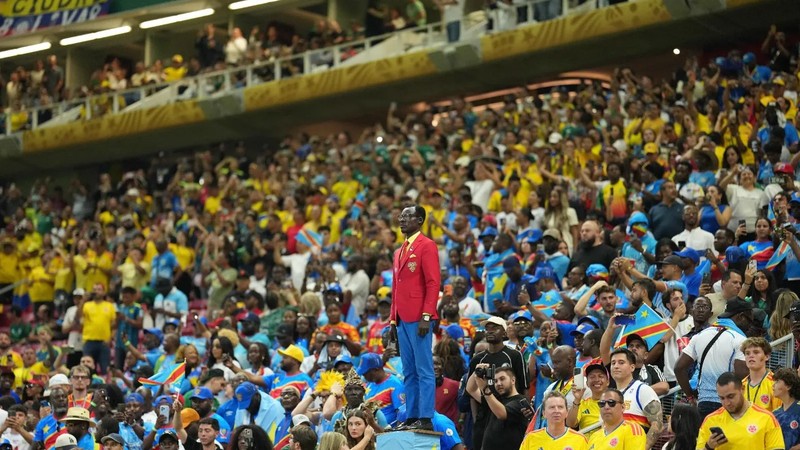
Mboladinga, 53, has built an international following through a singular matchday ritual: dressed as Congolese independence hero Patrice Lumumba, he stands motionless on a small pedestal for the duration of a match, right arm raised in silent salute. His name, “Lumumba Vea,” translates directly from Lingala as “Lumumba Lives” — a deliberate act of political and cultural memory embedded within a football stadium.
He rose to continental prominence during the 2025 Africa Cup of Nations in Morocco, where his living statue performance during DR Congo’s matches went viral across African and global sports media. His presence at the 2026 World Cup in Mexico was widely anticipated. His arrival, however, was far from guaranteed.
Ebola-related health protocols in DR Congo triggered a mandatory 21-day quarantine period, immediately disrupting his travel timeline. A parallel visa process pursued through Kenya — which reportedly involved direct engagement from Kenya’s sports ministry — collapsed at a critical stage, forcing Mboladinga and members of his travelling group to return to Kinshasa. He missed DR Congo’s opening Group K fixture, a 1-1 draw against Portugal on 19 June 2025, entirely as a result of these compounding delays.
Visa Access and the Geography of Football Fandom
Mboladinga’s experience is not an isolated incident. It reflects a well-documented asymmetry in global visa architecture that systematically disadvantages passport holders from Central and West African nations. The Henley Passport Index consistently ranks the Democratic Republic of Congo’s travel document among the world’s least powerful, granting visa-free or visa-on-arrival access to fewer than 40 destinations globally.
For comparison, a French or Spanish national travelling to the same World Cup in Mexico faces virtually no administrative friction. An Ivorian or Senegalese fan, holding ECOWAS travel documents, faces fewer barriers within the West African region — but encounters the same wall of consular bureaucracy the moment they attempt intercontinental travel.
The 2026 World Cup, co-hosted by the United States, Canada, and Mexico, has concentrated the most logistically complex visa requirements in North America — a region where African nationals face some of their highest consular rejection rates. No coordinated facilitation mechanism was established between FIFA, host governments, and African football federations to address this structural gap ahead of the tournament.
DR Congo’s World Cup Return and Continental Representation
DR Congo’s qualification for the 2026 FIFA World Cup marks a significant moment for Central African football. The Léopards last appeared at a World Cup in 1974, when the country competed as Zaire. Their return, after more than five decades, carries weight beyond sport — it represents the Confederation of African Football’s (CAF) expanded allocation of nine berths at the expanded 48-team tournament, a structural gain that African football governance has pursued for years.
On the pitch, DR Congo opened their campaign creditably, holding a Portugal side featuring established European league talent to a 1-1 draw. The result demonstrated tactical organisation under coach Sébastien Desabre and signalled genuine competitive intent within Group K. A subsequent 1-0 defeat to Colombia, played at Estadio Akron in Guadalajara on 24 June — the match Mboladinga finally attended — tightened their qualification calculus but did not eliminate their progression prospects.
Mboladinga’s arrival at that Colombia fixture, confirmed through a video posted to his X account from the airport with the caption “It’s a God’s plan,” was received by DR Congo supporters as a moment of communal relief. His pedestal had been absent from the opening match. Its presence in Guadalajara restored something intangible to the Congolese support.
Cultural Diplomacy and the Politics of African Fan Identity
The figure of “Lumumba Vea” operates simultaneously on multiple registers. At the most immediate level, Mboladinga is a football supporter whose ritual has earned him genuine global recognition. At a deeper level, his choice of costume and name constitutes an act of deliberate historical reclamation.
Patrice Lumumba, the DRC’s first democratically elected Prime Minister, was assassinated in January 1961 with documented involvement from Belgian and American intelligence services. His image remains charged across Central Africa — a symbol of sovereignty denied, of pan-African aspiration suppressed by Cold War geopolitics. Mboladinga’s decision to embody Lumumba at international football tournaments transforms stadium stands into a space of political and cultural assertion.
This is not incidental to the story of his visa delays. A Congolese man, dressed as Patrice Lumumba, attempting to enter the United States for a global sporting event, encountering bureaucratic obstruction at multiple consular stages — the symbolism is neither subtle nor accidental to those who know the history.
African fan cultures at major tournaments have increasingly become vectors for continental identity expression. From the Senegalese “Lions” supporters’ organisations to the Egyptian ultras’ cross-border networks, the stadium has become a site where African agency, creativity, and political memory are performed for global audiences. Mboladinga’s living statue belongs firmly within this tradition.
What Institutions Should Address Before the Next Tournament
Mboladinga’s ordeal points toward concrete policy failures that governing bodies and regional institutions have the mandate and capacity to address.
FIFA, as the tournament’s governing body, has an obligation to negotiate fan visa facilitation agreements with host governments as a standard condition of World Cup hosting rights. The organisation has precedent for this in its accreditation frameworks for players, officials, and media. Extending a structured facilitation mechanism to supporters from nations with restricted passport access would require political will, not new institutional architecture.
CAF and ECOWAS could jointly develop a regional sports travel protocol — analogous to the ECOWAS free movement framework that already governs intra-regional mobility for West African nationals — that provides a credentialing mechanism for verified supporters travelling to CAF-affiliated or FIFA-sanctioned events. Such a protocol would require coordination between member state foreign ministries, national football associations, and host country consular services.
The African Union’s Agenda 2063 framework explicitly targets the free movement of African citizens as a continental development objective. The African Union Passport, currently issued only to AU heads of state and officials, has been proposed as a future instrument for broader African mobility. Accelerating that instrument’s rollout — even in a limited, event-specific form for major continental and global sporting events — would address a real and recurring barrier.
For now, “Lumumba Vea” stood on his pedestal in Guadalajara, arm raised, motionless. DR Congo may not advance from Group K. But the image of Mboladinga finally reaching the stadium, after weeks of bureaucratic obstruction, carries a meaning that extends well beyond football: African fans, like African nations, continue to assert their place in global institutions — often against institutional friction that their counterparts elsewhere simply do not face.