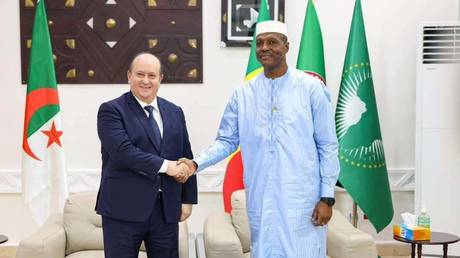
When Algerian and Malian officials sat down in Bamako this week to discuss joint investment in gold, lithium, and cross-border transport infrastructure, they were doing so against a backdrop that, barely six months earlier, had looked entirely different. The meeting between Malian Prime Minister Abdoulaye Maiga and his Algerian counterpart, Sifi Ghrieb, marked the most substantive economic engagement between the two neighbors since a diplomatic rupture that had briefly severed air links, recalled ambassadors, and cast a shadow over the entire Alliance of Sahel States (AES).
The origins of that rupture trace back to April 2025, when Algeria announced it had intercepted and shot down a Malian surveillance drone over its territory, citing an airspace violation. Bamako rejected the claim outright, and the incident ignited a crisis that had, in truth, been building for some time. Mali’s military-led transitional government had already withdrawn from a 2015 Algerian-brokered peace agreement with northern separatist factions, a decision that effectively dismantled the diplomatic architecture Algiers had spent years constructing in the Sahel. Bamako then escalated further, publicly accusing Algeria of providing material support to those same armed groups, an allegation Algiers denied with equal force.
The fallout was immediate and regional in scope. Burkina Faso and Niger, Mali’s partners within the AES, stood in solidarity with Bamako and jointly recalled their own ambassadors from Algiers. For a brief period, the three juntas that had consolidated authority across the central Sahel were aligned in a posture of collective defiance toward Algeria, a country that had long positioned itself as the region’s pre-eminent security broker and mediator.
By July 2025, however, both governments had concluded that the costs of sustained estrangement outweighed the political value of the standoff. Ambassadors were returned, airspace was reopened, and the formal architecture of diplomatic relations was restored. What followed was a carefully sequenced series of confidence-building steps. In August, Prime Minister Maiga traveled to Algiers for the first high-level visit since the dispute, a trip that signaled Bamako’s willingness to re-engage on Algerian terms while preserving its own sovereign posture on the peace deal question.
The Bamako talks this week moved the relationship into explicitly economic territory. Malian officials presented a structured set of investment opportunities to their Algerian counterparts, spanning sectors where Mali holds significant resource endowments but faces acute capital and infrastructure deficits.
Ghrieb, speaking through Algeria Press Service, described Algiers as prepared to resume full institutional cooperation and characterized the moment as an opportunity to elevate bilateral relations to a “new stage.” The language was deliberate, signaling that Algeria does not view the rapprochement as a return to the status quo ante but as a reorientation of the relationship on a broader economic footing.
The timing carries strategic logic for both sides. Mali, operating outside the ECOWAS framework since the AES bloc’s formal withdrawal from the regional body in early 2025, faces mounting pressure to demonstrate that its foreign policy realignment has not left it economically isolated. Deepening ties with Algeria, which is not an ECOWAS member but holds observer status with the African Union and commands significant influence through its energy exports and security apparatus, offers Bamako an alternative axis of economic partnership without requiring re-engagement with the Abuja-based bloc.
For Algeria, the calculus is equally clear. The Sahel’s instability has consistently threatened to spill northward through migration flows, arms trafficking, and the territorial ambitions of jihadist networks. Maintaining economic leverage over the AES states serves Algiers’ security interests more reliably than diplomatic isolation, which, as the drone episode demonstrated, produces solidarity among the juntas rather than compliance. The deployment of four Algerian Su-30 fighter jets to Niger in late August, at Niamey’s request following a failed military mutiny, illustrated how quickly the security dimension of the relationship had been rehabilitated alongside the diplomatic one.
The broader regional implications deserve attention. The AES withdrawal from ECOWAS has created a governance vacuum in the central Sahel that no single institution has yet filled. Algeria’s re-engagement with all three AES capitals, including its parallel moves to restore ties with Burkina Faso and Niger, positions Algiers as an informal anchor for a sub-regional order that operates outside the ECOWAS architecture. Whether this dynamic complements or competes with ECOWAS and AU frameworks for Sahelian stabilization remains an open question, but one that Accra, Abuja, and Dakar will be watching with considerable attention.
For investors and development finance institutions tracking West African exposure, the Bamako talks introduce a degree of optionality into a market that has appeared increasingly closed. Mali’s lithium reserves, in particular, sit within a global supply chain conversation dominated by Chinese operators and Western governments anxious about critical mineral access. Algerian capital and infrastructure capacity, if deployed at scale, could alter the ownership and routing dynamics of that sector in ways that neither the AES governments nor their external partners have fully mapped.
The two prime ministers concluded their Bamako meeting by agreeing on logistical arrangements for a forthcoming state visit to Algeria by Malian transitional leader Assimi Goita. That visit, when it occurs, will be the clearest signal yet of how far this reset has traveled and what institutional architecture the two governments intend to build on top of it.