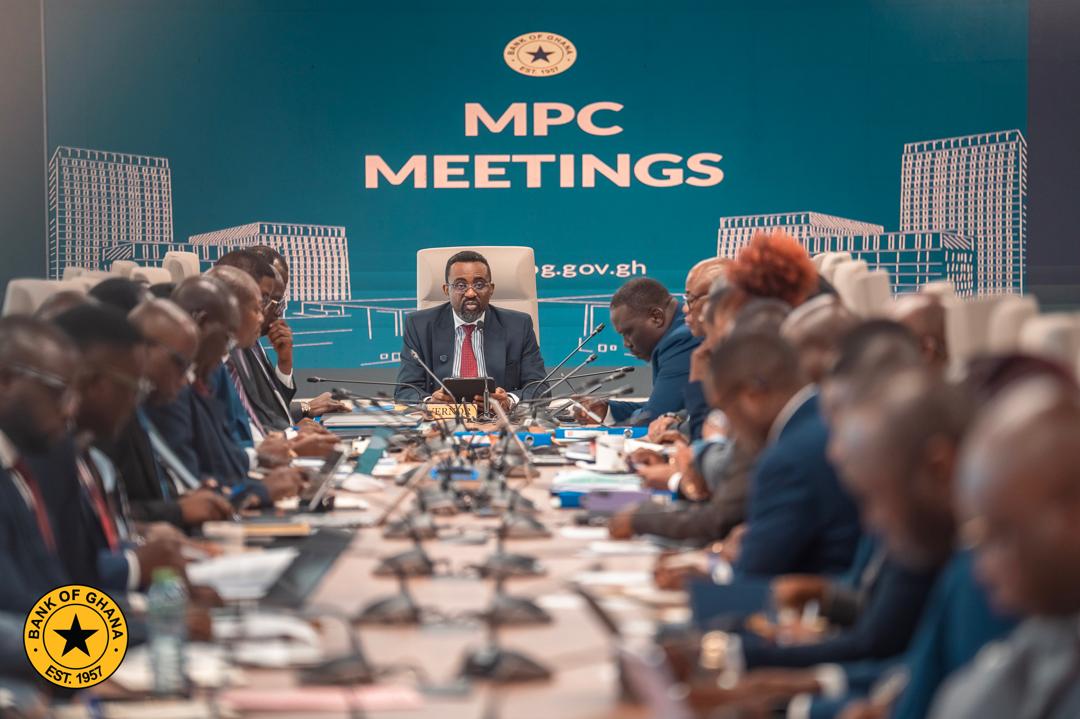
When the Bank of Ghana’s Monetary Policy Committee convened for its 133rd meeting in Accra on 18 November 2026, the decision it announced carried implications that extended well beyond a single numerical adjustment. The MPC voted to move the policy rate from 14% to 11%, a 300-basis-point shift that Governor Dr Johnson Pandit Asiama was careful to distinguish from a conventional rate cut, framing it instead as a structural realignment of Ghana’s monetary operations framework. That framing matters, because it signals something more fundamental than a response to short-term economic conditions: it reflects the Bank’s acknowledgment that its announced benchmark had become detached from the actual cost of money circulating in Ghana’s financial system.
The disconnect had been building for some time. Market interest rates had drifted below the 14% policy rate, creating an awkward gap between the Bank’s stated monetary stance and the effective rate at which banks were actually transacting. “Prevailing market rates have evolved at levels below the current monetary policy rate, indicating that the effective policy stance is actually lower than the announced rate,” Dr Asiama said at the post-meeting press briefing. In plain terms, the policy rate had lost its function as a credible anchor for market expectations, a problem that strikes at the core of central bank credibility and the transmission mechanism through which monetary decisions filter into lending, investment and consumption decisions across the economy.
Weeks before the announcement, the Bank had already been redesigning the operational scaffolding around its policy rate. The 14-day Open Market Operations instrument, long the primary tool for managing short-term liquidity, was replaced with a seven-day instrument, tightening the Bank’s grip on near-term money market conditions. Simultaneously, the policy corridor, the band within which overnight rates are permitted to fluctuate around the policy rate, was narrowed from plus or minus 400 basis points to plus or minus 100 basis points. Together, these changes compress the range of outcomes that can diverge from the Bank’s stated intentions, reducing the ambiguity that had allowed market rates to drift so far from the benchmark. Dr Asiama described the cumulative effect as “a reset,” a word that signals institutional recalibration rather than reactive policy loosening.
The backdrop against which this reset occurred is, by recent Ghanaian standards, relatively benign. The Bank’s Composite Index of Economic Activity recorded year-on-year growth of 17.7% in September 2026, sharply up from 9.6% over the same period in 2025. Private sector credit, exports, tourist arrivals and construction activity all contributed to that expansion. Average bank lending rates fell to 15.8% in October 2026 from 22.2% a year earlier, while private sector credit growth accelerated to 37.2% from 13.9%, a pace the Governor described as robust but not yet threatening to liquidity management. Total banking sector assets grew 21.2% year-on-year to GH¢512.9 billion, and the non-performing loan ratio dropped to 13.1% from 19.5%, signalling a sector that has meaningfully recovered from the stress that accompanied Ghana’s 2022 debt restructuring episode.
Inflation, however, introduced a note of caution into an otherwise favourable picture. Headline inflation edged upward to 5.5% in October 2026 from 5.2% in September, driven by a rise in non-food inflation from 6.2% to 7.9%. Higher utility tariffs and elevated crude oil prices were the primary culprits, reflecting cost-push pressures that monetary policy alone cannot fully neutralise. Food inflation moved in the opposite direction, easing to 2.8% from 4.0% as improved supply conditions took hold. The MPC indicated it would keep a close watch on crude oil price movements, food production risks tied to El Niño weather patterns, and further utility tariff adjustments, all of which carry the potential to push inflation off its current relatively stable trajectory.
Ghana’s gross international reserves stood at US$12.1 billion as of 17 November 2026, equivalent to 4.4 months of import cover. That figure represents a decline from US$13.8 billion recorded at the end of December 2025, a contraction that warrants monitoring even as the overall reserve position remains adequate by conventional benchmarks. For West African peers and regional investors assessing Ghana’s external stability, the trajectory of reserves over the coming quarters will carry as much weight as the policy rate adjustment itself, particularly given the country’s ongoing engagement with the International Monetary Fund and its obligations under the post-restructuring fiscal consolidation programme.
Within the ECOWAS monetary landscape, Ghana’s operational reforms carry a broader relevance. The Economic Community of West African States has long grappled with the challenge of monetary policy coordination among member states operating under different currency regimes, and the credibility of individual central banks directly affects the prospects for deeper regional monetary integration. The Bank of Ghana’s move to tighten its policy corridor and shorten its OMO instrument maturity brings its operational framework closer to practices observed in more developed monetary systems, including those of WAEMU members operating under the West African CFA franc regime, where the BCEAO maintains tighter corridor management. For Ghana, which operates its own currency and conducts independent monetary policy, demonstrating that its institutional framework can maintain credible price signals is essential to sustaining investor confidence and preserving the conditions under which AfCFTA trade flows can deepen.
By the time Dr Asiama concluded his remarks on 18 November, the institutional message was clear: the Bank of Ghana had identified a structural flaw in its own signalling architecture and moved to correct it through operational reform rather than waiting for market conditions to force its hand. The 300-basis-point shift in the headline rate was, in this reading, less the story than the framework changes that accompanied it. Whether the narrowed corridor and the shorter OMO instrument succeed in restoring tight alignment between the policy rate and market rates will become apparent in the months ahead, as the Bank navigates a combination of strong credit growth, creeping non-food inflation, and an external reserve position that demands continued fiscal discipline. The MPC committed to ongoing monitoring, with the next policy assessment expected to test whether the reset has held.