
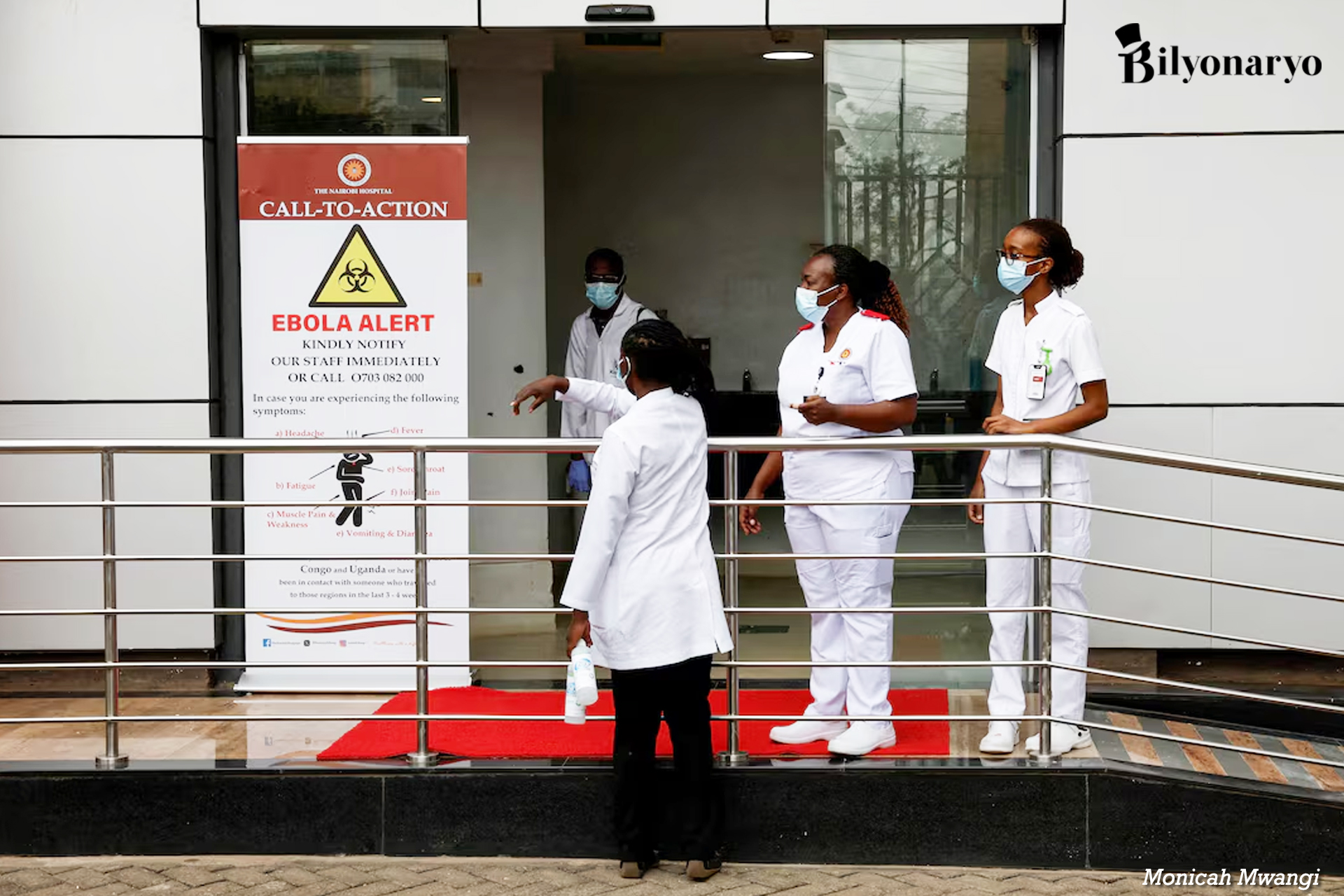
A Governance Failure Hidden Inside a Health Crisis
Kenya’s first confirmed Ebola fatality is not simply a public health emergency. It is a diagnostic test of the country’s institutional capacity to manage cross-border disease surveillance within a region where human mobility, climate stress, and health system fragility intersect with increasing regularity. The central question is not whether Kenya was prepared in the abstract, but whether its border governance mechanisms and regional coordination frameworks were operationally fit when it mattered most.
The confirmed death, caused by the Bundibugyo strain of the Ebola virus, involved a Kenyan national who traveled by road from the Democratic Republic of Congo through Uganda before boarding a flight to Nairobi. He was not detected at any point along that corridor. That failure is institutional. It is measurable. It demands accountability.
The Cross-Border Surveillance Gap
The DRC has recorded more than 4,000 Ebola-related deaths since May, a sustained outbreak that has placed East African health authorities on formal alert for months. Kenya’s Ministry of Health, led by Cabinet Secretary Aden Duale, confirmed that protocols were followed after the patient’s death, including a rapid private burial and contact tracing for individuals who may have been exposed. Several contacts have since been isolated.
But the sequence of events raises a harder institutional question. How does an individual symptomatic enough to die shortly after arrival travel hundreds of kilometres overland, cross at least one international border, and board a commercial aircraft without triggering a single health screening alert? The East African Community’s cross-border health surveillance architecture, which Kenya participates in alongside Uganda, Tanzania, Rwanda, and the DRC, exists precisely to prevent this scenario.
Uganda, which shares a border with both the DRC and Kenya’s air travel corridor, is a critical node in this system. If the infected traveler transited through Ugandan territory without detection, the failure is regional, not merely Kenyan. That distinction matters for how the response is structured and funded.
El Niño as a Compounding Governance Variable
The timing sharpens every institutional vulnerability. Kenya’s Meteorological Department has forecast above-average rainfall across roughly 80 percent of the country, with the El Niño pattern expected to trigger widespread flooding. Flood conditions damage road infrastructure, disrupt emergency logistics, and create the precise environmental conditions under which viral transmission chains become harder to trace and contain.
This is not a coincidence to be managed through reassurance. It is a compounding governance variable that requires integrated emergency planning across health, infrastructure, and disaster response ministries. Floods accelerate the spread of waterborne disease, overwhelm already underfunded county health systems, and physically isolate communities that contact tracers need to reach quickly. The window for effective Ebola containment is narrow by definition. El Niño narrows it further.
Kenya’s public health system faces a structural stress test. County-level health facilities, which bear the operational weight of primary response, are unevenly resourced. The gap between Nairobi’s referral capacity and rural county infrastructure is significant. Any Ebola case that moves beyond the capital’s health network before containment enters a dramatically more difficult operational environment.
Regional Integration as a Health Security Instrument
The analytical frame here must extend beyond Kenya’s borders. West and Central Africa have absorbed the institutional lessons of previous Ebola outbreaks, most consequentially the 2014-2016 West African epidemic that killed more than 11,000 people across Guinea, Liberia, and Sierra Leone. That crisis exposed the cost of fragmented national responses and accelerated investment in the Africa Centres for Disease Control and Prevention, established under the African Union in 2017.
The Africa CDC now provides a continental coordination mechanism that did not exist during the 2014 outbreak. Its engagement with the current DRC outbreak, and its capacity to support Kenya’s response through technical assistance, rapid diagnostics, and regional alert systems, represents real institutional progress. But the Kenya case demonstrates that coordination frameworks are only as strong as their weakest operational link, and that link is border-level screening.
The African Union’s Integrated Disease Surveillance and Response framework, alongside the East African Community’s regional health protocols, must now be stress-tested against what actually happened in this case. Did alerts flow between the DRC, Uganda, and Kenya health authorities in real time? Were border health posts adequately staffed and equipped to identify Bundibugyo strain symptoms, which differ from the more widely publicized Zaire strain? These are not rhetorical questions. They require documented answers.
For investors and development partners operating across East Africa, the institutional implications are direct. Health security is a determinant of economic stability. Outbreak risk, particularly when compounded by climate events, affects supply chains, workforce continuity, and sovereign risk assessments. Kenya’s ability to contain this case cleanly will influence how regional and international capital prices East African exposure in the near term.
What Accountability Looks Like Here
Cabinet Secretary Duale’s call for calm is appropriate as a public communication posture. But calm without institutional accountability is insufficient. Kenya’s Ministry of Health, the East African Community Secretariat, and the Africa CDC must jointly conduct a rapid operational review of how this case moved undetected through a surveillance corridor that should have caught it. That review must be transparent and its findings made available to regional partners.
Kenya should simultaneously accelerate its engagement with the WHO’s Ebola vaccination protocols and ensure that health workers in contact-tracing operations have access to protective equipment and clinical support. The country also holds a governance obligation to its neighbors: sharing contact data, travel histories, and genomic sequencing results from this case with Uganda, Tanzania, and the DRC health authorities without delay.
The convergence of Ebola importation and El Niño is a governance stress test, not a natural disaster beyond human institutional control. Kenya has the institutional architecture to respond. The question its health leadership must now answer, concretely and publicly, is whether that architecture performed as designed, and if it did not, which specific mechanisms failed and who holds responsibility for fixing them.