
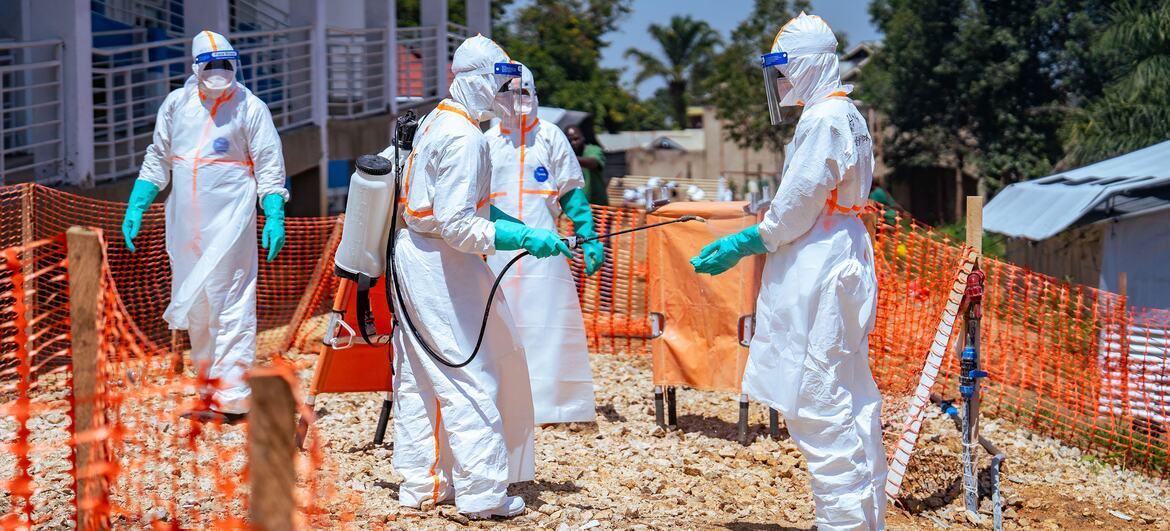
A US$10 million commitment from the United Arab Emirates to contain the Ebola outbreak in the Democratic Republic of the Congo has placed renewed scrutiny on East Africa’s cross-border health governance mechanisms, exposing both the structural vulnerabilities and the institutional capacities that will determine whether the DRC outbreak remains geographically contained. The pledge, directed by UAE President Sheikh Mohamed bin Zayed Al Nahyan and channelled through the UAE Aid Agency, was announced during a United States-convened meeting on the sidelines of the United Nations General Assembly in late September 2025. Kenya sits at the centre of the regional risk calculus.
The governance question is precise: does East Africa’s existing institutional architecture, spanning national health ministries, the East African Community’s health coordination frameworks, and WHO’s regional emergency protocols, possess the surveillance density and cross-border coordination authority to prevent a DRC-originating outbreak from exploiting the Northern Corridor trade route? Kenya has recorded no confirmed Ebola case. Yet the country’s position as the region’s dominant logistics hub, with the Busia border crossing alone recording over 3,000 daily crossings and continuous freight movement toward Uganda, Rwanda, Burundi, South Sudan, and the DRC, transforms preparedness from a domestic health question into a regional integration governance imperative.
The material dimensions of the UAE’s intervention are concrete and worth examining carefully. Dr. Tareq Ahmed Al Ameri, Chairman of the UAE Aid Agency, confirmed that the commitment accompanies the prior delivery of over 150 tonnes of aid and supplies to affected areas in the DRC, including protective equipment, infection-control materials distributed across approximately 280 health facilities, and shelter and food provisions for displaced communities. This operational footprint matters because it signals that the UAE’s engagement is not merely financial signalling but constitutes a functioning supply chain operating in active outbreak conditions, a model that East African institutions can benchmark against their own logistical preparedness.
The regional integration dimension of this episode extends beyond emergency health response. ECOWAS member states in West Africa have long grappled with analogous cross-border disease governance challenges, and the 2014-2016 West African Ebola crisis demonstrated with devastating clarity what happens when national health systems fail to coordinate at speed across porous borders. East Africa’s institutional architecture differs, with the East African Community providing a distinct regional coordination framework, but the structural lesson is identical: trade integration and health governance must advance in parallel, not sequentially. The Northern Corridor’s commercial vitality, which underpins Rwanda’s landlocked export economy and Uganda’s import dependency, creates a governance obligation on Kenya to maintain border health infrastructure commensurate with the corridor’s economic significance.
From an investor confidence standpoint, Kenya’s preparedness investments carry direct implications for the country’s positioning within AfCFTA’s emerging services and logistics corridors. Foreign direct investment in East African logistics, manufacturing, and agribusiness is acutely sensitive to perceptions of health system resilience. A cross-border outbreak that disrupts Northern Corridor freight flows would impose measurable costs on regional trade volumes and would complicate Kenya’s ambitions to serve as a continental gateway economy. The Ministry of Health’s institutional investments, including the proposed National Infectious Diseases Centre, therefore function simultaneously as public health infrastructure and as sovereign risk management for the country’s trade and investment profile.
The policy pathway is evident from the institutional evidence assembled here. Kenya and its East African Community partners should formalise and resource a standing cross-border health surveillance protocol anchored at the Northern Corridor’s major crossing points, with real-time data sharing between national public health institutes and WHO’s regional emergency operations. The UAE’s contribution demonstrates that Gulf state partnerships can deliver both financing and operational logistics capacity at scale; Kenya’s Ministry of Health and the East African Community Secretariat should structure formal memoranda of understanding with the UAE Aid Agency to embed this capacity within a predictable institutional framework rather than relying on ad hoc crisis-driven mobilisation. The 200-bed National Infectious Diseases Centre, if funded and constructed to the specifications currently under review, would give Kenya a regional anchor institution capable of providing diagnostic and case management support to neighbouring states during future outbreaks, converting a national investment into a regional public good with genuine integration value.