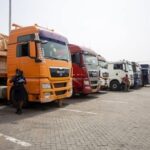

When the National Onion Producers and Marketers Association of Nigeria suspended onion exports to Ghana, four Ghanaian trucks loaded with produce sat stranded at the border, and markets across Accra began to feel the pressure of tightening supply. The episode, resolved within days through direct ministerial intervention, illuminated a structural vulnerability that runs far deeper than a single commodity dispute: West Africa’s intra-regional agricultural trade remains dangerously exposed to bilateral friction, with no standing institutional mechanism capable of absorbing shocks before they escalate.
The roots of the standoff, while not fully detailed in official communications, reflected a recurring pattern in Ghana-Nigeria trade relations, where informal grievances among trader associations harden into collective action that disrupts supply chains affecting thousands of small-scale operators on both sides of the border. The Accra Onion Sellers and Importers Cooperative Society, an umbrella body comprising five major associations including the Accra group, the Adjei Kotoku traders, and the Dominanse Association in the Central Region, found itself at the centre of a disruption it had not caused and could not resolve through its own channels. Nigeria’s onion producers hold significant market power over Ghana’s supply, and any suspension of exports translates almost immediately into price volatility and shortages at retail level, hitting urban consumers and market women first.
By 12 August 2026, Ghana’s Minister for Trade, Agribusiness and Industry, Elizabeth Ofosu-Adjare, convened an emergency meeting in Accra with representatives from both countries. Her appeal was direct: end the suspension, restore the flow of goods, and recognise that prolonged disruption carries costs that cascade well beyond the traders themselves, reaching farmers in Nigeria’s northern onion belt, transport operators along the corridor, and consumers managing already strained household budgets in Ghana. The minister explicitly framed the resolution within the ECOWAS mandate, positioning bilateral agricultural trade not as a commercial preference but as a regional integration obligation that both governments carry responsibility to protect.
The intervention produced rapid results. By 13 August 2026, all four stranded Ghanaian trucks had been released and cleared to complete their journey. Nigerian trucks already in Ghana finished offloading their produce at markets across the country. The Accra Onion Sellers and Importers Cooperative Society, together with the Cross Border Women Traders Association, publicly commended Ofosu-Adjare for the speed and effectiveness of her engagement, a notable endorsement from trader bodies that more often find themselves navigating bureaucratic indifference rather than responsive government action.
What the commendation also revealed, however, is how much the resolution depended on a single minister’s willingness to act swiftly, rather than on any pre-existing dispute resolution architecture. ECOWAS’s Trade Liberalisation Scheme and its protocols on the free movement of goods theoretically provide the framework within which disputes like this one should be managed before they reach the point of export suspension. In practice, the corridor between Ghana and Nigeria, the two largest economies in West Africa, remains governed more by informal trader networks and ad hoc political intervention than by the kind of rules-based institutional machinery that the ECOWAS Trade Directorate has long been mandated to build. The contrast with the WAEMU zone, where the West African Economic and Monetary Union maintains more integrated customs and trade facilitation structures among its eight Francophone member states, is instructive: monetary and regulatory cohesion reduces the space for bilateral disputes to metastasise into supply chain crises.
For Ghana specifically, the episode exposes an import dependency in onions that carries real governance implications. Ghana’s domestic onion production, concentrated in the Upper East Region, covers only a fraction of national demand, making the country structurally reliant on Nigerian supply. That dependency gives Nigerian producer associations considerable leverage, and as this dispute demonstrated, they are willing to use it. A governance response adequate to this asymmetry would involve not only diplomatic agility of the kind Ofosu-Adjare displayed, but a longer-term agricultural investment strategy that builds domestic production capacity, reduces import exposure, and strengthens Ghana’s negotiating position within bilateral trade relations. The Ministry of Food and Agriculture and the Ministry of Trade would need to coordinate on that agenda in ways that have historically proved difficult.
At the regional level, the dispute points to a gap in AfCFTA’s implementation architecture. The African Continental Free Trade Area entered into force with the ambition of eliminating tariff and non-tariff barriers across the continent, but its Dispute Settlement Mechanism remains underutilised and largely untested for the kind of trader-association-level conflicts that characterise agricultural commodity corridors. Ghana and Nigeria are both AfCFTA state parties, and both have signalled commitment to the protocol on trade in goods, yet the institutional reflex when a dispute erupts is still to reach for the phone and call a minister rather than to invoke a protocol. Closing that gap, between formal commitment and operational institutional capacity, is the work that AfCFTA’s Secretariat in Accra and ECOWAS’s own trade bodies must now accelerate if the continent’s integration architecture is to function as more than a diplomatic declaration.
The Cross Border Women Traders Association’s visibility in this episode also deserves analytical attention. Women dominate the informal agricultural trade networks that move onions, tomatoes, pepper, and other perishables across West African borders, absorbing the price risks, logistical costs, and regulatory friction that formal trade statistics rarely capture. When a suspension hits, it is these traders who lose income first and recover last. Any durable governance framework for agricultural trade corridors must account for their participation not merely as beneficiaries of resolution, but as institutional actors whose knowledge of corridor dynamics, pricing signals, and cross-border relationships represents an intelligence asset that trade ministries consistently undervalue. Integrating trader associations formally into early-warning and dispute-prevention mechanisms, rather than consulting them only after a crisis has broken, would materially improve the resilience of these corridors.
The release of the four trucks on 13 August 2026 restored normalcy to a specific supply chain. It did not resolve the structural conditions that allowed a trader association dispute to strand those trucks in the first place. Ghana’s Ministry of Trade, ECOWAS’s Trade and Customs Directorate, and the AfCFTA Secretariat now have a documented case study in corridor fragility, one that argues clearly for investment in standing dispute resolution capacity, deeper agricultural trade facilitation, and the formal integration of cross-border trader networks into the governance architecture that is supposed to serve them.