Fuel Price Disparities Across Africa Expose Governance Gaps in Energy Subsidy Policy and Regional Market Integration
Petrol prices across Africa’s 54 nations vary by a factor of more than 160, a gap that reflects not market fundamentals alone, but divergent fiscal policy choices, subsidy regimes, refining capacity deficits, and currency instability — structural governance failures that distort intra-regional trade and undermine ECOWAS and AfCFTA integration objectives.
The Extremes: Libya’s State Subsidies vs. Malawi’s Structural Vulnerability
Libya anchors the continent’s cheapest end at $0.023 per litre — approximately R0.38 — a price maintained entirely through state subsidies and near-zero taxation on domestically produced crude. The figure places Libya among the cheapest fuel markets globally, alongside Iran, where state ownership of the hydrocarbon supply chain insulates consumers from international price signals.
At the opposite extreme, Malawi charges motorists approximately $3.83 per litre (around R68), a price more than 200% above the global average, according to GlobalPetrolPrices data current as of 22 June 2026. A single tank of fuel in Malawi can represent over 213% of the average monthly income — a ratio that illustrates how energy pricing, when disconnected from income realities, functions as a regressive tax on economic participation.
Malawi’s pricing crisis stems from compounding structural deficits: the country is landlocked, operates no domestic refining capacity, holds no petroleum reserves, and has experienced sustained currency depreciation of the Malawian kwacha against the US dollar. Each of these factors adds cost at every link in the fuel supply chain.
West Africa’s Fragmented Fuel Markets: A Regional Integration Failure
Within West Africa, fuel pricing divergence is particularly sharp, and it exposes a core contradiction in ECOWAS’s economic integration mandate. Member states including Sierra Leone and Nigeria sit at opposite ends of the regional price spectrum. Nigeria, as a major crude producer and ECOWAS’s largest economy, has historically maintained subsidised pump prices — a policy that cost the federal government an estimated $10 billion annually before President Tinubu’s subsidy removal in May 2023.
Sierra Leone, by contrast, lacks both domestic production and refining infrastructure, leaving it exposed to global price volatility amplified by logistics costs and port inefficiencies. The country consistently ranks among West Africa’s most expensive fuel markets.
This divergence matters for AfCFTA implementation. When transport fuel costs vary dramatically across borders, the effective cost of moving goods within the free trade area rises — undermining tariff reductions negotiated at the continental level. A truck crossing from Nigeria into Benin and onward into Togo encounters fuel price environments that can shift total logistics costs by 30 to 40%, according to regional transport sector estimates.
ECOWAS has no harmonised fuel pricing mechanism. The bloc’s energy protocols encourage member states toward market-based pricing, but enforcement authority is limited, and political incentives for subsidy maintenance remain strong, particularly in oil-producing member states where fuel subsidies function as informal social contracts.
The Landlocked Premium: Geography as a Governance Challenge
The Central African Republic recorded a pump price of approximately $2.229 per litre as of mid-2026, ranking it among the continent’s most expensive markets. The CAR is landlocked, politically fragile, and operates no refining capacity whatsoever — a combination that makes the country entirely dependent on costly overland imports of refined fuel, routed through supply chains that traverse multiple conflict-affected territories.
Uganda and Zambia face structurally similar constraints. Zambia’s petrol prices trended upward throughout the first quarter of 2026, driven by international crude price movements compounded by continued depreciation of the Zambian kwacha against the US dollar. For landlocked economies without refining assets, every dollar of exchange rate movement translates directly into pump price increases — with no domestic policy lever capable of absorbing the shock short of fiscal subsidy expenditure.
The governance implication is direct: investment in regional refining capacity and cross-border pipeline infrastructure would reduce the landlocked premium for multiple countries simultaneously. The East African Crude Oil Pipeline (EACOP) project, whatever its environmental controversies, reflects this logic — that infrastructure investment can structurally reduce energy cost burdens for inland economies. West Africa has no comparable regional refining integration project at advanced development stage.
North Africa’s Subsidy Architecture: Low Prices, High Fiscal Risk
Egypt, Algeria, Angola, and Libya all maintain fuel prices significantly below global averages, sustained by combinations of domestic production and explicit government subsidy. Egypt’s fuel subsidy bill has historically consumed between 3 and 5% of GDP annually, a fiscal burden that the government has sought to reduce through phased price reforms under IMF programme conditionality.
Algeria’s hydrocarbon revenues, channelled through the state energy company Sonatrach, have long funded subsidised domestic fuel pricing as an implicit social contract. As global energy prices fluctuate and Algeria’s hydrocarbon production faces long-term decline projections, the sustainability of this model is under increasing fiscal pressure.
Morocco, which produces no significant domestic crude, has taken a different path: partial liberalisation of fuel pricing since 2015, exposing consumers to international price movements while reducing the fiscal burden on the state. Moroccan motorists currently pay approximately MAD 15.49 per litre (around $1.67), reflecting a market-aligned pricing structure with limited subsidy support. The Moroccan model offers a partial template for managed price liberalisation — though Morocco’s relatively higher per capita income and more diversified economy ease the social adjustment costs that liberalisation imposes.
South Africa’s Middle Position and the Levy Question
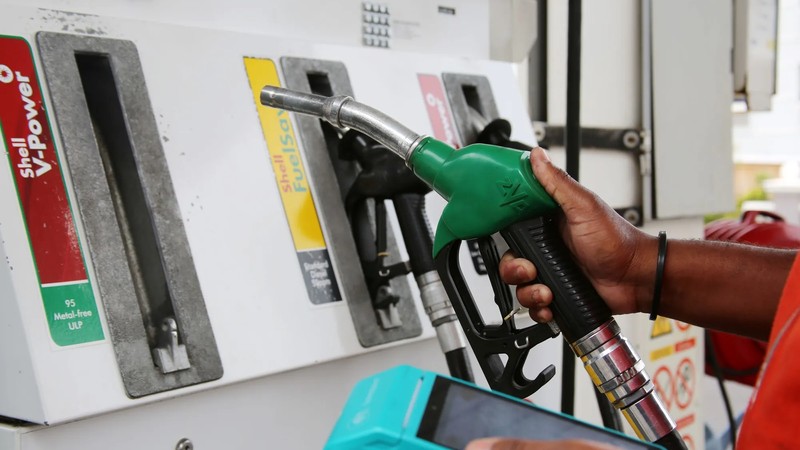
South Africa’s 95 Unleaded petrol price stands at R22.53 per litre at coastal locations and R23.36 inland, placing the country in the middle tier of African fuel markets. The pricing formula is transparent and rule-based, linking pump prices to the international Brent crude price, the rand/dollar exchange rate, and a fixed levy structure that includes the General Fuel Levy and the Road Accident Fund (RAF) levy.
The levy component is significant: combined, the General Fuel Levy and RAF levy account for approximately R6.00 per litre, representing roughly 26% of the total pump price. This levy burden is a deliberate fiscal and social policy choice — the RAF levy funds compensation for road accident victims — but it also means South African fuel prices are structurally insulated from full international price decreases, since levies are fixed in nominal terms.
From a regional integration standpoint, South Africa’s transparent, formula-based pricing mechanism represents a governance standard that many ECOWAS and SADC member states have not achieved. Opaque pricing, politically motivated subsidy adjustments, and irregular supply create market distortions that disadvantage cross-border traders and logistics operators throughout the region.
Policy Pathways: From Price Divergence to Regional Energy Governance
The 160-fold price differential between Libya and Malawi is not a natural market outcome. It is the accumulated result of policy choices: subsidy decisions, infrastructure investment deficits, currency management failures, and the absence of regional coordination mechanisms with enforcement authority.
Three institutional responses merit serious consideration. First, ECOWAS should develop a regional fuel pricing transparency framework — not price harmonisation, which is politically infeasible, but standardised public reporting of pricing components (taxes, subsidies, logistics margins) to enable comparative accountability across member states.
Second, the African Development Bank’s infrastructure financing mandate should be directed more aggressively toward regional refining capacity — shared facilities that reduce the landlocked premium for multiple countries simultaneously and reduce dependence on costly refined product imports from outside the continent.
Third, as AfCFTA’s implementation deepens, the African Continental Free Trade Area Secretariat should formally incorporate energy cost harmonisation into its trade facilitation agenda. Tariff reduction delivers limited benefit when fuel-driven logistics costs remain structurally high and unpredictable across member state borders.
The data from GlobalPetrolPrices makes the governance challenge concrete: Africa’s fuel price map is a direct readout of its institutional architecture. Where governance is strong, production exists, and infrastructure is adequate, prices are manageable. Where those conditions are absent, ordinary citizens bear the cost — in fuel prices that can consume their entire monthly income in a single tank.